
Royal Society of Canada recognizes seven McMaster researchers
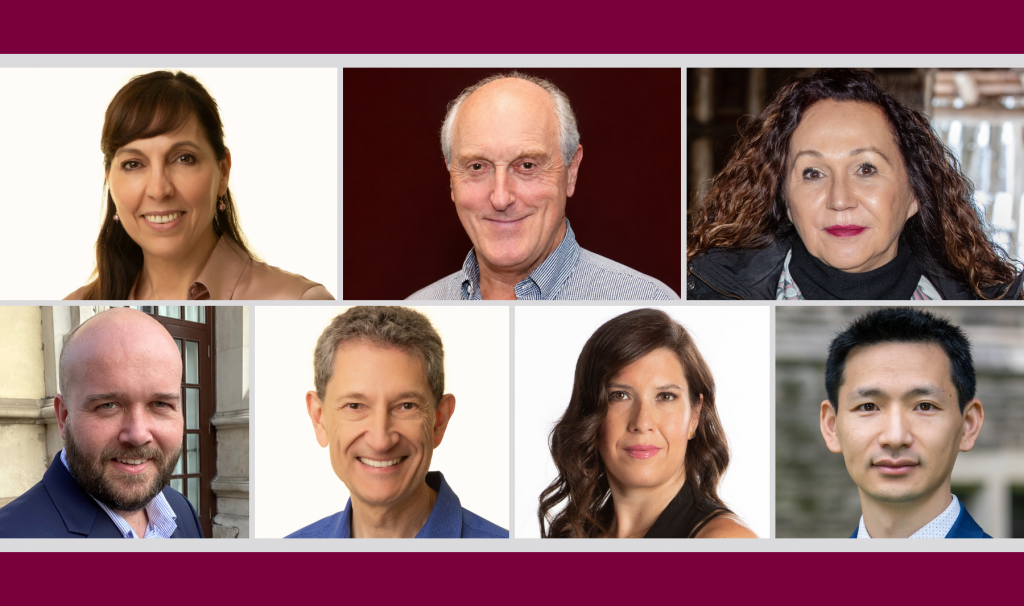
Seven McMaster researchers are being recognized this year by the Royal Society of Canada (RSC) for their contributions to research and scholarship.
Five have been elected to the RSC as Fellows, a distinction awarded to Canadians who have made remarkable contributions to the arts, the humanities, the sciences or Canadian public life.
Two have been named to the RSC’s College of New Scholars, Artists and Scientists. The college recognizes mid-career leaders who are helping Canada and the world address major challenges and seize new opportunities, including those identified in emerging fields.
“It is a tremendous achievement to be recognized by the Royal Society of Canada, and we are proud to celebrate this year’s McMaster honourees,” says McMaster’s vice-president, Research, Gianni Parise.
“Their accomplishments reflect the extraordinary range of research taking place at McMaster and the impact our researchers are making across disciplines and in communities around the world.”
The Class of 2026 Fellows and College members will be inducted into the Royal Society of Canada at its annual Celebration of Excellence and Engagement in Ottawa, Nov. 12 to 15.
Ronald Barr | Professor Emeritus, Pediatrics
Ronald Barr is internationally renowned for his transformative leadership in child health research and advocacy. His 50-year legacy has advanced global standards of care by championing equitable access to essential medicines, evaluating the late benefits and harms of cancer treatments, and measuring overall health, nutritional status, and quality of life in children with cancer in low- and middle-income countries, where the vast majority of affected children live.
David Earn | Professor, Mathematics and Statistics
David Earn is a global leader in mathematical epidemiology whose research involving dynamical systems, asymptotic analysis, and game theory has advanced the mathematical foundations of infectious disease modelling. His work has sharpened our understanding of recurrent epidemics, the long-term persistence of pathogens, and the effects of human behaviour on disease dynamics. It has also informed public health decision-making in many contexts, including the COVID-19 pandemic.
Dawn Martin-Hill | Professor Emeritus, Indigenous Studies
Dawn Martin Hill has dedicated her career to promoting the importance of Indigenous knowledge and participation in academia. Dawn actively engages in dialogues that push for policy changes, recognizing Indigenous sovereignty and knowledge systems as essential components of self-determination, climate action, and sustainable development. Her efforts demonstrate how Indigenous processes can lead to innovative solutions that are ecologically and culturally sound and respectful.
Paul McNicholas | Professor, Mathematics and Statistics
Paul McNicholas is a world-renowned statistician whose research in clustering using mixture models has revolutionized the analysis of many modern data types, including high-dimensional data, data with asymmetric clusters, higher-order data, and multivariate longitudinal data. The only statistics researcher to win the Steacie Prize (2020), he has held the Tier 1 Canada Research Chair in Computational Statistics since 2015 and is a former Dorothy Killam Fellow (2023-25).
Elena Verdu is an internationally recognized leader in gastroenterology who has transformed the the understanding of how diet and the intestinal microbiome shape chronic gastrointestinal disease. By integrating fundamental discovery and clinical experience, she has uncovered key microbial and immune mechanisms underlying celiac disease and inflammatory bowel disease and informed the development of next-generation microbial interventions. These contributions are reshaping strategies for disease prevention and treatment, with direct impact on patient care.
Derek Chu | Associate Professor, Medicine
Derek Chu is internationally recognized for rigorous interdisciplinary research that transforms the understanding and management of allergic diseases. Through innovative studies, randomized trials, and global knowledge translation, his collaborative research program delivers best-in-class evidence to improve patient and family outcomes. His revolutionary work informs national and international guidelines, policy and clinical practice. His commitment to health across the life course, including Indigenous health, advances Canadian leadership in innovation, health equity, and optimal allergy care globally.
Chelsea Gabel | Professor, Health, Aging & Society and Indigenous Studies
Chelsea Gabel is an internationally recognized leader in Indigenous health research currently serving as Scientific Director of CIHR’s Institute of Indigenous Peoples’ Health. As Canada Research Chair in Indigenous Well-Being, Community-Engagement and Innovation, she studies intergenerational communication between Indigenous Elders and youth through community driven and decolonizing approaches. With expertise encompassing arts-based research, Métis health and well-being, and Indigenous data sovereignty, her work fosters digital innovation in Indigenous communities and transforms understandings of Indigenous research and community engagement.
Related Stories
 Canada
Former MP Mike Morrice only candidate for Green Party of Canada leadership after Nira Dookeran withdraws
46 minutes ago
 Canada
Ottawa ends NunatuKavut bid for Indigenous rights recognition, NCC says
47 minutes ago
 Canada
‘Donald J. Trump Memorial’: Rogue sign put up outside B.C. bathroom
47 minutes ago
 Canada
What counter
1 hour ago
 Canada
'Hunted,' 'shattered,' 'scared': How victims say Canada's most prolific voyeur has altered their lives
1 hour ago
 Canada
Canada Nickel Announces Filing of NI 43
1 hour ago
 Canada
One of the giant ships at the centre of Canada’s shipbuilding revival is taking shape
1 hour ago
 Canada
Canada Infrastructure Bank closes loan for Nunavut wind project serving gold mine
2 hours ago