
Province waited before disclosing that chemical spill contained toxic compound
Province waited before disclosing that chemical spill contained toxic compound
Emails show more than a day passed before province revealed that the spill contained hexavalent chromium
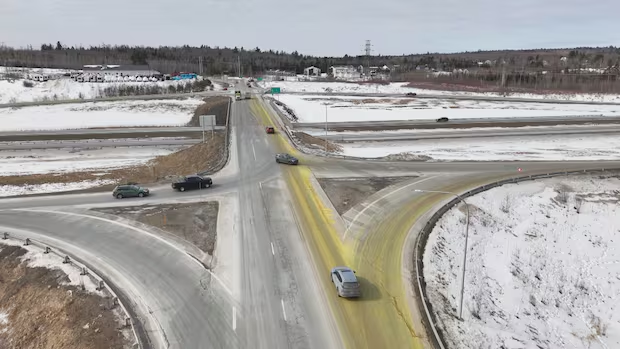
The New Brunswick government waited more than a day before informing the public that a chemical spill across 14 kilometres of highway in Fredericton contained a carcinogenic compound, according to documents obtained by CBC News.
The documents, obtained through a right to information request, show that Department of Environment staff knew the spill on and around the Vanier Highway contained hexavalent chromium as early as about 1 p.m. on March 6.
However, it wasn’t until about 4 p.m. the following day that the province publicly revealed that the bright yellow substance contained high levels of the carcinogenic compound.
“A onetime or short contact with hexavalent chromium does not increase your cancer risk,” the Government of New Brunswick said in an update on its Facebook page on the afternoon of March 7.
The documents, largely made up of emails and reports shared among provincial government staff, offer a behind the scenes look at the response to a chemical spill that prompted the closure of roads and raised concerns about the health and safety of people who drove through it in the day-and-a-half before clean up began.
About 900 litres of the bright yellow substance coloured sections of Vanier Industrial Drive, the Vanier Highway and the Trans-Canada Highway after leaking from a broken plastic tote that was being transported on the back of a truck, according to the documents.
The province has named XL Plating and Machining as the party responsible for the spill.
CBC News has attempted to contact XL Plating and Machining to respond to the accusation, but no one from the company has answered phone calls or replied to requests made through registered mail.
Emails show the Department of Environment was first notified of the spill by a City of Fredericton employee on the morning of March 5.
Later that day, staff from the Department of Transportation and Infrastructure took samples to be tested in a lab.
“We received results back from the lab," Mitchell Clark, an engineer with the Department of Environment, said in an email at 12:51 p.m. on March 6. "The spill was hexavalent chromium."
However, the department's replies to media outlets that same afternoon failed to mention this finding.
“Samples of the substance have been sent to a lab for analysis," department spokesperson Jennifer MacNeil said in an email to CBC News at 4:02 p.m. on March 6. "The investigation is ongoing."
An email exchange shows deputy environment minister Charbel Awad gave MacNeil the approval to send that response to CBC News and two other media outlets that afternoon.
That same evening, MacNeil drafted an update for the public, which Awad approved in an email at 7:29 p.m.
The update mentioned sample testing had detected traces of chromium, but it left out a key detail about the compound.
According to Health Canada, chromium is a naturally occurring metal that is principally found in either trivalent or hexavalent forms and is used in a wide variety of industrial applications, including metal finishing.
Trivalent chromium, which is the most common natural state of chromium, is essential in humans and animals for metabolism, and is considered non-toxic, according to Health Canada.
Meanwhile, chromium in the hexavalent form is considered to be carcinogenic, and is included in the Canadian Environmental Protection Act’s list of toxic substances.
The notice that specified that the spill contained hexavalent chromium came only a day later when the province announced it was setting up a car wash for vehicles that had driven through the spill.
“Preliminary testing indicates that the spilled material contains hexavalent chromium, and we are continuing to investigate.”
Behind the scenes response to Fredericton chemical spill revealed in documents
CBC News asked the Department of Environment for an interview with Minister Gilles Lepage about why his department didn't disclose its full understanding of the chemical makeup of the spill earlier, but the request was denied.
Instead, MacNeil, the spokesperson for the department, said in an email to CBC News that information evolves rapidly and circumstances can change quickly “during a crisis.”
“The Department of Environment and Local Government recognizes there is always an opportunity to improve while remaining committed to balancing the need for accuracy with the importance of timely communication to the public,” she said.
Company didn’t disclose full details about spill
The documents also suggest that the company held responsible for the spill did not help with the speed at which the public found out about its full makeup.
Emails and handwritten notes show provincial staff were able to trace the source of the leak to XL Plating and Machining on the morning of March 6.
When a provincial employee asked what had been spilled, a worker provided a material safety data sheet for sodium carbonate.
The encounter is detailed in an unnamed Department of Transportation and Infrastructure employee’s handwritten notes, which were also sent to CBC News as part of its request under the Right to Information and Protection of Privacy Act.
“I asked him how this had spilled and he refused to answer, stating ‘I am not going to answer any other questions right now,'” the government employee wrote.
“He was clearly uncomfortable with my presence so I left once I had the [material safety data sheet].”
Spilled material was waste product from chrome stripping
XL Plating and Machining is a chromium electroplating business, specializing in the hard chrome resurfacing of machine components, according to the company’s approval to operate from the provincial government.
Based on emails between provincial government and WorkSafeNB staff, the spill was the waste product derived from using sodium carbonate and sodium hydroxide to strip chrome plating off machine components.
“Essentially, the spilled material is a spent chrome stripping solution,” Johannes Doemer, an occupational hygienist with WorkSafeNB, said in a March 8 email to a colleague.
Doemer wrote he received safety data sheets for sodium carbonate and sodium hydroxide from XL Plating and Machining, along with a document explaining the process “the solution” is used for.
“The process is an electrochemical chrome removal process,” Doemer wrote.
“The two substances from the [safety data sheets] are mixed to create the solution, the chrome originates from the parts being processed/cleaned.”
Doemer said XL Plating and Machining co-owner Joel Demers told him it was the first time in 15 years that the spent solution was being discarded.
CBC News has made repeated attempts to contact XL Plating and Machining to request interviews with Demers and co-owner Lorne Goodine about how the spill happened.
CBC News also asked the Department of Environment whether the company was still operating, and whether it would face legal consequences as a result of the spill.
MacNeil, in an email, said the department would not comment on that until its investigation was finished.
Testing for potential contamination continues
The documents provided to CBC News also revealed the degree to which the spill dumped hexavalent chromium on sections of Vanier Highway.
On March 5, provincial staff took samples of surface water in two areas where the spill happened.
In one of those areas, the sample contained 1,190 milligrams per litre of hexavalent chromium, exceeding the accepted level of 0.05 milligrams per litre for commercial and residential potable sites, according to Mallory Gillis, a manager with the Department of Environment’s contaminated sites unit.
CBC News asked the department whether any testing has found contamination of well water or other drinking water sources.
In an email, MacNeil said the Department of Environment has found no indication the spill has contaminated drinking water sources, however testing will continue.
She said EFI Global, an environmental consultant, will drill groundwater monitoring wells in areas along the Vanier Highway where the spill happened, beginning June 29.
“To date, samples have been collected from soil next to the roadway, surface water if present in roadway ditches, and from potable wells in two subdivisions located next to the highway,” MacNeil said.
“There have been no detections of hexavalent chromium in any potable wells.”
Aidan Cox is a journalist for the CBC based in Fredericton. He can be contacted at aidan.cox@cbc.ca.
Related Stories
 Canada
The MOU is a vision; Canada still needs the pathway
7 hours ago
 Canada
‘This crosses partisan lines’: Canada Day singalong seeks national unity
7 hours ago
 Canada
H
7 hours ago
 Canada
'Major shock': Canadians grapple with loss of CBC's Hockey Night in Canada tradition
3 days ago
 Canada
Hundreds of families return home after crews bring West Kelowna, B.C., wildfire under control
3 days ago
 Canada
Davies' status for Canada
3 days ago
 Canada
Winnipeg judge removes high
3 days ago
 Canada
Victoria firefighters fight blaze at Canada’s oldest Chinese temple
3 days ago