
PM says 'more can be done' to address increasingly severe wildfire seasons
PM says 'more can be done' to address increasingly severe wildfire seasons
First Nation leaders, environmental group call for stronger climate change policies
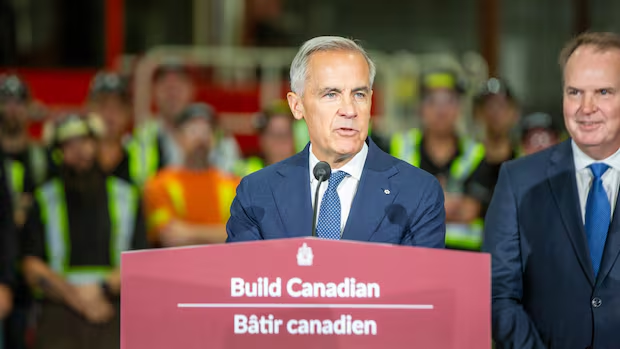
PM Mark Carney speaks on northwestern Ontario wildfire season
Prime Minister Mark Carney has promised new investments in early warning and detection of wildfires as Ontario faces its worst ever year for fires.
CBC News asked Carney about his approach to wildfires while he was in Thunder Bay, Ont., on Thursday to announce a major investment in Via Rail.
“What more can be done? We have made major investments and we have more to come in terms of early warning and detection,” Carney said.
This year is already being described as Ontario’s worst wildfire season on record, with the northwest of the province the worst affected area. More than 2,800 people from the region were displaced at the peak of this year’s wildfire activity, affecting well over a dozen communities.
Wildfires destroyed two First Nation communities in northwest Ontario this summer: Namaygoosisagagun First Nation (also known as Collins First Nation) and Whitewater Lake First Nation.
“I think we have to recognize, certainly do recognize this is the worst forest fire season in Ontario history — but the dynamics unfortunately are such that that record may be broken, and we're preparing for that possibility,” Carney said.
Carney thanked those on the front lines of the fires, including the Canadian Armed Forces, which assisted with the evacuation of members of Eabametoong First Nation, as well as host communities such as Thunder Bay.
Feds announce $4.7B for new Via Rail cars to be built in Ontario, Quebec
“More can be done in terms of investing in firefighting and aircraft and other equipment. More can be done working with communities, particularly Indigenous communities on both traditional methods [of] countering fires, but also for preparations for evacuations and others as those become necessary,” the prime minister said.
After Carney’s announcement at Alstom train manufacturer, he visited the Thunder Bay Fire Management Centre to meet wildland firefighters and hear about their efforts this season.
‘We need much, much tougher climate policies’
Outside the fire management centre, Carney was met with a lone member of Citizens United for a Sustainable Planet, a local environmental advocacy group.
Paul Berger, the group’s lead organizer, stood with a sign that read “Carbon Carney: Our Prime Arsonist.”
While Berger welcomed Carney’s investment in passenger rail services, he said the government should not be spending money on projects to promote fossil fuels, referring to the Canada-Alberta deal to build a new oil pipeline to the West Coast.
“To build rail cars and try to get people moving in trains while you're building pipelines is like being in a leaky boat and drilling holes in the hull and then getting a Dixie cup to bail. It's not adequate,” Berger said.
“We need much, much tougher climate policies, and we can have climate policies that also make life more affordable and better for Canadians.”
The federal government released a summary of findings from the second edition of Canada's Changing Climate Report on Thursday, which says Canada is projected to warm through this century with an estimated temperature increase of 5 C by 2081 to 2100.
“I think we have to help Canadians understand that climate isn't something that's just nice to have. It's absolutely imperative and the future generations are not going to forgive us for focusing on a war of words with the states,” Berger said, referencing the ongoing Canada-U.S. trade war.
“We need to do what we need to do for climate as well as everything else, and we could do those things together. We're just choosing not to do it.”
Nishnawbe Aski Nation (NAN), a political-territorial organization that represents 49 First Nations in treaties 9 and 5, posted a statement about climate change and critical infrastructure on Thursday following Carney’s visit to Thunder Bay.
“More than 30 First Nation communities in northern Ontario have no year-round road access, relying on winter roads that are increasingly threatened by climate change. As temperatures rise, the season for these roads grows shorter every year, cutting communities off from essential goods, services and emergency response they depend on,” the statement said.
Canadians should prepare for a 5 C hotter future, report warns
“The prime minister talked today about investing in infrastructure that will secure ‘our future.’ We see nothing in his announcement so far to convince us that First Nations are included in that future,” NAN Grand Chief Alvin Fiddler continued in Thursday’s news release.
“We are calling on Canada to prove otherwise with the same ambition, the same urgency, and the same scale of investment.”
Sarah Law is a CBC News reporter based in Thunder Bay, Ont., and has also worked for newspapers and online publications elsewhere in the province. Have a story tip? You can reach her at sarah.law@cbc.ca.
Related Stories
 Canada
Albertans head to polls in historic referendum on whether they want to stay in Canada
4 days ago
 Canada
In the news today: four soldiers killed, Alberta referendum, AI privacy fears
4 days ago
 Canada
How a grass fire at a Canadian military base killed four soldiers
4 days ago
 Canada
How will household electricity rebate reduction, temporary winter pricing change impact Ontarians?
4 days ago
 Canada
Residents told to boil tap water due to bacteria
4 days ago
 Canada
Oil
4 days ago
 Canada
Albertans vote on path to independence as Carney fights to keep Canada united
4 days ago
 Canada
Two of 4 soldiers killed in fast
4 days ago