
PH: Environmental commitments need funding, technology
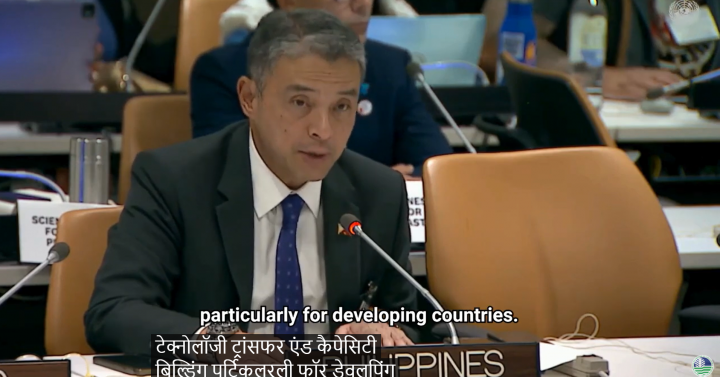
ENVIRONMENTAL COMMITMENTS. Department of Environment and Natural Resources (DENR) Secretary Juan Miguel “Mitch” Cuna delivers the Philippines’ statement during the High-Level Political Dialogue on “Renewing Environmental Multilateralism” at the 81st United Nations General Assembly in New York City on Wednesday (Sept. 23, 2026). Cuna called for adequate financing, technology transfer, and capacity building to help developing countries meet environmental commitments. (Screengrab)
MANILA – The Philippines has called for environmental commitments to be backed by financing, technology, and capacity-building support, particularly for developing countries being asked to do more despite limited access to resources.
Department of Environment and Natural Resources Secretary Juan Miguel “Mitch” Cuna made the call at the High-Level Political Dialogue on “Renewing Environmental Multilateralism” during the 81st United Nations General Assembly (UNGA) in New York on Wednesday.
Delivering his statement, Cuna stressed that global environmental agreements must translate into practical action on the ground.
“Consensus is hard to achieve, negotiations are becoming more complex, and countries are expected to implement a growing number of commitments regarding climate change, biodiversity, pollution, and other environmental issues,” he said.
“For many developing countries, these demands are not matched by comparable access to finance, technology, and capacity building,” he added.
Noting that fragmentation remains a practical problem for many developing countries with closely related environmental issues being addressed through separate institutions, reporting systems, and financing mechanisms, Cuna emphasized that efforts should focus not only on new commitments, but on making the existing system easier to implement.
He explained that doing this would reduce duplication, improve coordination, and direct more resources toward delivery at the national level.
Noting that the International Court of Justice advisory opinion on climate change provides greater clarity regarding the obligations of states under international law, he said “legal clarity must be matched by the means to implement those obligations”.
Cuna also noted the importance of access to finance, technology and institutional capacity, especially for developing countries, towards effective implementation.
“For the Philippines, an effective treaty must be ambitious but implementable, taking into account national circumstances and capabilities, and provide adequate finance, technology transfer and capacity building, particularly for developing countries,” he said.
Cuna also called for better coordination among environmental agreements, saying climate change, biodiversity loss, pollution, land degradation, water stress and marine ecosystem pressures increasingly overlap.
He proposed compatible reporting systems, shared scientific information, coordinated technical assistance and better-aligned financing to reduce the burden on countries while preserving the mandates of existing agreements.
Cuna also highlighted the need for greater cooperation against environmental problems that cross borders, including transboundary pollution and threats to marine ecosystems and biodiversity corridors. (PNA)
Related Stories
 Technology
First Trust Expanded Technology ETF declares quarterly distribution of $0.0035
51 minutes ago
 Technology
REG - Bytes Technology Grp Barclays PLC
1 hour ago
 Technology
Microsoft Strengthens Its Commitment to the Middle East by Investing in Technology, Digital Resilience and People
1 hour ago
 Technology
Amsterdam-based Duqu raises €1.5 million to unlock cash tied up in unpaid invoices
2 hours ago
 Technology
EU Offers Ukrainian Businesses 10
2 hours ago
 Technology
News Content Hub
2 hours ago
 Technology
Geely challenges BYD with 2.2 MW charging technology
4 hours ago
 Technology
Boston officials pushing for stricter rules on police surveillance technology
4 hours ago