
PeeCycling technology put to work at DHL Stadium
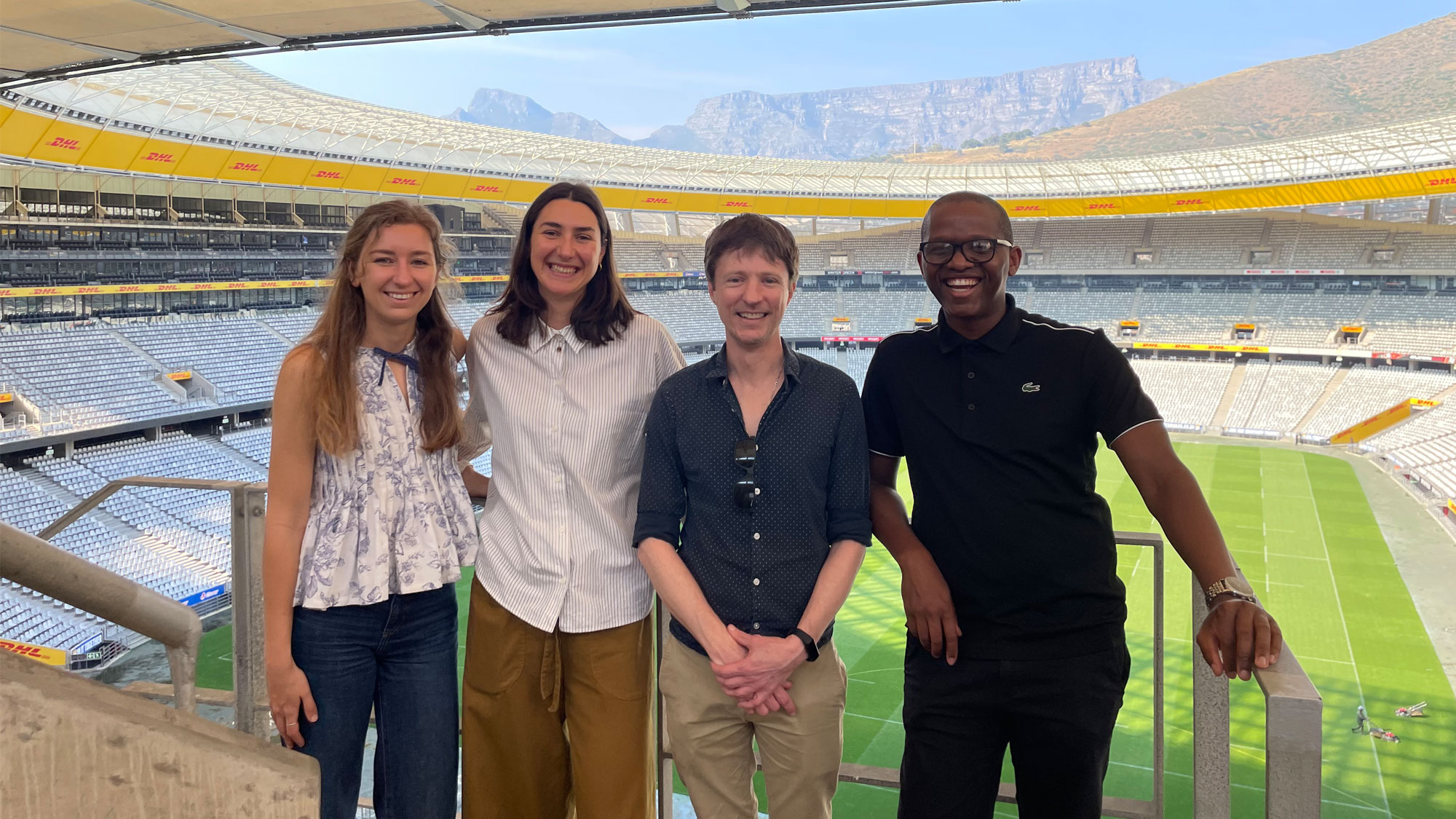
PeeCycling technology put to work at DHL Stadium
When thousands of rugby enthusiasts descended on the Mother City to watch the All Blacks play the Stormers and the Springboks at the DHL Stadium, all the PeeCycling team focused on was how much urine they would collect from a single urinal in the men’s bathroom.
Thanks to a partnership with the Bidvest Group, the University of Cape Town (UCT) spin-out company was permitted to use the two sporting matches with enormous appeal to their advantage. This meant that they could attach their system – that turns human urine into high quality, sustainable fertiliser – to a urinal and collect urine from every male spectator who used it. The result was 2 700 and 3 600 litres of urine respectively, an incredible achievement given the contraption was attached to just one of several urinals in the bathroom.
“This is extraordinary. We are thrilled by the number of litres of urine we managed to get from just one urinal trough. This demonstrates that there is substantial scope to scale up the volume collected at the stadium,” said Dyllon Randall, a professor in water quality engineering at UCT and the cofounder of PeeCycling.
PeeCycling uses an innovative system to collect and concentrate urine into fertiliser, but not before removing harmful compounds first. The concept contributes massively to the rapidly evolving field of urine treatment. The heart of the project was first developed by the start-up’s cofounder and UCT PhD graduate Dr Caitlin Courtney, whose research focused on the urine treatment and concentration process to produce the liquid fertiliser.
“We spent years developing a robust system to manipulate the urine’s chemistry.”
Professor Randall said the true value of urine, which comprises around 95% of water, is immense. So, together with Dr Courtney, the duo buckled down to come up with workable and efficient ways to put it to good use. The result, Randall explained, is a technology similar to that of a desalination system (the technology used to convert seawater into drinking water, also known as reverse osmosis). The process produces nutrient-rich, safe fertiliser that closes the loop on sanitation and agriculture.
“Sending urine straight through a reverse osmosis system quickly blocks the membrane,” he said. “We spent years developing a robust system to manipulate the urine’s chemistry and we now have one that allows us to use reverse osmosis for the very first time.”
But what really happens on urine collection day?
Using the stadium as an example, Randall said the team started with plumbing a single urinal into a collection tank. They then added a special chemical to the system to prevent the breakdown of nitrogen in the urine – this is a crucial step in the process and prevents “a terrible smell”. Thereafter, he said, the pretreatment step kicked in. This process involved some chemical manipulation and allowed them to use reverse osmosis to remove the water from the urine.
“There we’ve split the urine into two valuable components and what you’re left with are two products: a water stream and a liquid fertiliser with zero waste,” he said.
On what this project means for saving water, specifically at a site like the stadium, Randall said it is invaluable. On both match days, the team fully recovered the flushed water from the urinal and produced a completely new stream of water directly from the urine. For every 1 000 litres of water PeeCycling treated, they received 700 litres of water back.
“Because urine comprises 95% water, once the process of recovering water from urine is complete, it means you’re sitting with about 70% of water. That water can be used for toilet flushing, irrigation or cleaning. It’s a substantial amount of water that can be produced,” Randall said.
The start-up’s partnership with the Bidvest Group, which manages and maintains large commercial, industrial and corporate buildings through one of its subsidiaries Bidvest Prestige, is a move in the right direction.
“This is a fantastic partnership. Bidvest acknowledges the value of the work that we’re doing, and we realise the value that they bring to the table. This partnership allows us to mitigate our biggest constraint, which is the space to collect large volumes of urine,” Randall said.
Piloting the technology at a site as iconic and as large as the DHL Stadium is particularly significant. Randall said it opens the door to other commercial buildings coming on board to be retrofitted to collect urine on site as well.
“The potential of this work is substantial. We’ve already convinced a partner, an entity, that there is value in what we are doing. It’s only forward from here. Imagine other commercial buildings or suburbs being plumbed to collect urine so that we can have an alternative source of water and a local fertiliser production plant. It’s an enormous opportunity,” he said.
Randall and Courtney are immensely proud of their passion project that has now developed into a fully-fledged business that prioritises both sustainability and innovation.
“The best part of innovation is when you develop something, you don’t know where it’s going to lead and you don’t know what challenges you will encounter. But if you persevere and push through, you end up developing some incredible things,” Randall said.
“What this work emphasises is that there is substantial value in what society views as waste.”
Currently, the team is most excited about what PeeCylcing means for fertiliser production in South Africa. Randall said the country imports about 80% of its fertiliser and the opportunity to produce it locally will be a gamechanger.
“Imagine a future where buildings are fertiliser-producing factories. What all this work emphasises is that there is substantial value in what society views as waste. And if we just dare to think differently about these streams, we have the potential to recover such valuable resources,” Randall said.
PeeCylcing recently scooped first place at the 2026 FNF AfriGreenPitch Challenge – an expanded pan-African competition for green economy innovators. The event took place on 3 September.
Others involved in the start-up include PhD candidate Njabulo Thela (lab manager) and Anna Reid (chief technical officer). Both are UCT postgraduate students.
This work is licensed under a Creative Commons Attribution-NoDerivatives 4.0 International License.
Please view the republishing articles page for more information.
Related Stories
IFF Introduces AQUASCENT(TM): Advanced Water
59 minutes ago
 Technology
REG - Technology Minerals
59 minutes ago
 Technology
Estonia blames Russia for arson attack on drone maker supplying Ukraine
1 hour ago
 Technology
Asia’s top tech startups move beyond software towards physical AI
1 hour ago
 Technology
MSMEs and startups: converging for growth
1 hour ago
 Technology
Tech Savvy Seniors For English Speakers: Bayside 30 September
2 hours ago
 Technology
Aces' A'ja Wilson gets tech for confrontation with Fever fan, who was determined to have broken no rules
3 hours ago
 Technology
Apple's redesigned MacBook Pro may bring OLED and touchscreen
3 hours ago