
Opinion: Venture capital’s software bias constrains materials start

Essays from our readers on issues that impact the scientific community
Venture capital often presents itself as technology agnostic. In practice, today’s dominant VC model is optimized for fast-scaling software. That bias quietly shapes how investors evaluate opportunity, risk, and success. For chemistry- and materials-based start-ups, that bias has real consequences, affecting the capital they can access, the value investors assign to each milestone, and the timelines they are expected to meet.
Investors routinely apply software logic to physical science businesses, even when the economics and timelines are fundamentally different. Software companies are often evaluated against expectations of fivefold to 10-fold annual revenue expansion, particularly early on. Materials companies operate under far more constrained dynamics. Even with strong execution, doubling revenue year over year is often an upper bound, reflecting manufacturing capacity, customer qualification cycles, and supply chain realities.
Two assumptions sit at the core of modern venture capital. The first is scalability. Software products can add users at near zero marginal cost, allowing revenue to grow faster than infrastructure or head count. The second is the depth of capital required before revenue. In software, it is often assumed that roughly $10 million, a small team, and 18–24 months are sufficient to build something usable and test market demand.
Materials development rarely fits that profile. Physical technologies consume capital earlier and longer. Demonstrating a viable material process typically takes 2–3 years because synthesis, scale-up, and validation are iterative, physical processes. Multimillion-dollar pieces of equipment are required before a product can be evaluated at a pilot scale.
Yet expectations around speed persist. Materials founders are routinely asked which quarter they will reach self-sustaining revenue, often within 12–18 months of initial funding.
The mismatch between how software and materials companies are evaluated for commercial success becomes most visible in how commercial progress, or traction, is defined. Software traction is measured through user growth, engagement, and annual recurring revenue. Materials traction looks different. Reaction yield, product stability, lifetime performance, manufacturability, and customer qualification are the important signals, and they do not update weekly.
Materials start-ups often rely more heavily on strategic partnerships and nondilutive grants because their development cycles are longer, and their scale-up costs often arrive up front. This funding mix can become a proof point of traction. When an industrial partner commits funding, it is typically tied to a specific commercial objective. A partnership requiring several dedicated employees can bring in roughly $1 million per year, modest compared to venture rounds but meaningful because it is tied to real customer need. Grants from agencies such as the US Department of Defense, the US Department of Energy, and the US Department of Agriculture can support ongoing and adjacent development. Together, these nondilutive sources lower burn and extend runway, allowing $5 million in series A or $20 million in series B funding to support years of deliberate scale-up.
Another source of misunderstanding for investors is that materials companies do not scale through rapid iteration alone; they scale through physical manufacturing milestones. A laboratory setup proves feasibility but produces small batches. A pilot line increases capacity by roughly an order of magnitude, enabling larger customer sample runs. A full manufacturing line represents another 10-fold increase, establishing true commercial capacity.
If investors treat these steps as delays rather than value-creating milestones, they risk pressuring companies to commercialize before the product, process, or customer qualification is ready. In a North American manufacturing environment, moving from lab to pilot often takes close to 2 years once equipment procurement, installation, and validation are considered.
The investor landscape has evolved since 2010. Materials-focused investors are now more common, though these funds are typically smaller, often around $300 million in assets, with limited partners drawn from industrial and chemical companies that understand manufacturing timelines and technical risk.
This specialization has improved fluency around how materials businesses scale. But it has not fully reset expectations. Even sophisticated materials investors often operate on compressed timelines.
Ultimately, success in a chemistry- or materials-based start-up is defined the same way it is in any business: by customers who buy, use, and reorder. Grants, pilot lines, and installed equipment are necessary steps, but they are not end points. Sustained annual recurring revenue is what enables valuation, attracts acquirers, and supports liquidity events.
Investors and founders need a new rubric for evaluating physical technologies through the realities of scale-up, rather than relying on software metrics like rapid user growth or recurring revenue. In practice, that means treating funded partnerships, pilot-line progress, customer validation, and actionable manufacturing plans as evidence of value creation. Founders and technical leaders must also clearly define those milestones before investors default to the wrong criteria. If materials innovation is to play its essential role in energy, food, infrastructure, and manufacturing, it must be funded and evaluated on its own terms.
Michael Burrows is chief commercial officer at UbiQD.
Views expressed are those of the author and not necessarily those of C&EN or ACS.
Do you have a story you want to share with the chemistry community? Send your idea or an 800-word submission to cenopinion@acs.org.
Related Stories
 AI News
World's Largest Rubber Duck returns to Buffalo for Fourth of July weekend
2 minutes ago
 AI News
Maine couple spots a bear chasing a moose calf and helps it escape
2 minutes ago
 AI News
'Right under our nose and no one was there to help them.' 16 kids found in squalor shocks Ohio town
2 minutes ago
 AI News
Former Olympian indicted on felony charge over alleged Reflecting Pool vandalism
2 minutes ago
 AI News
It's hotter than world soccer guidelines recommend in Toronto today. What that means.
2 minutes ago
 AI News
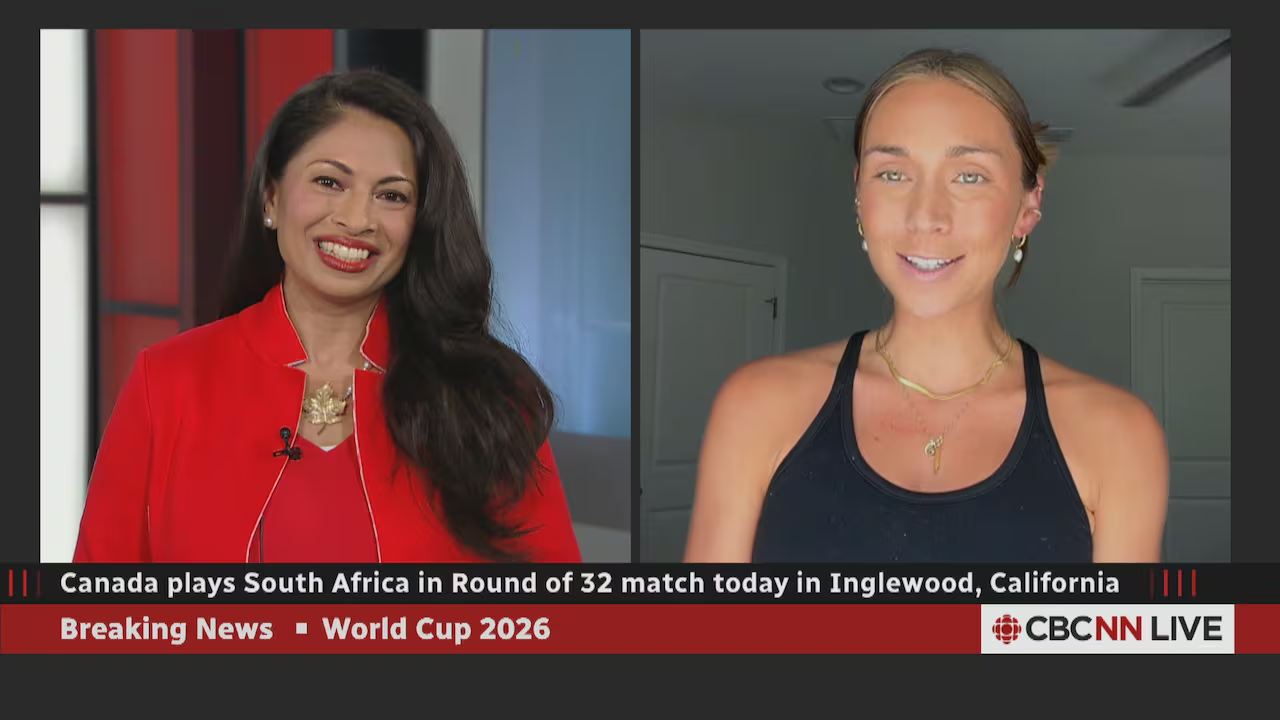
CBC News speaks to Jess Shaffelburg on brother Jacob Shaffelburg scoring for Canada
3 minutes ago
 AI News
Record
3 minutes ago
 AI News
Boy, 7, found dead at Binbrook Conservation Area after going missing on Canada Day, police say
3 minutes ago