
OPINION | Decoding Modi 3.0’s next pivot as a reshuffle may be on the cards
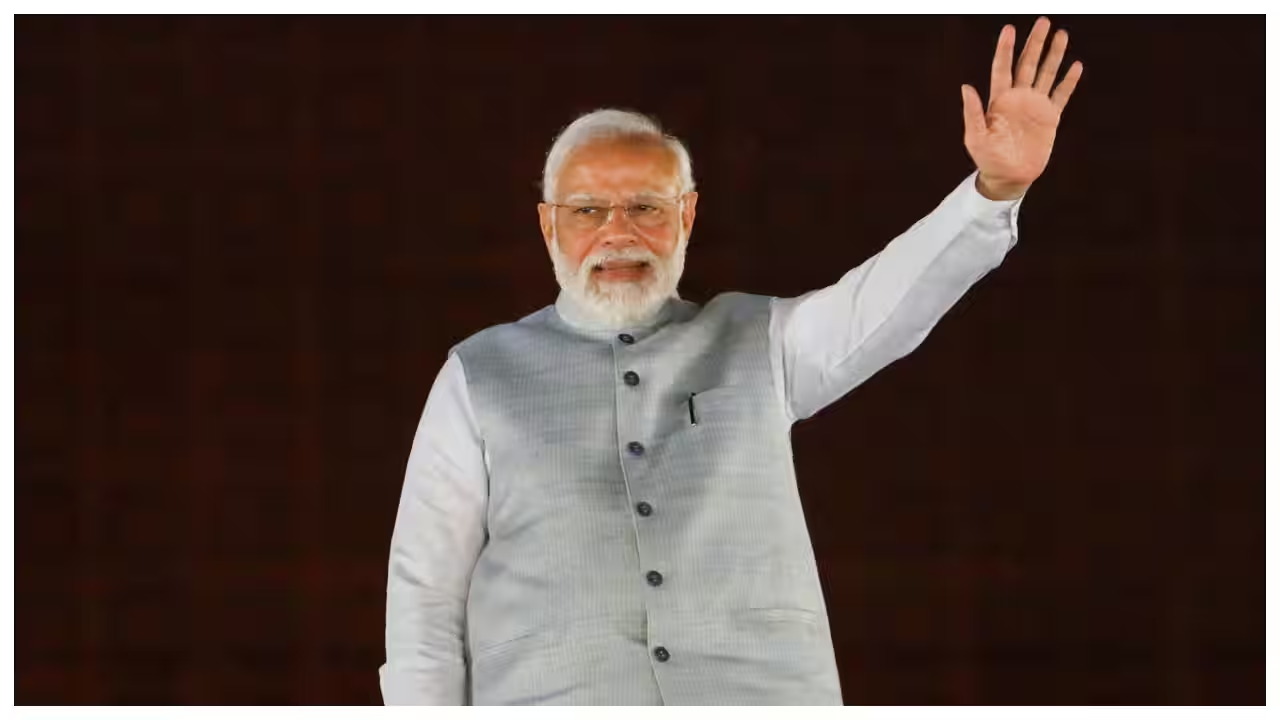
OPINION | Decoding Modi 3.0’s next pivot as a reshuffle may be on the cards
A well-known Chief Executive Officer (CEO) once told me that his first meeting with Narendra Modi when he was Chief Minister of Gujarat was unusual business. The top executive reached ahead of the scheduled appointment but was pleasantly surprised to see that the CM joined without making him wait and most importantly he was alone, keen to strike a chord directly with the company leadership.
The bureaucrats joined only later. This was proof enough that Modi was a hands-on political executive who didn’t let nuance slip by.
Leaning towards former civil servants in economic ministries
Modi, now in his 12th year as Prime Minister of India, has reaffirmed that image but has in parallel endured with a set of bureaucrats enlarging their role from merely being executioners of public policy to being the authors of policy under his overall leadership and vision. Modi’s three terms testify to his ever-growing trust and confidence in bureaucrats driving key portfolios, especially in the economic domain.
Now with chatter about an impending cabinet reshuffle, it is pertinent to see whether the PM continues to give pride of place to babus-turned -netas or he pivots away into inducting traditional grassroot politicians to drive the change he wishes to bring about in the near three-year period left in his third term.
A technocrat waiting in the wings?
For now, there is buzz about a heavyweight technocrat joining the Union cabinet to drive the new age AI and Deep Tech ministry -- being set up for the first time, to build a truly Indian AI template that serves as a global benchmark. Also, to possibly dent the criticism from a section of the opposition that India has already missed the AI bus.
But clearly ahead of the reshuffle talk, it is an opportune occasion to see whether his reliance on the "babu" brigade has given Modi the expected dividends, or if it is time for him to reimagine the political-administrative balance.
Former bureaucrats who are steering the economy
It is important to point out here that while Modi has leaned heavily on giving select bureaucrats meaty roles in his Cabinet, he has never shied away from engaging with the larger babudom through initiatives like PRAGATI (Pro-Active Governance and Timely Implementation), where he speaks directly to top secretaries across states to monitor project execution. He has frequently emphasised that while "political will can reform, bureaucracy performs."
Let us look at the current Cabinet where S Jaishankar (External Affairs), Ashwini Vaishnaw (Railways, MeITY, and I&B) along with Hardeep Puri drive core economic ministries. Puri earlier handled urban affairs as well. Arjun Meghawal is in charge of (Law & Justice & Parliamentary Affairs). Earlier, R K Singh, former home secretary, too was part of the Modi cabinet manning the power ministry. Between Jaishankar, Vaishnaw and Puri, India’s outreach to the world is articulated, whether it is the idea of multi-alignment, India Stack or energy security.
These portfolios have faced unprecedented turbulence since 2024 due to global headwinds and India’s energy vulnerability has come to the fore like never before due to ongoing wars. Veteran politicians Ravi Shankar Prasad and Prakash Javedkar manned MeITY and I&B in Modi’s second term but were dropped mid-way.
Stability in the core team of civil servants
That Modi has immense trust in bureaucracy is also evident from the fact that he has retained his core team manning the all- important Prime Minister’s Office. Administrative veterans like Principal Secretary P.K. Mishra and National Security Advisor Ajit Doval continue to hold sway, marking continuity as a policy plus. PM’s earlier principal secretary too is in circulation running his favourite project – PM’s Museum – as also the man who drove the Ram Mandir Ayodhya mission on the ground.
Shaktikanta Das, the longest-serving governor of the Reserve Bank of India (RBI) in seven decades, was widely expected to get an extension after completing a second three-year term. He quit RBI and re-entered the top echelons of bureaucracy making a grand entry into the Prime Minister’s Office (PMO) last year.
Modi today actually divides his governance model neatly: the economy and future tech are outsourced to domain experts/technocrats (Jaishankar, Vaishnaw, etc.), while hard politics and crisis management are outsourced to Amit Shah.
Reshuffling of business allocation is a possibility
Coming back to the Union cabinet, given Modi’s austerity pitch it is likely that some ministries might be bundled for optimisation while some might be unbundled for efficiency as also to reduce the load of one or two individuals.
Railway remains the largest government-controlled ministry with a direct, daily interface with the masses. From political and public convenience standpoint, this merits stand-alone attention. Moreover, it might make sense to hand it over to a hard-core politician and there is no dearth of aspiration now with a key NDA ally parked in New Delhi.
While endorsing the central thesis that Modi inherently distrusts the generalist grassroots politician with highly technical portfolios, it might make sense to carve out AI as a single unit under a technocrat, signalling that for next-generation economic drivers like AI, even the trusted administrative service general purpose prowess is no longer specialised enough. Modi has been talking about AI for global good as a mission statement.
Amit Shah remains the key person
That is in the realm of speculation. What can be said safely is that the core political element in the Union Cabinet represented by Amit Shah would only get bolstered. The Union government, now in its third term, under Modi, has demonstrated increasing trust and faith in Shah’s capabilities well beyond his official remit as home minister.
Often credited rightly for running the BJP election machinery bringing it to power in hitherto non-BJP bastions while reinforcing its hold in traditional bastions, the home minister has now carved a new role in high-stake business interventions. He is increasingly the go-to person for complex cusp challenges that fuse governance, business, and national growth.
The Centre announced an informal group of ministers (iGoMs) in August last year headed by Shah to prescribe reforms in the economic domain. The group’s motive is laying out the legislative and policy reform agenda in the technology and economic sectors. He along with the FM intervened recently in the Tata boardroom challenge as well.
The key takeaway today being that Modi means business in the remaining three-year period could either further burnish his image or pose fresh challenges in the run-up to the 2029 general elections. Therefore, the core political heavy-lifting and electoral management will remain centralised under the Amit Shah-led wing with a crisis manager nomenclature, but the strategic, futuristic engines of India's economy will remain firmly out of reach of the grassroots politician, entrusted instead to specialized czars who marry administrative experience with domain knowledge.
(Rakesh Khar is a seasoned editor. He writes at the intersection of politics, business, technology and society.)
Views are personal and do not represent the stand of this publication.
Discover the latest Business News, Sensex, and Nifty updates. Obtain Personal Finance insights, tax queries, and expert opinions on Moneycontrol or download the Moneycontrol App to stay updated!
Find the best of Al News in one place, specially curated for you every weekend.
Stay on top of the latest tech trends and biggest startup news.
Related Stories
 India
India
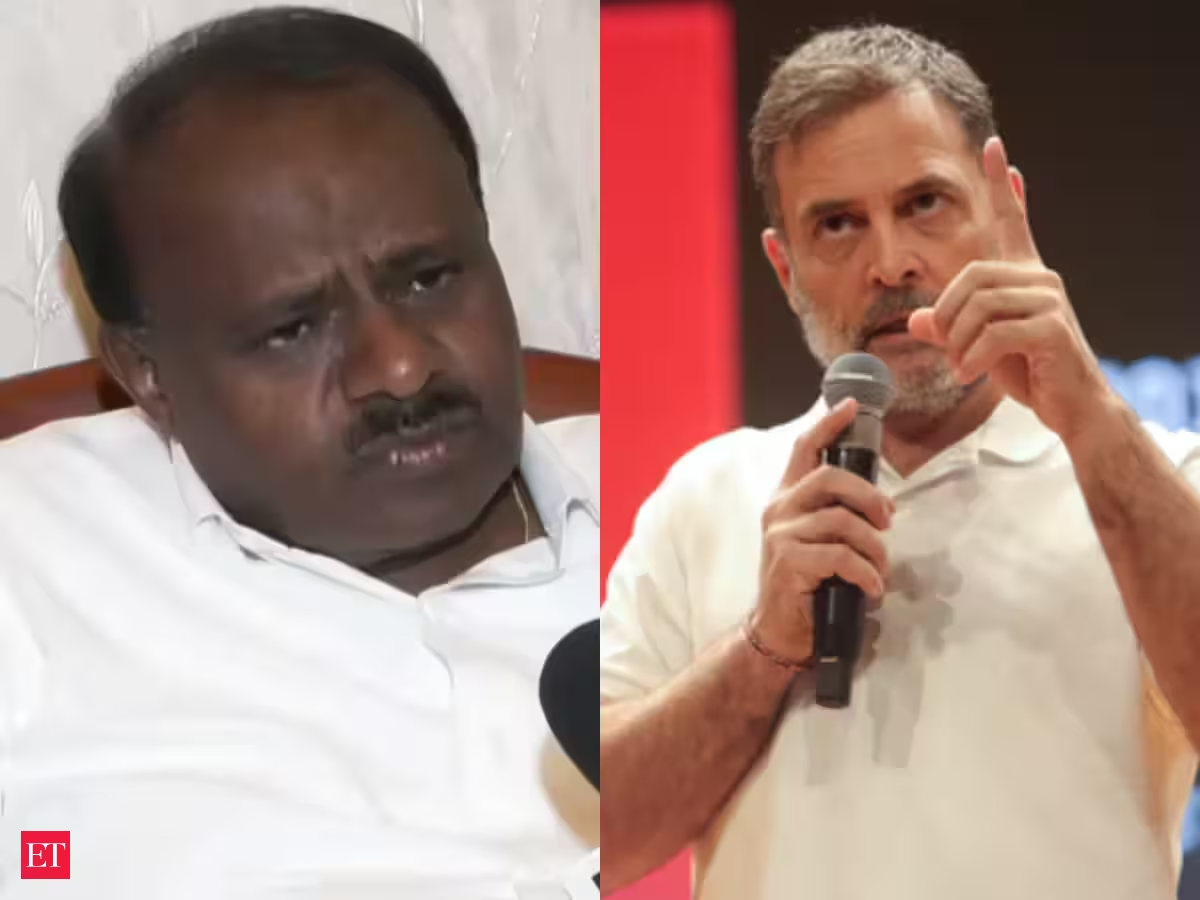
HD Kumaraswamy slams Rahul Gandhi for seeking to 'drag’ CJI into political debate
1 hour ago
 India
India
Trade minister leading 300
1 hour ago
 India
India
Whizzo, started by ex
1 hour ago
 India
India
A show of resistance on Delhi’s streets as Rahul Gandhi
2 hours ago
 India
India
Delhi braces for more protests against election chief amid crackdown
2 hours ago
 India
India
Democracy can't be held hostage to opposition's comfort, SIR necessary for fair polls: Delhi CM Rekha Gupt
3 hours ago
 India
India
India’s opposition marches on Supreme Court as ‘cockroach’ protests gain ground
3 hours ago
 India
India
BJD slams State government for Hockey India’s notice to downgrade Odisha’s status
5 hours ago