
Opinion: Canada must confront the Kremlin’s agents at home
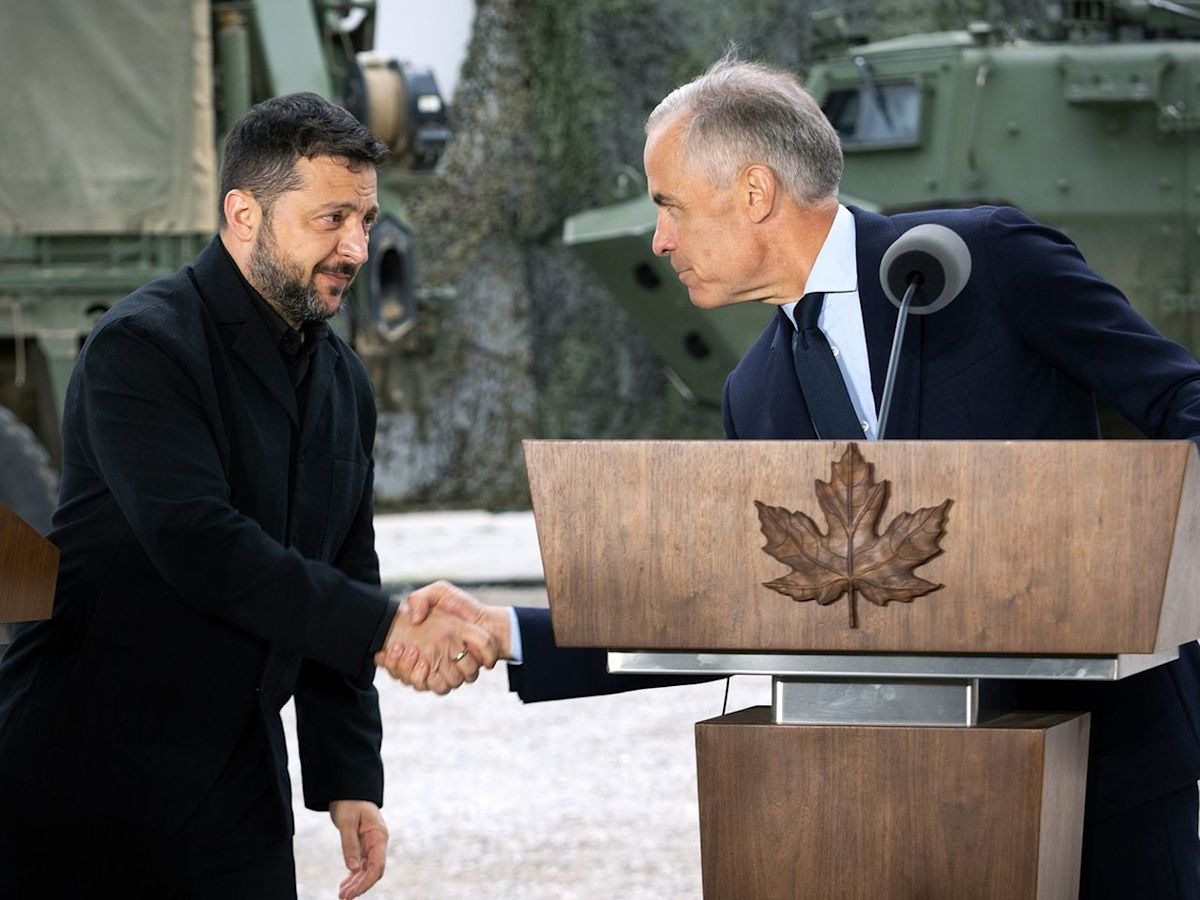
Last week, Prime Minister Mark Carney and Ukrainian President Volodymyr Zelenskyy took an important step toward the long-term defence of Canada and Ukraine.
The new long-term Canada-Ukraine partnership will expand co-operation on the joint production of drones, counter-drone technologies and priority munitions. Such investments help Ukraine protect its cities while strengthening Canada's own defence-industrial capacity through Ukraine's hard-earned battlefield expertise.
But helping Ukraine resist Russian aggression abroad must be matched by a willingness to impose consequences on the Russian state and its agents here in Canada. That means continuing to pursue accountability for Russian war criminals and scrutinizing the unusually large Russian official presence in Canada. Parliamentary testimony has put that presence at more than 60 Russian diplomats. Not every Russian diplomat is an intelligence officer. But it would be equally naïve to ignore Russia's long-standing use of diplomatic postings as cover for intelligence and influence operations. Those who abuse diplomatic status to undermine Canadian security should be expelled.
In August, a man walking in front of the Russian Embassy in Ottawa approached a blue and a yellow balloon on a pole left outside by anti-war protesters. He punctured them and walked away. The video posted on X by Bulgarian investigative journalist Christo Grozev would be almost comic if the context were not so serious. Grovez identified the culprit as a Russian diplomat.
Canada's security service (CSIS) has previously warned us about the hostile activities targeting Canada that the Russian mission is engaged in. A recent Senate Standing Committee on Security and Defence report concluded that in Canada, "Russian disinformation has been growing and evolving at a rapid pace." These disinformation activities are designed to sow discord in our society and create or increase social fractures that challenge our democratic institutions. They include but are not limited to seeking to discredit Canada's Ukrainian community by branding it as "neo-Nazi;" blaming the North Atlantic Treaty Organization for Russia's genocidal full-scale invasion of Ukraine; spreading falsehoods about the West's response to its aggressions and more. These narratives are designed to erode Canadian public support for Ukraine and to delegitimize and incite hate towards Canadians of Ukrainian heritage.
The hate that such narratives seek to incite has violently manifested itself. In February 2022, Toronto's Future Bakery was vandalized with pro-Russian graffiti, including the words "Russia is power." Weeks later, its Stand With Ukraine banner was slashed and splattered with paint.
When a "diplomat" from the Russian mission is filmed engaging in petty vandalism of Ukrainian-coloured protest symbols placed on public property, outside the Russian Embassy, it both illustrates and reinforces the atmosphere of contempt for the Canadian value of freedom of expression and intimidation that Kremlin disinformation operations seek to create.
Canada needs to act publicly to address such activities. And previous governments have done so. For example, in 2018, Ottawa expelled four Russian diplomatic staff who were identified as intelligence officers or as individuals who used diplomatic status to undermine Canadian security or interfere in our democracy. One was the Russian Embassy press secretary Kirill Kalinin. Investigative journalist Justin Ling later told Parliament that Kalinin had repeatedly tried to seed stories about alleged Ukrainian Nazis in Canada and had actively sought to defame then Deputy Prime Minister Chrystia Freeland. Ling described the embassy as a hub for Russian disinformation operations and said Kalinin was expelled for his involvement in them.
Kalinin's expulsion should have set a precedent — that diplomats who abuse their status to run disinformation warfare against Canadians will not be tolerated — but after Russia launched its full-scale invasion of Ukraine, Canada stopped using expulsions as a tool through which to impose consequences.
Canada does not need to sever diplomatic relations with Russia to act. It should review Russia's diplomatic footprint, in close consultation with CSIS and allied intelligence services, and reduce it where officials are believed to be conducting intelligence, intimidation, disinformation or other activities incompatible with their diplomatic status. Diplomatic accreditation should not be a shield for hostile-state activity.
Unfortunately, Ottawa has recently moved in the opposite direction. In August, Canada removed former senior Kremlin official Anatoly Chubais from its Russia sanctions list, restoring his admissibility to Canada, while saying on that there was "reasonable grounds to do so," without elaborating.
Estonia offers a useful model for what Canada should do. Shortly after Russian diplomats in Estonian helped organize the deadly 2007 Bronze Soldier riots in Tallinn, Estonia repeatedly denied entry in 2009 to Johan Bäckman, a Finnish Kremlin-aligned activist known for hostile, Stalinist attacks on Estonia and for denying the Soviet Russian occupation. In March 2022, Estonia expelled three Russian diplomats for directly undermining its security and spreading propaganda justifying Russia's war. Weeks later, it expelled 14 Russian consular staff, including seven diplomats. And in August 2025, Estonia expelled a Russian Embassy first secretary for what its foreign ministry described as activities undermining Estonia's constitutional order and seeking to divide Estonian society.
Estonia has made it clear that foreign representatives who abuse their presence to undermine the state or target its society will face predictable consequences.
Former Estonian president Toomas Hendrik Ilves put it plainly when we asked him about the Ottawa incident: "We have seen similar behaviour by Russian 'diplomats' throughout Europe and indeed by the Russian embassy staff in Washington, D.C. as well. Foreign diplomats are not allowed to engage in political activity in the country where they are accredited. Vandalism already calls for a PNG designation."
Canada knows that a clear strong response to Russian intimidation is needed. In its formal response to a 2023 House of Commons recommendation, the government of the day agreed that Russian diplomats engaged in activities that are inconsistent with their official status should be expelled. It also noted that Canada can declare a foreign representative persona non grata under the Vienna conventions and is not required to explain that decision publicly.
Canada should apply that standard now. Global Affairs Canada and CSIS should immediately confirm the identity of the individual in the video and any connections he may have to the embassy, and then review his diplomatic accreditation, activities and role at the Russian mission. His conduct captured on video all warrant scrutiny. If his activities are incompatible with his status or Canada's security interests, he should be required to leave the country.
Balloons on their own may be trivial; what Canada is prepared to tolerate from Vladimir Putin's "diplomats" and agents is not.
The new Canada–Ukraine defence partnership is an important investment in deterrence abroad. It should be matched by consequences for hostile Russian activity at home, including the expulsion of officials who abuse diplomatic cover. Moscow only understands strength and reacts to consequences. Estonia has learned to impose them. Canada should too.
Stanley Kutcher is a former Canadian Senator.
Marcus Kolga is a Senior Fellow at the Macdonald Laurier Institute.
Jamie Sarkonak: Don't trust Carney to tell us what EU 'associate membership' means
Sylvain Charlebois: While Canada fights Trump, Mexico is preparing to eat our lunch
Related Stories
 Canada
Should municipalities ban smart glasses in pools and change rooms?
15 minutes ago
 Canada
6 hospitalized after man drives vehicle into crowds at festival in Quebec
15 minutes ago
 Canada
Transport minister won’t guarantee prices won’t go up after airport privatization, promises fees will be ‘partially regulated’
15 minutes ago
 Canada
Why are more teens using creatine? Here’s what experts say
2 hours ago
 Canada
Flight training school says 2 killed in plane crash near Kisbey, Sask.
3 hours ago
 Canada
Canada's 'Railway City' wants passenger trains back. Like much of the country, it's not so simple
3 hours ago
 Canada
Are you a weather whiz? Take Canada’s weekend weather quiz
5 hours ago
 Canada
Calgary Stampeders down Ottawa Redblacks 40
7 hours ago