
New laws trigger a fresh legal fight over Nazi
LOS ANGELES (AP) — Jewish heirs of Holocaust victims and their representatives have filed two lawsuits in California staking their claims to Nazi-looted paintings that still hang on the walls of prominent museums in Los Angeles and Auschwitz.
This pair of lawsuits are the first to be filed after the recent passage of laws by California and Congress, which strengthen U.S.-based claims to artwork that were forcibly taken from Jewish families during World War II.
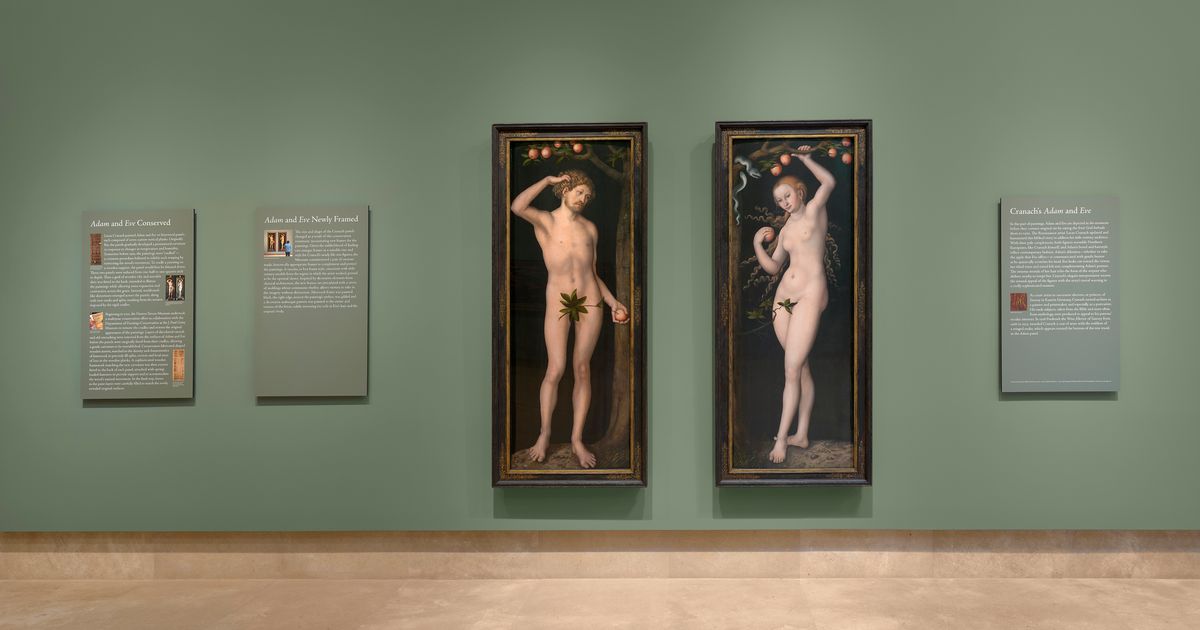
One lawsuit was filed in Los Angeles Superior Court on Monday by the Jewish Federation of Greater Los Angeles and its board chair Daniel Gryczman against Norton Simon Museum in Pasadena for the return of “Adam and Eve.” These are two life-size oil-on-panel masterpieces created by Lucas Carnach the Elder in 1530.
The other lawsuit was filed in federal court in Los Angeles the same day by the daughters of the late Dinah Gottliebova Babbitt, a Holocaust survivor and California-based animator who was held in Auschwitz. It demanded the return of watercolors of fellow prisoners that the artist was forced to paint for Josef Mengele, a Nazi physician who had earned the nickname the “Angel of Death.”
Spokespersons for both museums say the museums legally hold titles to the works, and intend to continue displaying them to the public. The lawsuits don’t specify the monetary value of the paintings.
Artworks pit Jewish families against museums
The issue of Nazi-looted art is an emotional, legally and ethically charged topic that pits Jewish families that have suffered inter-generational trauma against museums that say they are trying to preserve a painful, yet important, chapter of history. Between 1933 and 1945, the Nazi regime orchestrated the largest art theft in world history, seizing over 600,000 works of art across Europe from Jewish families, collectors and museums. Decades later, many of these masterpieces reside in prominent museums around the world, making the push for their recovery more complex than a simple property dispute.
Rabbi Noah Farkas is president and CEO of the Jewish Federation of Los Angeles, the organization to which Marei von Saher, sole heir of Dutch Jewish art dealer Jacques Goudstikker, has signed over her rights. The paintings were seized from Goudstikker's collection by Hermann Goring, Adolf Hitler’s second-in-command and changed a number of hands before being sold in the 1960s to the Pasadena Museum of Modern Art, which was renamed Norton Simon Museum in honor of its benefactor.
Farkas said the federation plans to use most of the net proceeds from the recovered art to provide much-needed help to the about 2,500 Holocaust survivors living in the Los Angeles area.
“These are incredibly beautiful European masterpieces stolen from a Jewish family to enrich the Nazi party and fund the war and death machine against the people,” he said. “It's our honor to take on this role on behalf of the community and use most of the proceeds to help these elderly survivors live out the last years of their lives in dignity, comfort and peace – something their family members were denied during the Holocaust.”
Marei von Saher, in a statement, said she is grateful to the Jewish organization for taking up her family’s cause.
“This effort represents a meaningful step toward justice for Holocaust survivors and victims of Nazi era atrocities,” she said.
New legislation gives lawsuits second wind
California Assemblyman Jesse Gabriel, D-Woodland Hills, wrote Assembly Bill 2867, signed by Gov. Gavin Newsom in September 2024, which requires that the state law must apply in lawsuits brought by California residents or their heirs to recover art seized during the Holocaust or during other acts of persecution. Gabriel, who co-chairs the California Legislative Jewish Caucus, introduced the legislation in response to a federal court ruling, which allowed the state-owned Thyssen-Bornemisza National Museum in Madrid to keep a multimillion-dollar Camille Pissarro impressionist masterpiece.
That painting had been taken by the Nazis from the Cassirer family in 1939. This case, which prompted this new law, is expected to be heard in federal court in California next month.
Gabriel said it’s time for museums to “do some deep introspection on whether they want to be on the right side of history.”
Museums want to preserve paintings for posterity
Norton Simon Museum released a statement pointing out that a federal court in 2018 unanimously determined that the museum had proper title to the Cranach paintings. In May 2019, the U.S. Supreme Court declined to get involved in the case, leaving in place lower court rulings.
They said the Cranach paintings, which originally belonged to the Stroganoff family, were put up for sale in 1931 by the Soviet Union in an illicit auction in Berlin where they were purchased by Goudstikker. After a complicated journey, the paintings were sold to the museum by a Stroganoff family descendant. The museum later restored and preserved the pieces.
“For nearly 50 years, they have been on view at the Norton Simon Museum and will continue to be accessible to the public for years to come,” the statement said.
Pawel Sawicki, a spokesperson for the Auschwitz Memorial, said the watercolors of Roma victims that Gottliebova Babbitt was forced to paint by Mengele to document his horrendous experiments and racial research, “must remain in the Memorial” to document the man's crimes. He said these paintings must not be mischaracterized as “Nazi-looted art” because Gottliebova Babbitt painted them against her will as a prisoner and therefore didn’t have ownership of the watercolors.
While he understands the family’s sentiments, Sawicki said the portraits of Roma and Sinti victims are among the few remaining documents of Mengele’s criminal experiments and should be treated as unique documents related to the history of the Auschwitz concentration camp.
“While fully respecting the rights of people who created some of the documents here, we are of the opinion that any loss in the collections of the Memorial will constitute irreparable harm,” he said. “ … The loss of even the smallest part of the documentation is an irreparable loss and blemish on the memory of the victims of Auschwitz.”
Advocates hope cases will now be heard on their merit
Joel Greenberg, founder of Art Ashes, a Philadelphia-area nonprofit that helps Jewish families track down and recover Nazi-looted art, said in addition to the California law, President Donald Trump signed into law and updated the Holocaust Expropriated Art Recovery Act of 2025. This new law permanently eliminated the expiration date to allow Holocaust survivors and their heirs to indefinitely pursue the recovery of these works of art.
Greenberg said the new federal law gave families the right to reclaim their art for up to six years from the time they find out in whose possession they are.
“These new laws mean that technical defenses will no longer stick in court,” he said. “Every case will be heard on its merits.”
He said the new legislation also ensures that these Jewish families have their day in court and a fair process to determine ownership of the stolen art.
“It will make sure the stories of what happened to European Jewry is not lost and forgotten,” he said. “The art can still be returned to the rightful owner.”
Associated Press religion coverage receives support through the AP’s collaboration with The Conversation US, with funding from Lilly Endowment Inc. The AP is solely responsible for this content.
Related Stories
 World
World
England hammer Sri Lanka to return top of T20 world rankings as 3
1 hour ago
 World
World
Video. Latest news bulletin | September 19th, 2026
2 hours ago
 World
World
Award
2 hours ago
 World
World
Fareham man's memories of a world sailing adventure 50 years ago
3 hours ago
 World
World
Photos of the Bavarian tradition of Oktoberfest in Munich
3 hours ago
 World
World
CNN and MS Now denied White House access after Trump banned major media outlets
3 hours ago
 World
World
Ex
4 hours ago
 World
World
Cycling world championships schedule 2026: Times, channels, live streams to watch UCI Montreal races
4 hours ago