
N.B. working on support for employers hit by latest tariffs
N.B. working on support for employers hit by latest tariffs
Premier says she supports prime minister’s decision to walk away from trade talks
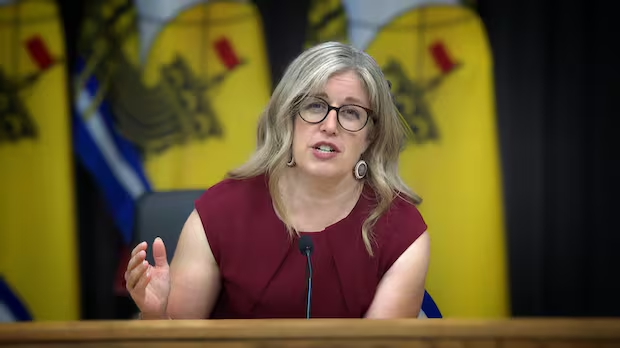
Premier Susan Holt says her government is working on new support programs for New Brunswick businesses and workers hit by the latest round of U.S. tariffs.
Holt was responding to the collapse on Friday of Canada-U.S. trade talks that were aimed at reaching an interim agreement to avoid new 50 per cent tariffs on a range of Canadian products.
“We're putting together tailored supports through Opportunities New Brunswick that will pair with the $25 billion that the federal government has committed to try to minimize the impact and support those entrepreneurs and those workers through this,” she said.
The new tariffs took effect on the weekend after Prime Minister Mark Carney pulled Canada’s negotiators out of the discussions in Washington.
Holt told CBC’s Information Morning in the Summer she supported Carney’s decision because it was “just not tenable” for Canada to accede to U.S. demands.
The premier said the new tariffs will affect about $112 million in New Brunswick exports to the U.S., or 0.8 per cent of the total.
She didn’t have an estimate of how many jobs would be affected.
Overall, 87,000 jobs nationwide could be lost, according to a study by University of Calgary economist Trevor Tombe.
He said Atlantic Canada would be “largely spared” the impact of the new tariffs, with New Brunswick likely to lose 1,600 jobs.
An agreement would have provided some relief from other U.S. tariffs imposed earlier in Donald Trump's presidency but would not have eliminated them.
Keith Parlee, the CEO of Apex Industries in Moncton, which manufactures steel doors sold in the U.S., said the tariffs that were already in place were “significant and costly” for the company, so any resolution would have been welcome.
Holt said Monday that despite the latest setback, she was still hesitant to cut off, or impose surcharges on, N.B. Power’s electricity exports to the U.S. as a form of retaliation.
About 58,000 residents of northern Maine who live in communities not connected to the main power grid in the southern part of the state rely on electricity from New Brunswick.
On Saturday, Carney noted the general U.S. reliance on energy from Canada, including crude oil, natural gas and electricity.
“I don’t think they want us to stop sending it,” he said.
But Holt said she was reluctant to restrict or tax power exports to Maine as leverage.
“That's an extremely serious line to cross,” she said, pointing out N.B. Power’s exports are subject to binding contracts.
“Those contracts go both ways. So we provide them with the energy products when they need it, and sometimes we rely on them to provide U.S. energy products at those peak times.
“We've got to be really careful not to respond emotionally to these situations and to look at our contracted commitments, look at the integrated system that we have.”
She also said, however, that “we keep these tools in our toolkit and they give us heft at the negotiating table.”
Holt said the breakdown in talks means N.B. Liquor will not resume buying new U.S. alcohol products for its stores.
Restocking American booze was a key demand of the Trump administrations during the negotiations this summer.
Jacques Poitras has been CBC's provincial affairs reporter in New Brunswick since 2000. He grew up in Moncton and covered Parliament in Ottawa for the New Brunswick Telegraph-Journal. He has reported on every New Brunswick election since 1995 and won awards from the Radio Television Digital News Association, the National Newspaper Awards and Amnesty International. He is also the author of five non-fiction books about New Brunswick politics and history.
Related Stories
 Canada
Canada’s Wonderland provides update on Behemoth and Leviathan roller
15 minutes ago
 Canada
Canada's Carney makes final appeal against Alberta separation ahead of referendum
15 minutes ago
 Canada
13 injured in multi
15 minutes ago
 Canada
The U.S. midterms are just weeks away. What’s at stake for Canada?
15 minutes ago
 Canada
3.7
1 hour ago
 Canada
New data points to strong summer for Toronto's tourism sector
1 hour ago
 Canada
UCP divisions over Alberta separation question come into focus ahead of referendum
2 hours ago
 Canada
Former Kugaaruk, Nunavut, hamlet employee charged with fraud
2 hours ago