
Mouna Ragam at 40: Cinema and the Neoliberal Turn
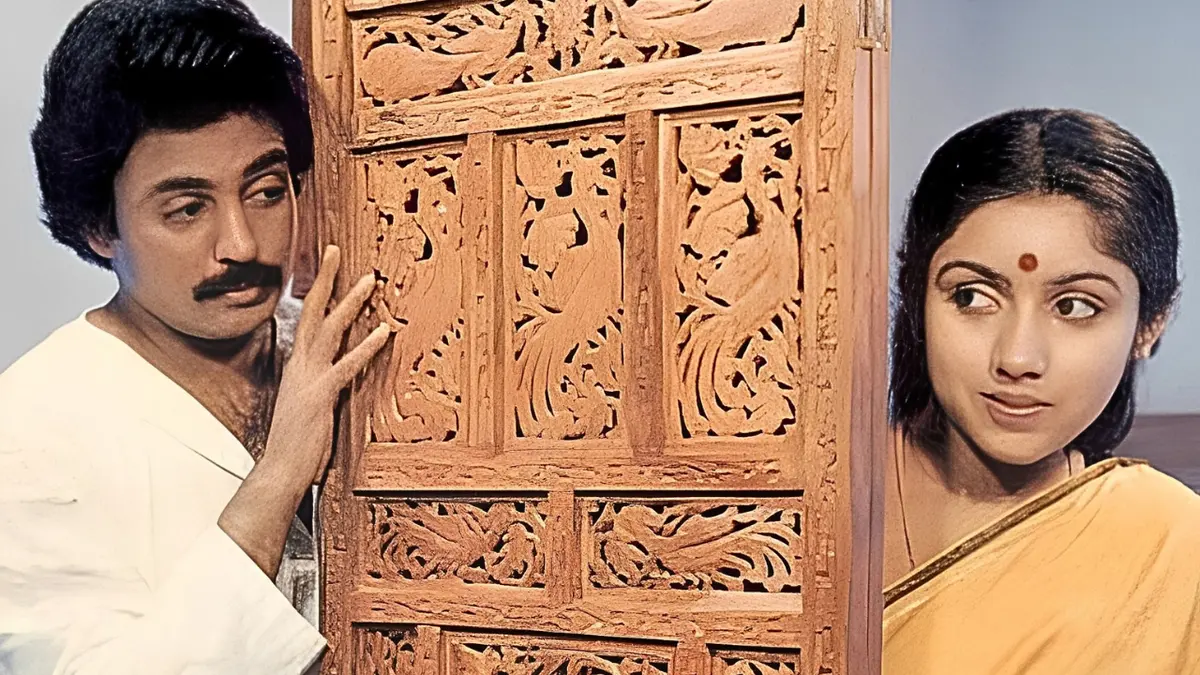
“The very principle of democracy is founded on the possibility of making alternative choices. There is no longer a need for democracy, since ideology made the idea that ‘there is no alternative’ acceptable.”
— Samir Amin, The Liberal Virus
“The most tragic form of loss is the loss of the capacity to imagine that things could be different.”
— A quote misattributed to Ernst Bloch
A young woman dances defiantly through the silver streets of Madras in the monsoon, driven by the naive hope that her absence from home will dissuade her prospective suitor. This sequence opens Mouna Ragam (1986), Mani Ratnam’s breakthrough film, which marked its fortieth anniversary this August 15. Its success ended a gruelling run of early misfires and announced Ratnam as a serious auteur. Revathi starred as Divya, with Mohan as Chandrakumar and Karthik as Manohar.
The film was celebrated for its portrait of urban middle-class romance, anchored by a heroine given rare emotional depth. Ilaiyaraaja’s synth-heavy score, Vaali’s lyrics, P.C. Sreeram’s cinematography, and editing by B. Lenin and V.T. Vijayan all added to its impact. In making the emerging urban middle class its subject, the film captured the desires and anxieties of a demographic on the brink of rapid change. It also arrived at a point of historical rupture for India.
In the mid-1980s, the Rajiv Gandhi government had begun the early moves towards economic liberalisation that would formalise into structural adjustment the following decade. The state was turning from Nehruvian dirigisme towards privatisation, deregulation, and integration into the circuits of global capital. This era produced a new managerial class. It also marked the beginning of the systematic suppression—and the violent dismantling—of the radical, class-based political movements that had defined the prior decades.
This shift had its corresponding cultural reverberations. Urban narratives in Tamil cinema found new audiences among the newly affluent middle class and the many just below it, hoping for upward social mobility. The 1970s had been dominated by stories of the urban working woman—in the films of K. Balachander, C. Rudraiah, and Durai, among others. Rudraiah’s Aval Appadithan (1978) follows a working woman whose traumatic past shapes her difficult relationships with men. As writer C.S. Lakshmi observed in 2008, Balachander’s Aval Oru Thodarkathai (1974) portrayed the inner life of an urban working woman navigating intimate relationships without the pull of marriage.
These were progressive departures from a Tamil cinema that had long centred on the kathanayagan, or hero. Sathiavathi Chinniah, also writing in 2008, traced this shift towards the kathanayaki: the chaste, confused, controlled woman of earlier decades giving way to one fighting for her economic position against a modern, urban patriarchy distinct from older feudal models.
The late 1980s and 1990s reversed this. As neoliberalism took hold, Tamil cinema turned regressive. Even in the Bharathiraja films that centred women—16 Vayathinile, Kadalora Kavithaigal—the story always returned her to marriage. Even in Mani Ratnam’s ostensibly female-centred films, the narrative scope narrowed to the conjugal sphere. Instead of a woman’s ambitions or her life outside marriage, her identity was confined to wife and mother.
This argument draws on the extensive archive of Tamil films from the late 1980s and 1990s, where the socialist politics of collective struggle became diluted through neoliberal individualism. Director Shankar’s films from the second half of the 1990s are a case in point. Both Mudhalvan (1999) and Indian (1996) are long meditations on corruption, framing corrupt politicians as the cause of India’s backwardness. Both films reassert an ideology central to neoliberalism: that the solution to corruption is to remove a certain kind of progressive politics from the picture altogether.
In both, the ideology thus produced is that a state’s success hinges on individualism taken to its extreme—one man setting things right, either by moral example (Mudhalvan) or through individual vigilantism (Indian). Neither film critiques capitalism itself, which produces the conditions of inequality and poverty both films otherwise condemn. Instead, they wage a crusade against corrupt officials, leaving unexamined the fact that the existence of capitalism leads itself inevitably, and contrastingly, to the existence of conditions of inequality and poverty.
In Shankar Anniyan, India’s underdevelopment is blamed on carelessness among those in positions of executive, legislative, and bureaucratic power. | Photo Credit: IMDB
Shankar returned to such themes in Anniyan (2005), where India’s underdevelopment is blamed on alatchiyam, or carelessness, among those in positions of executive, legislative, and bureaucratic power. A related trope—the good capitalist or feudal lord—recurs in Devar Magan (1992), Muthu (1995), Padayappa (1999), Arunachalam (1997), and Annamalai (1992). These films echo the Andrew Carnegie doctrine that surplus wealth is best administered by the capitalist class as trustees for society’s benefit, because the good capitalist, in the end, has society’s interests at heart.
Read today, Mouna Ragam’s love triangle reveals the Political Unconscious of India’s emerging middle class under the shadow of the Washington Consensus. Divya’s traumatic move from Madras to Delhi, following her unwilling marriage to Chandrakumar, becomes a National Allegory for a country pulled into the logic of neoliberalism. We borrow literary critic and philosopher Fredric Jameson’s idea of national allegory here, but only after setting aside two of its weaker premises, following Aijaz Ahmad’s critique: Jameson’s understanding of a singular “Third World” defined only by its experience of imperialism, and his claim that all texts from these varied societies must necessarily take the form of national allegory.
This analysis instead treats the nation as constituted by competing, interpenetrating forces rather than a unitary response to imperialism. What remains useful in Jameson’s framework, once stripped of these essentialisms, is its capacity to locate large-scale economic struggle within what looks like a private, domestic narrative.
Writing in The Hindu in 2013, K. Hariharan described the film’s movement of characters from Madras to Delhi as an attempt to “locate the market on a so-called global platform”. The journey beyond Tamil Nadu’s borders, he argued, expresses the political economy of liberalisation, which rejects local boundaries. Ratnam’s liberal instincts extend to his women: Hariharan notes that they carry a certain urban brazenness typically “associated with the upper-class urban educated”. Divya’s assertiveness surfaces in her love for the firebrand activist Manohar.
The allegory of national rupture, then, works through both her geographical dislocation and her chaotic past with Manohar, her former campus romance, shown to viewers in flashback. His passion as a lover is inseparable from his politics as an extra-parliamentary left-winger, which puts him on a fatal collision course with the state. The film leaves little doubt about his loyalties: the scene where he plots political action with his comrades opens on a poster for The Night of San Lorenzo (1982), the “Taviani brothers” film about Tuscan villagers joining the partisan resistance against Fascist Blackshirts.
Divya and Manohar’s plan to elope is thwarted when he is framed and arrested for a violent political act. His desperate escape to reach her ends when police shoot him dead on the courthouse steps. The chase that kills him recalls the climax of Jean-Luc Godard’s Breathless (1960), where Manohar, like Michel Poiccard, collapses before his lover, mortally wounded. The echo links both men through the archetype of the free-wheeling rebel undone by his own recklessness.
The film frames his death as an accident—the shot fires only because a passing truck clips the police jeep in which Manohar is being transported—obscuring the killing’s political weight and gesturing instead towards the neoliberal fantasy of a benevolent, paternalistic state that only wanted to discipline a wayward youth through imprisonment. Yet Manohar stands for what the film treats as the foregone conclusion of the Left: a youthful idealism the state must violently clear away to make room for the new economic order. Mourning him, Divya experiences what writer Mark Fisher called “the slow cancellation of the future”—grief for the foreclosure of any revolutionary alternative, trapping her within Capitalist Realism.
She is bound, instead, to Chandrakumar, the embodiment of the new, deracinated corporate managerial class. The film charts her progression from distaste to reluctance to acceptance of the marriage. Her alienation is staged against an affluent neighbourhood in Delhi’s urban sprawl. On their wedding night, Divya recoils from Chandrakumar’s advances; his choice to step back and offer her separate rooms is portrayed as patience, even open-mindedness, but conceals her structural entrapment within a liberal-seeming accommodation.
Unlike the “shock therapy” imposed upon Chile and the erstwhile Socialist Bloc, a hostile takeover and swift economic overhaul would have triggered India’s historical defence mechanisms. Instead, what was employed was a kind of gradualism for which hegemonic consent needed to be manufactured. The film, in a bid to resolve the conjugal tension between Chandrakumar and Divya, employs class-conflict: after Chandrakumar suspends their union leader, his company’s workers beat him and leave him near death. This eruption of working-class anger becomes the catalyst that saves the marriage. Nursing him back to health, Divya recognises her affection for him—signalled by her finally wearing the silver anklets he once gave her.
The structural adjustments Mouna Ragam tried to make palatable did not produce shared prosperity; they accelerated the concentration of wealth at the top. | Photo Credit: IMDB
This reconciliation functions as ideological closure. In Jameson’s terms, it offers a “symbolic resolution”: the trope of domestic romance stands in for, and makes palatable, the real and irreconcilable contradictions of neoliberalism. “There is no alternative,” as Margaret Thatcher put it. By casting organised labour as violent and tying that violence to the heroine’s emotional thaw, the film persuades its audience to accept passivity as the price of the new socio-economic reality. It works against the Left not through political critique but by association—with chaos, violence, the absence of a future, and a youthful idealism one must eventually outgrow. Instead, the affluence and meekness of the safely liberal Chandrakumar offers predictable succour
Forty years later, neoliberalism’s pacifying promises stay undelivered for most of the country. The structural adjustments Mouna Ragam tried to make palatable did not produce shared prosperity; instead, they accelerated the concentration of wealth at the top. Despite the culture industry working overtime to pacify and contain these contradictions, history has not ended.
Varkey Parakkal is a PhD scholar at the Department of Sociology, Jamia Millia Islamia. Anuraag Srinivasan is a PhD scholar (Urban Studies & Practice) at the Indian Institute of Human Settlements.
Also Read | Return of the repressed
Also Read | Tamil literature’s midnight’s child
Related Stories
 Entertainment
‘Amruthavarshini’: When Deva gave Kannada cinema an all
1 week ago
 Entertainment
Liam Gallagher makes stance on Fontaines D.C. painfully obvious
1 week ago
 Entertainment
Jailer 2 worldwide box office collection: Rajinikanth delivers highest
1 week ago
 Entertainment
New movies to watch this weekend: See 'The Social Reckoning' in theaters, rent or buy 'Spider
1 week ago
 Entertainment
Bash and smash: 'Rage room' opens in St. John's
1 week ago
 Entertainment
5 movies like 'Knives Out' to scratch the funny murder mystery itch
1 week ago
 Entertainment
‘You Can See Everything’ reviews: Nathan Fielder’s Elizabeth Holmes documentary hits 99% on Rotten Tomatoes as it opens in theaters
1 week ago
 Entertainment
Every major concert, show and music festival coming to Las Vegas in 2027
1 week ago