
More U.S. Workers Fear Losing Their Jobs to Technology
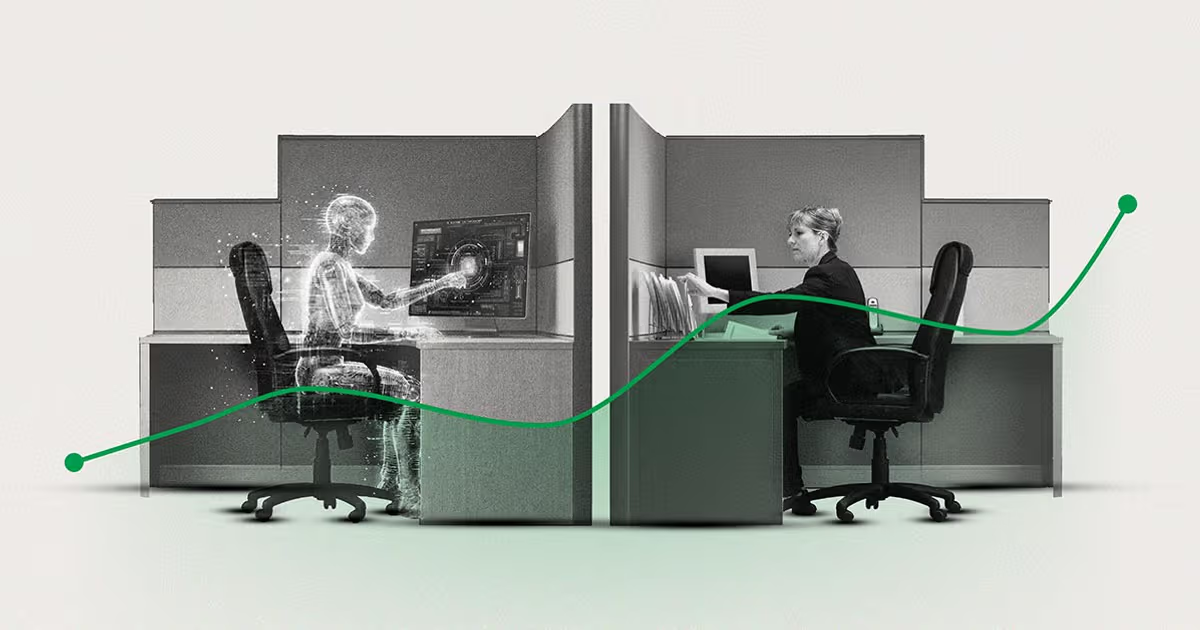
WASHINGTON, D.C. — Twenty-seven percent of U.S. workers, a new high, worry that technology could soon make their jobs obsolete. This is up seven percentage points from last year and roughly double the 13% recorded when Gallup first asked the question in 2017.
The recent increase in worry about the threat of technology contrasts with workers’ largely stable concern over the past year about more traditional threats to employment and income, including layoffs, reduced hours, lower wages and benefit cuts.
The latest findings are from Gallup’s Aug. 3-24 Work and Education survey.
College Gap in Tech Displacement Worry Remains Slim
Over the past year, worry about technological displacement has increased among workers both with and without college degrees. It has risen six points to 25% among college graduates and eight points to 29% among non-college graduates.
The two groups’ similar levels of concern about this risk are relatively new. When Gallup first measured it in 2017, college graduates were less likely than adults without a college degree to worry about technological displacement. But concern among college graduates rose sharply, from 8% in 2021 to 20% in 2023, as generative AI tools such as ChatGPT emerged. After holding steady last year, concern has risen again among both groups this year, keeping the gap slim.
At the same time, displacement fear differs for the two major age groups Gallup examined for this study — essentially those in the first and second halves of their working lives.
In 2017 and 2018, workers aged 18 to 44 and those 45 and older expressed similar levels of worry about technology making their jobs obsolete. Since then, concern among younger workers has grown, while it has been generally steady among older workers. Now, younger workers’ worry exceeds older workers’ by a 15-point margin (34% vs. 19%, respectively).
Traditional Job Worries Remain Relatively Stable
While concern about technology has risen, workers’ worries about four traditional employment and income threats have changed little over the past year.
Concern about benefit reductions remains the most common of these four, cited by 33% of workers. It is followed by concern about layoffs, at 24%, and reduced hours and lower wages, each at 21%. All four measures are near their long-term averages since Gallup began tracking them in 1997.
Historically, these concerns have tracked economic conditions. They were relatively low in the early 2000s, peaked during and just after the Great Recession, declined again between 2017 and 2019 when more Americans rated the economy positively than negatively, and rose sharply during the pandemic in 2020.
At 27%, workers’ worry about technology now exceeds that for three of the four traditional job concerns Gallup tracks.
Younger Workers Express Broadest Job Anxiety
In the latest survey, workers aged 18 to 44 are more likely than those aged 45 and older to worry about most of the job threats tested — all but benefit reduction. This pattern is typical for layoffs and reduced hours, but younger workers’ greater concern about wage cuts this year is relatively uncommon. As usual, workers in the two age groups are roughly equally likely to worry about losing benefits.
Notably, technological displacement now ties losing benefits as the most prevalent job concern among workers under 45: 34% worry about technology making their jobs obsolete, compared with 32% worried about benefit reductions, 30% about layoffs, 29% about reduced hours and 25% about lower wages. Among workers aged 45 and older, benefit reductions remain the leading concern by far, at 34%, while 19% worry about technological displacement.
College graduates are less likely than non-college graduates to worry about layoffs, wage cuts or reduced hours, but they are nearly as likely to worry that technology could make their jobs obsolete. For both groups, benefit reductions remain the top concern.
Although far from pervasive, workers’ concern about technology making their jobs obsolete continues to rise, now surpassing several traditional job worries that typically shift with the economy. The increase is especially notable among younger and college-educated workers, suggesting that anxiety about technological disruption is reaching groups that may have previously felt more insulated from workplace upheaval. Indeed, a recent Bentley University-Gallup study found that nearly eight in 10 Americans expect AI to reduce the total number of jobs in the country over the next decade.
So far, workers’ growing concern appears to be outpacing actual job displacement due to AI. Recent data show that AI’s overall effect on U.S. employment remains modest, and the latest jobs report showed solid hiring and a steady 4.1% unemployment rate. Still, there are signs of weaker hiring for entry-level and junior workers in occupations most exposed to AI. However, it is yet unknown as to whether employers will choose to replace workers or use technology to refine people’s roles as AI advances. The answer will ultimately determine whether workers’ current anxiety proves justified.
Stay up to date with the latest insights by following @Gallup on X and on Instagram.
Learn more about how the Gallup Poll Social Series works. View complete question responses and trends (PDF download).
Related Stories
 Careers
Announcing instance preference lists for Amazon SageMaker AI training jobs
4 hours ago
 Careers
FBI chief Kash Patel defends loosening of employment standards on bestiality, prostitution
5 hours ago
 Careers
Industry Unites Behind U.S. Production Incentive As New Study Predicts Windfall In Jobs And Spending
6 hours ago
 Careers
It's Day 2 of four
12 hours ago
 Careers
Why has Peterborough's local plan been called in?
15 hours ago
 Careers
Pope celebrates birthday but Vatican employees get the gift
16 hours ago
 Careers
Republican Mitch McConnell returns to U.S. Senate after 3
22 hours ago
 Careers
Family appeal over asbestos
1 day ago