
Montreal police take down high-powered surveillance camera after Radio-Canada story
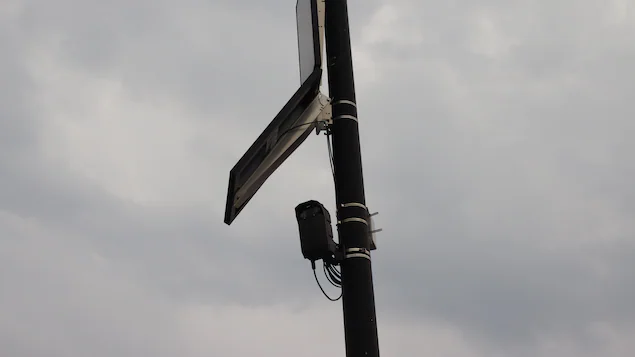
A high-tech camera was spotted by a Radio-Canada reporter in Montreal's Rivière-des-Prairies neighbourhood on Monday. It was quickly taken down on Wednesday.
Photo: Radio-Canada / Charles Séguin
Benjamin Shingler (new window), Gabriel Guindi (new window) · CBC News ·
Montreal police are quietly growing their network of AI-powered tools to track vehicles and people across the city, raising questions about public transparency and privacy rights.
A high-powered camera able to scan and identify vehicles was spotted earlier this week by a Radio-Canada reporter, on a lamp post along Henri-Bourassa Boulevard in Montreal’s Rivière-des-Prairies neighbourhood.
It was quickly taken down on Wednesday, after Radio-Canada published an article (new window) about the camera.
The device used was a Cloudrunner CR-H2, manufactured by Montreal-based company Genetec, the Service de police de la Ville de Montréal (SPVM) later confirmed.
Similar to the controversial (new window) Flock Safety cameras widely used in the United States, the system does more than scan licence plates.
It also captures and stores specific vehicle characteristics, including colour, make and model, according to the company’s website (new window).
While Flock cameras in the U.S. share data in a central database accessible to multiple police forces, Genetec's system differs in that the collected information is managed by its specific operator.
SPVM spokesperson Marc-Antoine Bélanger told CBC News that access to the captured images is used exclusively for the investigators in charge of the targeted work.
Bélanger said in an email that the camera was removed to "preserve our ongoing investigative strategies."
He said the SPVM intentionally keeps its technological tools secret so as not to hinder complex investigations.
"Investigative techniques, including the means and technologies used, are governed by clear rules from the courts and constitute privileged information," Bélanger said.
But privacy advocates say there has been a lack of transparency in rolling out new technology.
Dominique Peschard, a spokesperson for the Ligue des droits et libertés, a Quebec human rights group, said police need to keep the public informed about the kinds of tools they are using — and can do so without compromising their work.
"We're not asking what they are doing in detail, but what are the procedures?" Peschard said in an interview.
"Investigative techniques are getting more and more invasive with technology. You need more and more oversight to make sure it doesn’t go overboard and infringe on our Charter rights."
SPVM spokesperson Anik de Repentigny said iMotion ROC AI software is being used to help investigators sift through massive amounts of video, but denied that the force is using the software's facial recognition or biometric capabilities.
The use of the Cloudrunner cameras is part of a broader push by the SPVM into AI-driven technology.
The SPVM confirmed it is using iMotion ROC AI software, developed by Rank One Computing.
SPVM spokesperson Anik de Repentigny told CBC News the software is being used to help investigators sift through massive amounts of video, but denied that the force is using the software's facial recognition or biometric capabilities.
"This software will not be used to verify the identity of individuals in video images, but rather to identify the video passages where the targeted known element appears," de Repentigny said in an email to CBC earlier this year.
De Repentigny added that the system operates on a closed network offline from external databases.
The software analyzes footage from the SPVM's 46 marked urban security cameras, as well as private residential and commercial surveillance video manually collected by officers with citizen consent or a warrant.
An internal privacy impact assessment by the SPVM, obtained by CBC News through an access-to-information request, acknowledges the technology poses civil liberties risks, including the potential to put innocent bystanders under investigation and the risk of discrimination based on visible social characteristics.
The assessment, prepared in 2023, also says the risk of discrimination would be reduced because the software would be configured to search for objects — giving the example of a red coat or green bike — rather than identifiable traits such as ethnicity.
The SPVM’s admission about the Cloudrunner camera on Wednesday came after a morning of confusion.
Montreal police Chief Fady Dagher initially indicated he had no knowledge of the device on Wednesday morning. Later in the day, Dagher clarified his earlier comments, stating he was distracted by separate news regarding alleged racism at a Montréal-Nord police station.
The chief confirmed the device belonged to the SPVM and was being used to target armed violence and vehicle thefts. Peschard said it was "striking" that the chief didn’t seem to be aware the SPVM was using the technology.
"Whenever new investigative tools are used, it should be under supervision of the leading staff of a police department," he said. "It’s their responsibility to make sure there are protocols and people’s private information is protected."
Public records show that last October, Montreal awarded a $17,134 contract with Genetec to obtain four Cloudrunner units on a one-year subscription.
While only one camera was spotted and removed, Bélanger told CBC News that more cameras could be added depending on the needs of investigations tackling armed violence, motor vehicle thefts and violence against merchants.
Andrew Elvish, vice-president at Genetec, said the technology is designed to respect people’s privacy and every interaction with the data gathered is logged.
"You should have an expectation of reasonable privacy," he said, then added, "it’s a trade off. If the threat of something bad happening is high, as a community, what are we comfortable with giving up to ensure that the community is safe?"
In response to a request for comment, a City of Montreal spokesperson said it had not installed the Cloudrunner camera, and referred questions about its deployment to the SPVM.
During last fall’s election campaign, Montreal Mayor Soraya Martinez Ferrada championed the creation (new window) of a "voluntary" security camera registry that would allow officers to map out the locations of residents’ home closed-circuit television cameras.
In Quebec, the Commission d'accès à l'information (new window)mandates that video surveillance in public spaces by public bodies must address a "legitimate, important, urgent and real objective" and urges organizations to only collect images necessary to solve a targeted problem.
Jean-François Latreille, a lawyer specializing in data security and privacy, said the use of such tools must be tightly restricted.
If not, he said, "the individual will lose control over his privacy, at least in the public domain."
Related Stories
 Canada
Albertans head to polls in historic referendum on whether they want to stay in Canada
2 days ago
 Canada
In the news today: four soldiers killed, Alberta referendum, AI privacy fears
2 days ago
 Canada
How a grass fire at a Canadian military base killed four soldiers
2 days ago
 Canada
How will household electricity rebate reduction, temporary winter pricing change impact Ontarians?
2 days ago
 Canada
Residents told to boil tap water due to bacteria
2 days ago
 Canada
Oil
2 days ago
 Canada
Albertans vote on path to independence as Carney fights to keep Canada united
2 days ago
 Canada
Two of 4 soldiers killed in fast
2 days ago