
Métis leader, residential school survivor Louis Gardiner remembered for decades of advocacy
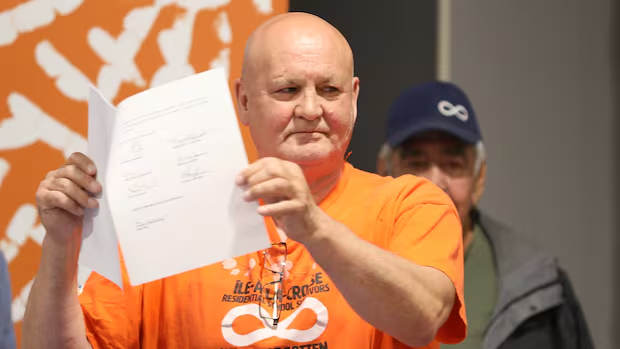
Métis leader, residential school survivor Louis Gardiner remembered for decades of advocacy
Family announced his death on Sunday
The death of Métis leader, residential school survivor and advocate Louis Gardiner has shocked many in Saskatchewan.
Gardiner, widely known as "Big Lou," died suddenly over the weekend. His family announced his death in a Facebook post early Sunday morning.
Gardiner was a longtime leader of the Métis Nation–Saskatchewan (MN-S), which represents the province's Métis citizens.
"He was always there. He sacrificed his personal time, his family time, and he did the job. He stood tall for all of us," said Brennan Merasty, Métis Nation–Saskatchewan's minister responsible for self determination, self government and regional representative for Northern Region 3.
Merasty was at the tail end of a Métis rights and engagement gathering at South Bay War Veterans Park when he woke up to the news Sunday morning.
He said he could feel goosebumps spread throughout his body as the realization set in.
"If you knew Louis, you knew he was unstoppable and a guy that you wouldn't think would go so soon, even though he was in his early 70s," Merasty said.
Gardiner made an impact on many communities across the province through his work as an advocate and leader.
"He was a leader that led with action, not just empty words," Merasty said.
The MN-S shared its condolences in a statement on Sunday. Buckley Belanger, Saskatchewan's sole Liberal MP, was also among those who spoke out about Gardiner on the weekend.
Fight for residential school survivors
Gardiner was the primary driver in a class action lawsuit filed in 2023 on behalf of Île-à-la-Crosse residential school survivors. The school's former students had originally been denied inclusion in the federal Indian Residential School settlement.
The school housed around 1,500 children from northern Saskatchewan — most of them Métis — who were forced to attend from the 1860s to the 1970s.
Gardiner was one of those children.
He attended the school beginning in 1961, when he was just five years old, and spent nearly a decade there.
Those experiences would help fuel decades of advocacy, as Gardiner pushed for recognition and compensation for survivors of the school.
Just this April, former students reached a settlement in their lawsuit against the federal government.
Survivors or their families will receive a combined $27.3 million in experience payments. The settlement also includes a $10-million legacy fund for the community.
For those who worked alongside Gardiner, the timing of his death makes the loss even more painful.
"Louis won being a lead plaintiff for the residential school [but] won't see payment because he passed before anything could be delivered," Merasty said.
"So that's unfortunate, very unfortunate, because I know so many fought hard to stay alive to see their day. And unfortunately Louis won't be able to receive that. But I know and I'm positive his family will."
Gardiner's legacy went beyond his advocacy work. He was also a well-known figure in the province's hockey community. He played junior hockey with the Flin Flon Bombers and continued playing recreationally right up until his death.
"It's sad because we lost a hockey icon," said Milton Tootoosis, who first heard Gardiner's name in the early '70s while attending the North Battleford Indian and Métis Friendship Centre All Native Senior Hockey Tournament.
"When you go to tournaments, you hear in the stands, people talking about their favorite players and who kind of stands out, and Louis Gardiner was indeed one of those," Tootoosis said.
Years later, he found himself playing alongside Gardiner with the River Cree Falcons.
Tootoosis remembers him as "cool, calm and collected," but also intensely competitive.
"He often wore the captaincy of teams he played for," he said.
Gardiner always proudly represented his culture on the ice and would choose to speak Cree over English whenever he could, Tootoosis said.
"That's how striking he was — very different than probably 99 per cent of the native hockey players that I played with or got to know."
He believed Gardiner had the talent and physical tools to play professional hockey, but racism stood in his Way, Tootoosis said.
"Louis fell victim to that," he said.
"He's an example of what's happened to so many First Nations."
For those who knew Gardiner, his death does not mark the end of the issues he spent his life fighting for.
Merasty said his legacy will continue through the people and communities he inspired.
"We keep it alive because we keep fighting. We keep pursuing our rights. And that's what he strongly believed in."
Aliyah Marko-Omene is a reporter for CBC Saskatchewan. She has previously worked for CBC and Toronto Star in Toronto. You can reach her at aliyah.marko@cbc.ca.
Related Stories
 Canada
Winter snowfall across Canada may fall victim to El Niño
25 minutes ago
 Canada
Richmond mayoral debate on CKNW
1 hour ago
 Canada
OPP officer accused of accessing, possessing child pornography makes first appearance
1 hour ago
 Canada
Toronto
2 hours ago
 Canada
Road closure warning after crash
2 hours ago
 Canada
Canada's future 'will be decided by Canadians': Carney on foreign interference
3 hours ago
 Canada
Ottawa considering ‘options’ as foreign home buyer ban nears end: minister
3 hours ago
 Canada
Harry says he 'slipped into depression' after leaving UK for Canada
3 hours ago