
Lionel Messi has spent 63% of this World Cup walking
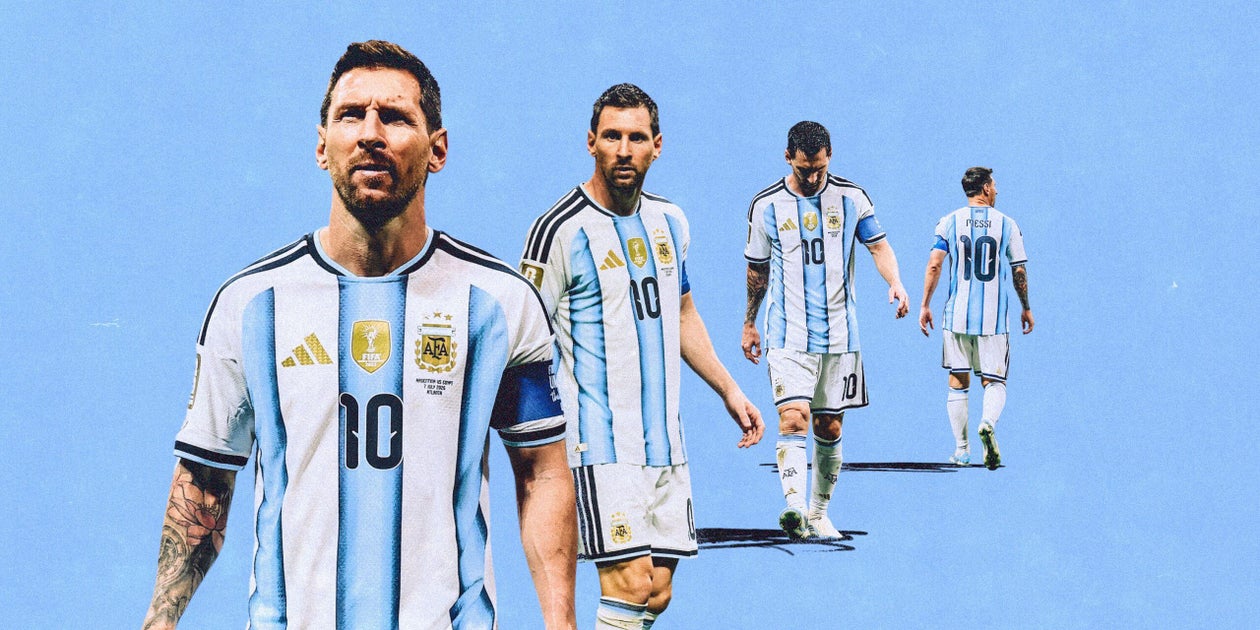
The Athletic has live coverage of Argentina vs Switzerland in the 2026 FIFA World Cup quarterfinals.
The best players make soccer look like a walk in the park. For Lionel Messi, it often is.
Argentina’s 3-2 comeback victory against Egypt in the round of 16 took an emotional toll, with Messi uncharacteristically bursting into tears after the final whistle. Physically, though, he hardly broke a sweat.
As in every game he has played at this tournament, Messi spent most of it walking. Walking has accounted for 63 per cent of his movement across the World Cup, a share that is far clear of any other outfield player in the competition.
And even these strolls were among his more energetic movements, with Messi spending a further 25 per cent of the match simply standing still. Occasionally, 8.6 per cent of the time to be precise, he breaks into a jog, lagging far behind the tournament average of 23 per cent, while he rarely accelerates into a sprint.
It is tempting to put this down to age: a 39-year-old carefully managing his body, conserving his energy for the most decisive moments. But while he no longer has the same explosiveness over short distances, ambling about has always been part of Messi’s game. In 2024, he told Clank Media that, when asked to do running drills for his Argentinian boyhood side Newell’s Old Boys, he “used to hide behind a tree”.
But behind that idleness lies a ruthless efficiency. Messi ranks third for touches in the attacking third, has created the third-most big chances with 15, and, alongside Kylian Mbappe, leads the race for the Golden Boot with eight goals.
The volume of Messi’s walking starts to make more sense when you look at where those steps are taken. While he can be seen patrolling across the length and width of the pitch, the heatmap below, using FIFA’s tracking data, shows that his walking is most concentrated in that familiar inside-right pocket between the centre circle and the penalty area.
That is where Messi is at his most dangerous, able to take the ball on the turn and drive at the back line. Before the quarter-finals, he had received the ball 97 times between the opposition’s midfield and defensive lines, the sixth-highest total in the competition.
Not wanting to draw attention or be pulled outside his favoured area, Messi creates space here through subtle adjustments rather than explosive sprints. Rather than making the run himself, he lets his team-mates move the defence for him.
Against Cape Verde, Argentina attack down the right, with the quick runs around Messi dragging the back line across to that side. As the defence shifts one way, Messi simply takes two steps in the opposite side. He is now free, positioned almost equidistant from four players, but without any one defender having clear responsibility for him.
Raphael Varane, the former Real Madrid, Manchester United and France defender who played against Messi 21 times, including the 2022 World Cup final, told The Athletic that Messi is a master at drifting into these areas of uncertainty.
“You really have to communicate a lot with team-mates to know who should do what,” he said. “Messi’s speciality was walking in areas where you don’t know who should defend (him). Is it the midfielder? Is it the full-back? Is it the (central) defender?”
That perceptiveness, knowing when defenders’ attention has been pulled elsewhere, is especially useful when Argentina attack at speed. With runners bursting beyond him and defenders forced into recovery runs, Messi hangs back, waiting for space to open at the edge of the box.
It was how he scored his opening goal in Argentina’s 2-0 group-stage win over Austria, sauntering to the edge of the D unnoticed while defenders scrambled back to pick up runners in behind, before applying a trademark finish.
That ability to escape detection at walking pace also helps Messi beat the offside trap. When defensive lines push up, he is in no rush to return onside, choosing instead to linger out of view as he drifts back into position.
Once defenders have lost track of him, he makes one sharp movement to return onside before darting in behind, as he did for his goal against Cape Verde, stealing a blindside run on centre-back Diney before latching onto Lisandro Martinez’s flighted pass.
That run captures one of the main reasons Messi’s walking is so dangerous: it lulls opponents into a false sense of security, and when he does burst forward, defenders are left flat on their heels.
Before Manchester City’s match against Barcelona in 2016, Messi’s former coach Pep Guardiola outlined that dynamic. “It looks like he’s just ambling around and maybe he’s the guy who runs least in the Spanish league but, boy, when that ball reaches him, he knows the complete time-space X-ray of who is where. Then… pow!” said Guardiola.
These selective, sudden bursts are kept for the moments when Messi can do the most damage. The plot below shows that when Messi does run, he is almost always moving forward. Of his runs with Argentina in possession, 71 per cent have ended in the final third and 21 per cent in the box.
Rene Meulensteen, Australia’s assistant coach when they faced Argentina at the 2022 World Cup, experienced this first-hand. “He spent 80 per cent of his time just wandering in our match and comes to life in the final third where he knows he can do something that matters,” he told The Athletic.
One such burst is shown below from the Cape Verde game, where Messi sidles up to the edge of the box before a sudden acceleration catches midfielder Kevin Pina by surprise, leaving him grasping as Messi gets a shot off inside the area.
Given how dangerous Messi can be even at walking pace, defenders might be tempted to get touch-tight and smother him completely. But as former Arsenal defender William Gallas, who played against a young Messi for Barcelona and Argentina, explained, it is not so simple.
“Even if he was walking, what you wouldn’t want as a defender is for him to receive the ball, so you would think about getting close to him,” he told The Athletic. “But if you get close to him, he has already won that battle because if he doesn’t get the ball, you’ve allowed space behind you to be created and that’s exactly what he wants.”
An example of that perilous trade-off is shown below. Diney tries to step up aggressively on Messi, only for Messi to peel away into the space vacated by the centre-back, run onto Lautaro Martinez’s pass and go one-vs-one with goalkeeper Vozinha.
Above all, Messi’s stillness plays into his preternatural game intelligence, giving him the calm perspective to digest the chaos around him and identify the vulnerabilities he can attack. Guardiola has talked about how Messi uses the opening 10 minutes to stroll about, building a mental picture of the game in front of him.
Yet in Argentina’s 3-2 victory over Egypt, Messi showed that he is constantly recalibrating that mental map throughout the course of the game. With his country two down with 15 minutes remaining, Messi, from his usual detached vantage point, plotted a new route through Egypt’s defence, one that felt like a throwback to his earliest days.
As the heat maps below show, Messi’s early Barcelona career saw him operate as a dribble-heavy, touchline-hugging winger before he gradually moved into a more advanced, infield position. He turned the game by shifting back to the wing and, although he no longer possesses the same explosiveness, his dribbling ability remains elite, with Egypt’s left flank unable to cope.
It was another example of Messi adapting his movement to the ebb and flow of the game. When Argentina are struggling to build, Messi drops deep to inject quality into their play. His movement can look sluggish, but it is never predictable.
Messi’s walking does come with a cost out of possession. Modern tactics often demand aggressive collective pressing from the entire team, something Messi does not offer, nor is he especially active when it comes to tracking back either. That leaves his team-mates with a greater defensive burden, but as Pablo Zabaleta — Messi’s former international team-mate and now part of FIFA’s Technical Study Group for the summer — told The Athletic, it is a cross that they are more than willing to carry.
“If the strikers need to run twice as much, they will do that,” he said, recalling that when he played with Messi, “he would bring those moments of magic” on the ball. Preserving Messi for those critical attacking moments far outweighs the need for extra defensive cover.
To an untrained onlooker, Messi’s strolling carries the aloof detachment of a disinterested player on the fringes. But that is exactly what he wants you to think. Behind those long stretches of inactivity lies a mind as quick as ever, ready to pounce.
Related Stories
 World
World
Manchester United weigh up stunning move for Real Betis and ex-Tottenham forward Troy Parrott
3 days ago
 World
World
Israeli police arrest 10 following weekend attacks by settlers on journalist and diplomats
3 days ago
 World
World
Trump says suspension of Russia sanctions is to keep peace negotiations going
3 days ago
 World
World
Ukrainian drones strike St. Petersburg oil facilities | NHK WORLD
3 days ago
 World
World
Victoria Falls stadium in Zimbabwe nears completion for CWC27
3 days ago
 World
World
‘The world will be amazed:’ Iran’s commanders prepare for further war
4 days ago
 World
World
Festival opens with musket salute in Sakai, Osaka
4 days ago
 World
World
Trump's new pitch for Republican candidates — they're really good
4 days ago