
Leadership in Digital Health: How to Transform Hospitals Through Technology, Data, and Artificial Intelligence

Leadership in Digital Health: How to Transform Hospitals Through Technology, Data, and Artificial Intelligence
Digital transformation is profoundly changing the way hospitals are designed, managed, and operated. However, technology alone does not guarantee better outcomes. Leadership is needed to integrate data, artificial intelligence, connectivity, cybersecurity, and clinical processes into a unified strategy aimed at improving healthcare. Gonzalo shares his perspective on the challenges and opportunities facing hospitals in this new era, where the ability to make data-driven decisions, protect clinical information, and implement more efficient care models has become a key element for the future of healthcare.
Pre-sales Engineer in the Healthcare Sector
Leadership in digital health involves using technology, data, and artificial intelligence to build hospitals that are more efficient, safer, and focused on patients and healthcare professionals.
What is digital health leadership, and why is it key for the hospitals of the future?
Digital health leadership is the ability to drive the technological transformation of hospitals and healthcare organizations to improve care, operational efficiency, and the patient experience through the use of data, artificial intelligence, and new digital infrastructure.
Because the hospital is no longer just a healthcare facility—it has become a critical digital infrastructure. Pressure on the healthcare system, an aging population, chronic conditions, and the need to make the system more sustainable require the design of hospitals where connectivity, data, security, spaces, and clinical processes are integrated from the outset. Technology enables the hospital to function as a smart ecosystem: it collects data, manages it, shares it securely, and uses it to improve care, optimize resources, and anticipate needs.
How does digital leadership help improve the quality of care?
Digital transformation in healthcare requires leaders capable of incorporating technology in a way that delivers real value to patients and healthcare professionals.
From a patient care perspective, technology helps improve the quality, safety, and continuity of care. It enables the integration of clinical and operational information, reduces response times, prioritizes cases, automates repetitive tasks, and frees up healthcare professionals’ time for activities of greater clinical value. It also facilitates hybrid care models, telemedicine, remote monitoring, coordination across levels of care, and clinical decision support through artificial intelligence, advanced medical imaging, and data analytics.
How Can Leadership in Digital Health Improve the Patient Experience?
The patient experience has become one of the key indicators of success in healthcare transformation processes.
For patients, the impact translates into a simpler, more accessible, safer, and more personalized experience. Digitization enables streamlined admissions, appointment scheduling, information kiosks, digital signage, wayfinding within the hospital or on campus, real-time information, and connected patient rooms. Additionally, remote monitoring, teleconsultations, and digital services facilitate follow-up care outside the hospital, reduce unnecessary travel, and improve continuity of care—especially for patients with chronic conditions, the elderly, or those with complex needs.
Why Do Healthcare Leaders Need to Make Data-Driven Decisions?
Modern hospital management requires real-time visibility into resources, infrastructure, and care processes.
Yes. Technology has a direct impact on a hospital’s operational efficiency. It provides real-time insights into space occupancy, the location of patients and assets, operating room usage, energy consumption, patient flow, resource availability, and the status of critical infrastructure.
With IoT, sensors, BMS, analytics, and dashboards, hospital management can make data-driven decisions, reduce costs, anticipate incidents, improve planning, and move toward more sustainable and resilient hospitals.
Which medical specialties are leading the digital transformation in hospitals?
Digitization affects all hospital departments, although some specialties show a higher level of technology adoption.
It affects the entire hospital across the board, but has a particular impact on the most digitized specialties (such as diagnostic imaging, pathology, and laboratory services) and the areas with the highest financial costs (such as oncology, operating rooms, and emergency departments). It also transforms areas that are not strictly clinical but are essential to hospital operations, such as admissions, logistics, security, maintenance, energy management, internal mobility, patient care, and coordination between facilities.
What leadership challenges does the technological transformation of hospitals pose?
Hospital digitization involves technological, organizational, and cultural challenges that require long-term strategic planning.
The main challenge is that technology must be integrated into highly demanding, mission-critical care processes involving multiple legacy systems and the need for permanent operational continuity. Added to this are interoperability, data protection, IT/OT/IoMT cybersecurity, change management, professional training, and the critical need to design the technological infrastructure from the project’s earliest stages. In a new hospital, failing to properly design the digitization plan as an integral part of the architectural project can limit the facility’s capacity for technological evolution for decades.
Which technologies should lead the evolution of the smart hospital?
Data has become the primary strategic asset of digital healthcare.
Data is at the core of the new healthcare landscape: protecting, governing, and bringing intelligence to the point of care are the key objectives of our technologies. Protection involves strengthening continuity of care and cyberresilience through 24×7 managed SOC services, monitoring of critical systems and connected medical devices, IT/OT segmentation, Zero Trust, NIS2/ENS compliance, and incident response capabilities. Governance means moving toward Healthcare Data Spaces that enable the sharing of clinical, imaging, genomic, or operational information under common rules—without losing control of the data—while ensuring interoperability, data sovereignty, traceability, and alignment with European regulatory frameworks. And bringing intelligence closer means deploying Cloud Edge capabilities to process healthcare data near the point of care and enable use cases based on artificial intelligence and advanced monitoring.
How should healthcare leaders prepare to integrate diagnostic artificial intelligence?
Diagnostic artificial intelligence requires a solid foundation of data, interoperability, and technological infrastructure.
Diagnostic AI will play an increasingly important role in supporting clinical decision-making: early detection of radiological findings, automatic triage of urgent studies, quantification of imaging biomarkers in oncology, or diagnostic support in digital pathology. But all that potential depends entirely on something that is often overlooked: the quality, accessibility, and governance of the imaging data used to train and apply that AI.
An AI algorithm is useless if it can only access studies from a single, isolated hospital, with inconsistent formats or without traceability of origin.
Underpinning diagnostic AI is the need for a centralized and standardized image repository, true interoperability between centers, cloud infrastructure with computing capacity, and a data governance framework that ensures traceability, anonymization when appropriate, and regulatory compliance.
What leadership challenges does the expansion of digital pathology and medical imaging present?
Managing large volumes of clinical information will require a redesign of infrastructure and processes.
Digital pathology represents a different scale of expansion than conventional radiology: a single scanned slide can generate files of several gigabytes, compared to the megabytes of an X-ray. This radically changes the requirements for storage, bandwidth, and remote viewing capabilities.
In addition, specialties such as dermatology, ophthalmology, and cardiology are increasingly incorporating digital imaging into their diagnostic workflows, which multiplies the total volume of studies that a hospital or network of facilities must store, distribute, and protect.
Why has cybersecurity become a strategic responsibility for hospital leaders?
Continuity of care depends increasingly on the protection of systems, networks, and clinical data.
In a hospital, physical security has always been deeply ingrained, but logical security has become equally—if not more—critical. Today, virtually all healthcare activity depends on digital systems, and an interruption in those systems can directly impact clinical operations.
Added to this is the fact that clinical data is one of the most sensitive assets in existence. As a result, protecting health information has become an indispensable requirement for providing reliable healthcare.
How can healthcare leaders protect connected medical devices?
The growth of IoMT (Internet of Medical Things) devices demands new security strategies.
In recent years, hospitals have become filled with network-connected medical devices that previously operated in isolation. This connectivity provides significant clinical benefits, but it also expands the technological attack surface.
That is why it is essential to segment networks, maintain up-to-date inventories, monitor devices, and apply advanced security principles to properly manage technological risk.
The transformation of hospitals demonstrates how technology can help improve essential services for society. Through advanced networks, connectivity, the cloud, artificial intelligence, cybersecurity, and data-driven solutions, Telefónica works to facilitate access to digital technologies and help build a more efficient, secure, connected, and people-centered healthcare system. In this way, Telefónica takes on the undeniable challenge of becoming the best gateway for citizens to access digital technologies.
What is leadership in digital health?
It is the ability to drive the technological transformation of hospitals and healthcare organizations to improve care, efficiency, and the experience of patients and professionals.
It is a healthcare infrastructure that integrates data, connectivity, artificial intelligence, and clinical processes to optimize healthcare.
How does artificial intelligence help hospitals?
It supports clinical decision-making, analyzes medical images, improves diagnoses, and optimizes resources.
Why is clinical data important?
Because it improves decision-making, drives interoperability, and facilitates the development of artificial intelligence models.
What is the main challenge of digital transformation in hospitals?
Integrating technology, processes, and people while maintaining security, continuity of care, and regulatory compliance.
Digital Leadership: How to Influence, Drive Innovation, and Deliver Results Without Hierarchical Authority
Leadership in Times of Change: How to Turn Uncertainty into Personal and Professional Growth
Leadership and Innovation: How to Build an Innovative Culture
Contact our communication department or requests additional material.
Related Stories
 AI News
OpenAI engineer arrested, accused of planting listening device inside company's office
35 minutes ago
 AI News
Helsinki’s Ambio raises €5.1 million to scale its AI-powered recycled plastics procurement platform
38 minutes ago
 AI News
Only 6.7% of Indian companies have scaled AI across workflows, 59% face hurdles
39 minutes ago
 AI News
Forvia brings artificial intelligence into its executive committee with Raphaël Viard
39 minutes ago
 AI News
MI5 tackling more state threats than during Cold War, warns intelligence chief
1 hour ago
 AI News
Natural language security queries at Orca Security using Amazon Bedrock
1 hour ago
 AI News
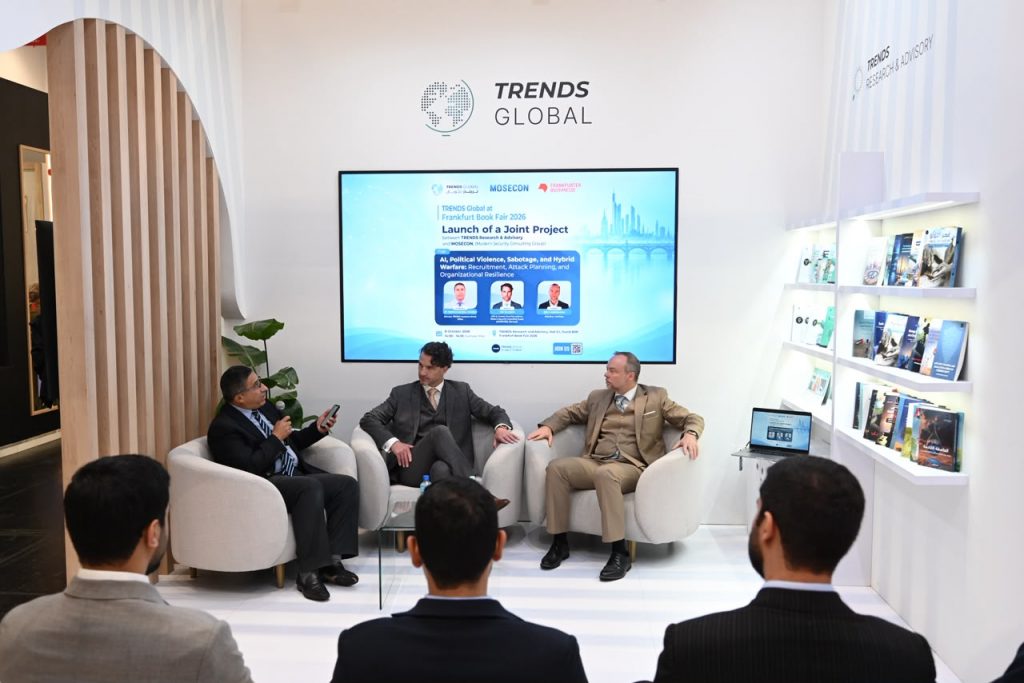
In Partnership with the German Modern Consulting Group MOSECON.. TRENDS Launches Research Project in Frankfurt on “Artificial Intelligence, Political Violence and Hybrid Warfare”
1 hour ago
 AI News
IMF warns about major economic risks and a ‘disorderly’ rise in bond yields
2 hours ago