
KAIST, Georgia Tech Unveil Energy
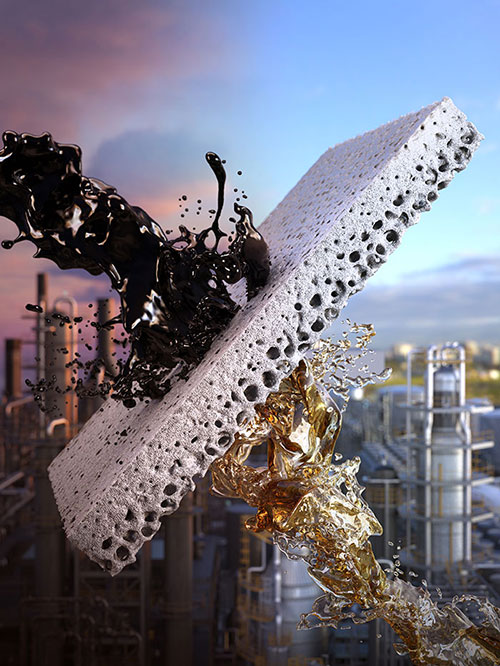
< Simple synthetic membrane supports yield surprisingly selective separation of real crude oils at steady state. Credit: KAIST >
An international research team led by KAIST has developed a membrane technology that could significantly reduce the energy required for crude oil refining by replacing part of the century-old distillation process.
KAIST(President Kwang Hyung Lee) announced that a team led by Professor Dong-Yeun Koh of KAIST, in collaboration with Professor Ryan Lively's group at Georgia Tech, demonstrated a simple and inexpensive membrane capable of separating crude oil at room temperature without heating. The research was published in Nature, one of the world's leading scientific journals.
Crude oil underpins modern life by providing not only transportation fuels but also essential feedstocks for plastics, packaging materials, textiles, and countless consumer products. Because the cost of refining directly influences the price of these products, technologies that reduce refining energy consumption can generate substantial economic and environmental benefits.
Traditionally, refineries separate crude oil through distillation, a process that heats crude oil above 350 °C to vaporize it and then cools the vapor to recover different fractions. Globally, crude oil distillation consumes approximately 1,100 terawatt-hours (TWh) of energy each year—equivalent to the annual output of about 130 nuclear power plants, each at gigawatt scale, operating continuously. As a result, distillation remains one of the largest sources of energy consumption and greenhouse gas emissions in the refining industry.
At the same time, increasing cost pressures in global petrochemical markets have intensified the need for more energy-efficient separation technologies.
Membrane-based crude oil fractionations have attracted increasing attention as a potential alternative. However, conventional wisdom has held that molecularly precise separation requires an ultrathin selective layer coated onto the membrane surface. While effective, such coatings increase manufacturing costs and are prone to defects when scaled to large areas, limiting industrial deployment.
To overcome this challenge, the researchers took a radically different approach. Instead of relying on a specialized coating, they passed crude oil directly through a bare porous polyacrylonitrile (PAN) membrane—a chemically stable and inexpensive polymer commonly used as a support material in industrial membranes.
As crude oil permeated through the membrane, heavy hydrocarbons selectively deposited on the pore walls, gradually narrowing the pores and creating self-assembled separation channels smaller than 2 nanometers. Rather than relying on a specially engineered coating, the crude oil itself created the nanoscale pathways needed for precise molecular separation.
Through these self-formed channels, lighter fractions such as naphtha, gasoline, and kerosene permeated rapidly, while heavier components were effectively retained. In a surprising reversal, membrane fouling—normally regarded as a performance-degrading phenomenon—became the very mechanism that enabled highly selective separation.
The bare PAN membrane delivered crude oil permeation rates approximately 23 times higher than those of previously reported state-of-the-art crude oil membranes while maintaining stable performance for 28 consecutive days.
Professor Ryan Lively (Georgia Tech) commented "one of the key challenges facing membrane systems for crude oil separation was the low productivities of the membrane units – the PAN membranes with their surprising separation mechanism – dramatically increase the productivity of the membrane unit, to the point where industry should seriously consider adopting the technology."
Importantly, the technology can be integrated into existing refinery infrastructure as a modular filtration unit, avoiding major equipment replacement and reducing barriers to industrial adoption.
Process simulations showed that using the membrane as a pretreatment step before conventional distillation could reduce energy consumption by 31.6%, carbon dioxide emissions by 37.6%, cooling water usage by 20.7%, and operating costs by 36%.
If adopted throughout Korea's refining and petrochemical sector, the technology could reduce greenhouse-gas emissions by approximately 10 million tonnes annually—equivalent to the emissions of roughly four million internal combustion vehicles.
Beyond crude oil refining, the membrane platform could be applied to a broad range of chemical separation processes, including the purification of pyrolysis oil derived from waste plastics, the recovery of solvents used in battery manufacturing, pharmaceutical purification, and biofuel production. The researchers believe the technology could serve as a versatile platform for next-generation molecular separations across multiple industries.
Professor Dong-Yeun Koh of KAIST said, "This study reveals a new scientific principle in which a membrane interacts with a complex mixture and spontaneously forms its own separation channels. Working with real crude oil supplied by HD Hyundai Oilbank allowed us to validate the technology under conditions relevant to industrial operation."
Professor Jae W. Lee of KAIST, a co-corresponding author of the study, added, "By advancing large-area membrane modularization and long-term operational reliability, we hope to broaden the adoption of membrane-based processes throughout the refining and petrochemical industries."
Dr. Jihoon Choi and Dr. Hyeokjun Seo of KAIST, the study's co-first authors, said, "Our goal is to precisely control this spontaneous pore-constriction phenomenon and develop it into a membrane platform applicable to the entire refining process. We also aim to expand the technology to plastic recycling, biofuel purification, and other sustainable chemical processes that support carbon neutrality."
The study was co-first-authored by Dr. Jihoon Choi and Dr. Hyeokjun Seo of KAIST and was published online in Nature on June 24, 2026.
Paper Title: Crude Oil Fractionation by Means of Mesoporous Polyacrylonitrile Membranes
https://www.nature.com/articles/s41586-026-10677-3
This research was supported by the Ministry of Science and ICT of Korea through the Basic Research Program for Outstanding Early-Career Researchers and the Engineering Research Center (ERC) Program.
Related Stories
 Technology
When Tech Companies Die, What Happens To The Products They Leave Behind?
5 days ago
 Technology
Two Finns supplying Russia with missile tech worth tens of millions
5 days ago
 Technology
Drones with pepper spray, four
5 days ago
 Technology
Micron Technology stock pre-market at EUR 800.50: memory storage - ad
5 days ago
 Technology
TAIEX Ends at 4
5 days ago
 Technology
ZAWYA: Technology, start-ups can double India
5 days ago
 Technology
Czech government to consider CZK 1 billion fund for startups
5 days ago
 Technology
GDIN Supports Eight Startups at CEATEC 2026 in Japan, Opens Door to Local Investor Collaboration
5 days ago