
Japan’s AI transition faces stumbling blocks
Japan is beginning to feel the labour shortages brought about by rapid population ageing, even as the economy shows faint signs of emerging from its long stagnation. Sustaining productivity growth under these demographic constraints requires paying due attention to the transformative potential of artificial intelligence (AI).
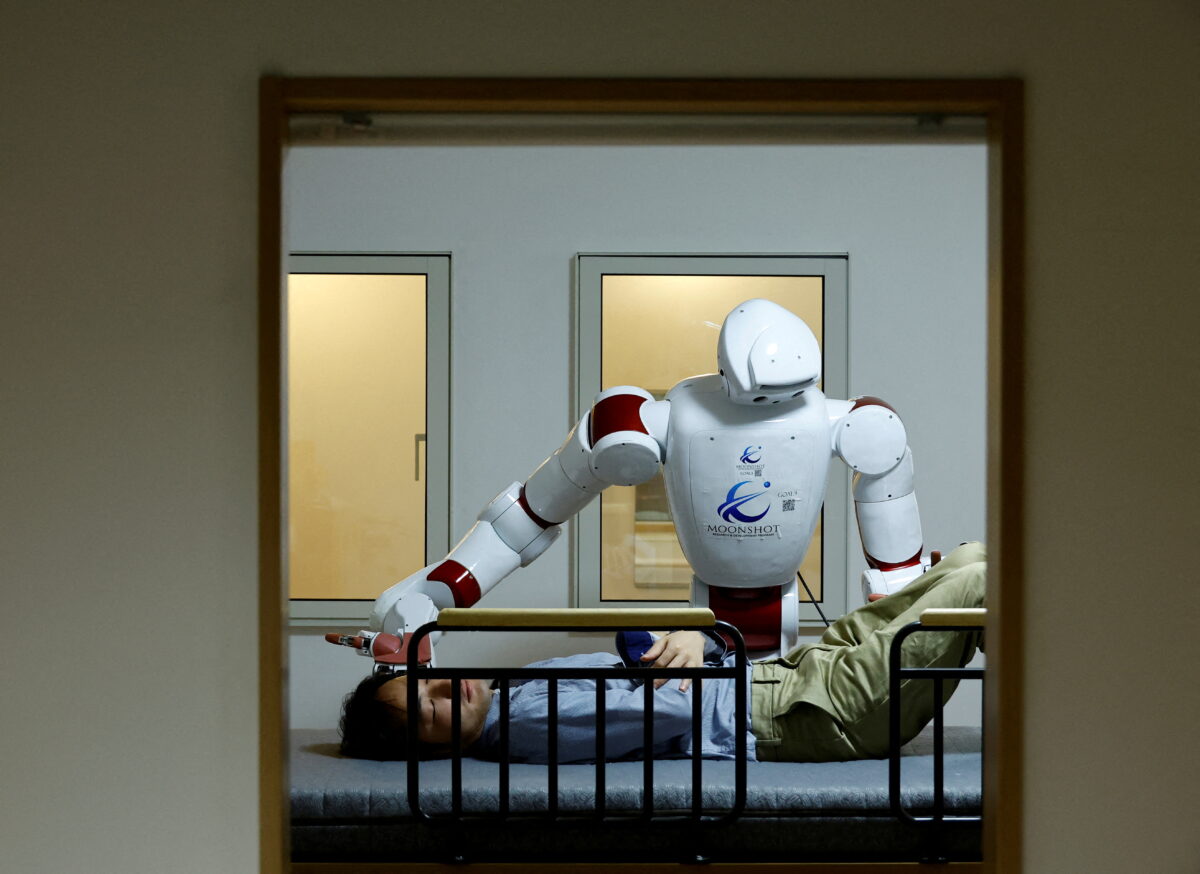
Unlike earlier waves of mechanisation like the 18th century Industrial Revolution, this technological change is not simply a substitution of capital for labour. It involves physical AI in manufacturing, logistics and eldercare, as well as vertical AI specialised in finance, healthcare and public administration. Task-level AI can also be embedded across corporate workflows.
Technology, labour and education policies all frame AI as a lever to confront demographic decline. Technology policy — exemplified by Japan’s ‘Society 5.0’ strategic vision — positions digitalisation and AI as engines of productivity growth and as a new industrial strategy to raise total factor productivity. Labour policy, recognising that Japan’s female and elderly labour force participation rates are already among the highest in advanced economies, expects AI to qualitatively enhance labour utilisation by assisting remote workers and digital workflows. Education policy emphasises AI literacy, digital skills and reskilling — though training systems often appear rooted in outdated institutional models.
But AI’s capacity to substitute for labour is not unlimited. Certain forms of human work — education, interpersonal services and caregiving — are expanding in an ageing society and require trust, empathy and complex social judgment. Full automation is difficult and human presence remains indispensable. Historically, innovations such as information technology required long periods before productivity gains materialised, as workflows, management practices and worker motivation adapted. AI is unlikely to be an exception. Effective use of AI also requires workers capable of managing entire processes leading to desired outputs, and cultivating such talent cannot be achieved overnight.
The diffusion of AI depends not only on technology itself but also on the institutional foundations that enable firms and workers to absorb it. Japan’s core challenge lies in two mutually reinforcing barriers — a weak competitive environment among firms and structural deficiencies in higher education. These dual constraints form negative feedback loops that suppress investment, limit talent formation and ultimately slow AI adoption.
The first barrier is stagnant competition among firms. Japanese firms have been slow to adopt AI even for basic tasks such as translation, document drafting and coding. Since the ‘lost decade’ of the 1990s, the share of loss-making firms has increased from 40–50 per cent to 60–70 per cent. A variety of subsidisation policies shaped by political considerations keep these firms alive, but have inadvertently reinforced this productivity stagnation. Many of these firms — especially small- and medium-sized enterprises — operate with outdated business models and lack the capacity to invest in AI.
Even in the United States, where concerns about AI-driven job displacement are widespread, broad-based job losses have not occurred. Employers value stability, and large-scale displacement is neither economically nor politically desirable. If job destruction has been limited in the United States, it is even less likely in Japan, where AI adoption is slower — though this is hardly encouraging.
The second barrier is a weak higher education system. Effective AI adoption depends crucially on cultivating the next generation of AI-capable workers. Yet Japan’s education institutions and administrative structures remain anchored in legacy models, producing a deep mismatch between skill formation and labour-market needs. AI functions as a general-purpose technology comparable to those of the Industrial Revolution — enhancing society’s overall knowledge-absorption capacity — so the success of its adoption depends fundamentally on the quality of higher education. Weak research and teaching environments constrain both the quantity and quality of AI talent.
A series of reform plans for higher education beginning in the 1990s have been well-intentioned but poorly organised. They have long eroded faculty research time, while increasing reliance on instructors in non-tenure track positions. AI evolves within research communities — a country with weak research capacity offers firms only limited channels to absorb frontier technologies.
Heavy dependence on non-tenure-track faculty also undermines the systematic cultivation of the cognitive skills essential in the AI era. Compounding this is the persistent lack of transparency in learning outcomes. Japan declined to participate in the OECD’s Assessment of Higher Education Learning Outcomes initiative, leaving firms unable to assess student skills and universities with little incentive to improve educational quality.
These two barriers of weak competition among firms and structural deficiencies in higher education form an interlocking structure that inhibits AI adoption. Lack of competition depresses productivity, lowers growth expectations and discourages investment — including in AI. Declining research capacity reduces technological absorption, weak educational environments limit talent supply and opaque learning outcomes impede improvement. International comparisons show that countries advancing in AI share common features — competitive markets and high levels of firm dynamism, as well as strong university research, robust educational environments and transparent learning outcomes.
Overcoming these entrenched barriers across firms, universities, government and the political system will determine whether AI can meaningfully substitute for labour in Japan and ultimately restore the country’s productivity growth.
Akira Kohsaka is Professor Emeritus in the Osaka School of International Public Policy at the University of Osaka.
Related Stories
 AI News
History created, tears flow after minnows stun the world
42 minutes ago
 AI News
Wahab disappointed after Pakistan crash out of T20 World Cup
42 minutes ago
 AI News
Ukrainian attacks prompt Russian
42 minutes ago
 AI News
President of Myanmar’s military
42 minutes ago
 AI News
Man arrested after high street stabbing
43 minutes ago
 AI News
Train crash passenger 'thought of an explosion'
43 minutes ago
 AI News
Appeal after rape reported in city park
43 minutes ago
 AI News
Key brain paste ingredient discontinued, leaving some hide tanners scrambling
43 minutes ago