
Insilico, SK Launch Up-to
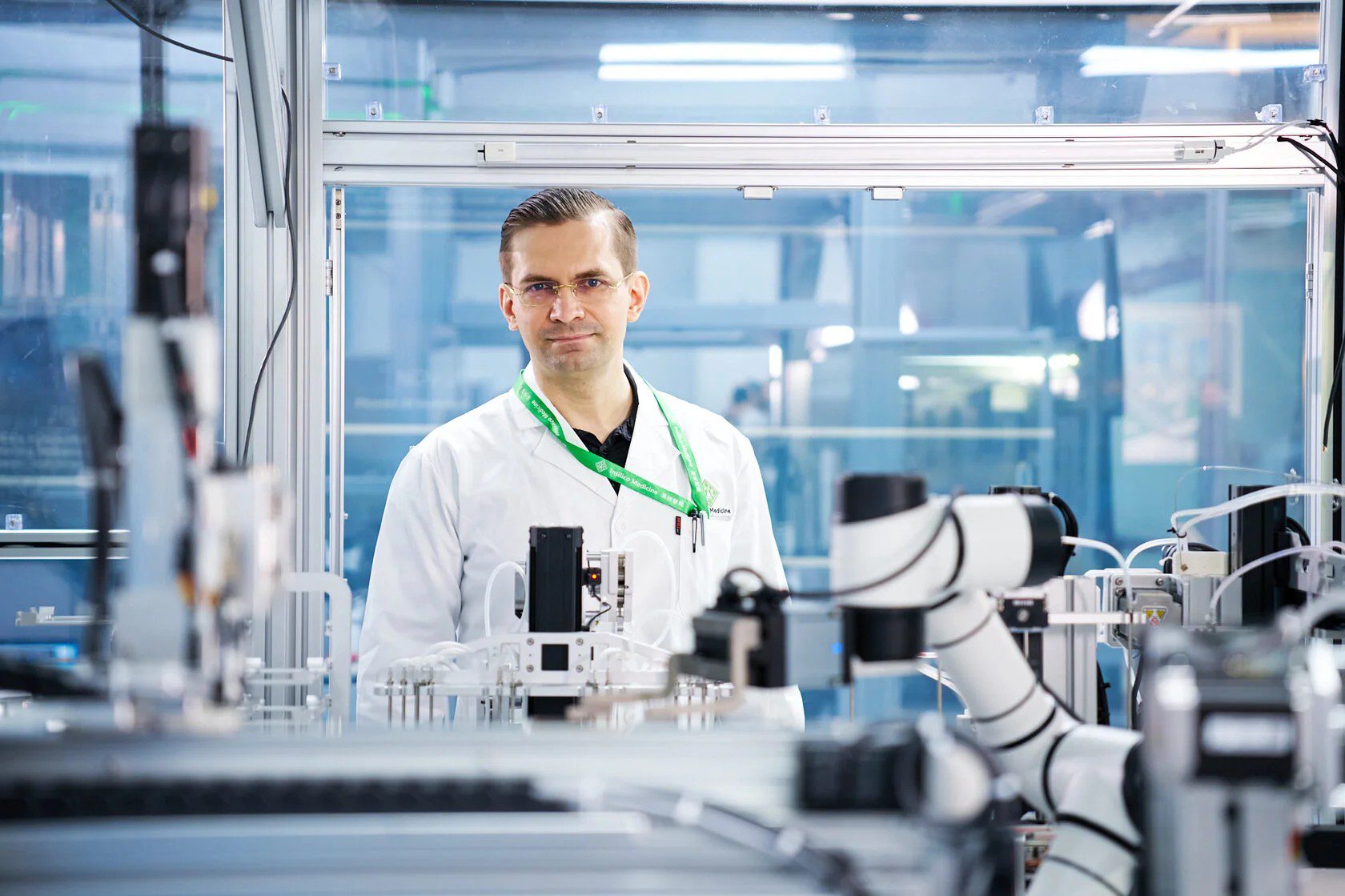
Insilico Medicine will partner with SK Biopharmaceuticals to discover new artificial intelligence (AI)-based drug candidates for disorders affecting the neuroimmune area of the central nervous system (CNS), through a collaboration that could generate up to $2.5 billion for the AI-based drug developer.
Insilico agreed to apply its Pharma.AI platform, which addresses target validation, generative chemistry, and molecule optimization, along with its preclinical drug discovery expertise, to discover, design, and optimize candidates for neuroimmune indications against targets that will originate with SK.
SK will contribute its development and clinical capabilities in neuroimmune disorders, steering the late-stage development and commercialization of all resulting programs.
“Some of the collaborations we do are very focused on target discovery, but here it’s more focused on the delivery of the real drug,” Alex Zhavoronkov, PhD, Insilico’s founder, co-CEO, and chief business officer, told GEN in an interview at his company’s exhibition-hall booth during the Biotechnology Innovation Organization (BIO) International Convention, held recently in San Diego.
“Basically, we are being brought in to develop a drug, to discover and take it to a certain point, after which the partner takes it over. And they usually have a lot of choices to do it with other partners,” Zhavoronkov explained. “But they trust AI. They like AI. They like the way we design drugs and like our speed and efficiency.”
Headquartered in Seongnam, South Korea, SK Biopharmaceuticals is a global biotech focused on the research, development, and commercialization of new therapies for CNS disorders and beyond, including radiopharmaceutical and targeted protein degradation therapies. In 2020, SK became the first Korean pharma to independently develop and commercialize a novel drug in the United States, the epilepsy treatment Xcopri® (cenobamate), after it won FDA approval a year earlier.
“This collaboration represents an important milestone in expanding our growth beyond epilepsy into new CNS therapeutic areas, building on the deep CNS expertise we have established through the successful development and commercialization of cenobamate,” Donghoon Lee, SK Biopharmaceuticals’ president and CEO, said in a statement. “By combining Insilico’s AI-powered drug discovery platform with SK Biopharmaceuticals’ clinical development and U.S. commercialization capabilities, we believe we can accelerate the discovery of innovative CNS therapies for patients.”
“Beyond a single program, we see this collaboration as a scalable and repeatable growth platform that can be leveraged for future target discovery and development opportunities,” Lee added.
SK Biopharmaceuticals is part of the SK Group, South Korea’s second-largest family-owned chaebol or conglomerate, after Samsung Group, and a chaebol whose holdings include the vaccine developer SK Bioscience, the contract development and manufacturing organization (CDMO) SK Pharmteco, and SK Hynix, a supplier of high bandwidth memory (HBM) chips that power the AI processors of Nvidia and AMD. SK Hynix and a sister chaebol company, SK Telecom, are investors in Rebellions, a Korean dedicated fabless design company specializing in manufacturing AI neural processing units optimized for data centers and large language models.
Insilico’s AI-based drug development background complemented SK’s focus on leveraging AI and digital technologies across drug discovery, development, and treatment, SK Biopharmaceuticals concluded.
“After you have done this,” Zhavoronkov said, pointing to a graphic showing Insilico’s AI-based pipeline, “people know that we can do this. The question is, can we do it in neuroimmunology? That is a very difficult space, one of the most difficult disease areas to tackle, given the need to develop molecules with properties that include high levels of safety and brain penetration.”
Insilico’s pipeline includes one candidate designed to treat CNS disorders—ISM8969, a Phase I oral brain penetrant NLRP3 inhibitor, which the company is co-developing with Hygtia Therapeutics under an exclusive global license and co-development collaboration. Both companies hold 50% worldwide rights to ISM8969, with Insilico eligible to receive up to $66 million in upfront and milestone payments from Hygtia, an incubatee of Shenzhen Pengfu Fund of Fosun Health Capital and Fosun Pharma.
Insilico is leading initial clinical development of ISM8969, from IND submission through execution of the Phase I trial (NCT07581431) for the drug’s initial indication of Parkinson’s disease. Hygtia will lead subsequent global clinical studies, regulatory submissions, and commercialization activities.
Discovered using the company’s generative AI platform Chemistry42, ISM8969 has shown strong efficacy, favorable safety, and robust blood-brain barrier (BBB) penetration, leading to marked anti-inflammatory activity in preclinical studies, according to Insilico.
Unlike other drug developers that concentrate on a few therapeutic areas, Insilico maintains a pipeline of 40+ programs across a wide variety of indications, including idiopathic pulmonary fibrosis (IPF), cancer, obesity and metabolic diseases, pain, and inflammatory diseases, including inflammatory bowel disease.
“We focus on aging. That’s what we care about,” Zhavoronkov declared. “Most of the programs that we like to work on are focused on longevity.”
Furthest along in clinical studies is rentosertib (formerly called ISM001-055), a small molecule designed to treat idiopathic pulmonary fibrosis (IPF) by targeting Traf2- and NCK-interacting kinase (TNIK), a serine/threonine kinase whose activation plays a crucial role in cellular processes that include signal transduction pathways essential for fibrosis development.
Rentosertib has completed a 12-week Phase IIa trial (NCT05938920) conducted across 22 sites in China, with results published in Nature Medicine, and is in a separate Phase II trial in the United States. In the Chinese trial, rentosertib met its primary endpoint of safety and tolerability across all dose levels, and showed positive results for the secondary efficacy endpoint, wherein a dose-dependent forced vital capacity (FVC) improvement was seen.
“We’re preparing for the next step. When that gets announced, it’s going to be a big deal. Hopefully sooner than later. Like, much sooner than much later,” Zhavoronkov said.
“It’s in the second half, but maybe closer to the earlier second half,” he replied.
The U.S. trial has not progressed as quickly as the Chinese trial. “We have not seen a trial slower than that in our history. Enrollment is just extremely slow because our criteria for enrollment are very high. Also, there are not that many [IPF] patients compared with China, where it was just much faster,” Zhavoronkov said.
Given the slow speed of the U.S. trial, he said, it would be more worthwhile to just start a Phase IIb or Phase III following more data from China. “It’s a game of chess, so to speak. You need to time it [an additional trial], and you need to properly adjust to the realities of enrollment.”
In April, Insilico received investigational new drug (IND) clearance from China’s Center for Drug Evaluation (CDE) to begin a Phase I study of inhalable rentosertib in IPF—the company’s 13th pipeline program to receive IND clearance. The study will evaluate the safety, tolerability, and pharmacokinetic (PK) profiles of rentosertib inhalation solution—first through a randomized, double-blind, placebo-controlled trial in healthy participants involving single and multiple ascending dose cohorts; then through a non-randomized, open-label evaluation in IPF patients who will receive multiple doses. Approximately 80 people are expected to be enrolled.
“IPF is the most promising disease for longevity therapeutic testing because the patients are old. And even normal people up to 65, they start losing force valve capacity quite a bit, like the amount of air you can breathe out of your lungs. And it’s like 30, 40 milliliters a year. IPF patients can lose up to 400 milliliters,” Zhavoronkov said. “That’s the critical measure of lung function, and that’s what we measure in the study.”
Insilico researchers chronicled the drug’s discovery and early development in Nature Biotechnology in March 2024, detailing a novel target discovered by Insilico’s target identification engine, PandaOmics, and a novel molecular structure designed by its generative chemistry engine, Chemistry42. Both are specific-function platforms within the company’s AI platform, Pharma.AI.
“We are making massive progress on the AI side,” Zhavornkov said.
Massive enough that users should expect to see either tweaks in the platform or new platforms? “100%, you’re going to see a complete rewall,” he replied, as in a secure, self-contained AI environment or “walled garden” pursued by AI developers during commercial inflection points.
“We have so many new next-generation tools right now that it’s actually very difficult to productize them. Because at the lab level and at the platform level, we see superintelligence already. I’m talking about, we can probably go from prompt to drug in some areas: You basically prompt it, and you could make it and potentially take it,” Zhavoronkov explained. “I think we’re there. It’s just, fortunately, you have to do all the nitty-gritty testing and then clinical studies.”
Insilico’s other Phase II program is ISM5411, a gut-restricted molecule designed to treat inflammatory bowel disease (IBD) by taking aim at another anti-aging target, PHD 1/2. Unlike with rentosertib, clinical studies for the PHD1/2 inhibitor have found it easier to recruit patients in the United States than in China, where fewer patients are diagnosed with the disease.
The program, formerly called ISM012-042, was shown in preclinical studies to restore intestinal barrier function and alleviate gut inflammation in multiple experimental colitis models, while exhibiting favorable safety and pharmacokinetic profiles, according to a 2024 study published in Nature Biotechnology. The program is one of two that target PHD 1/2; the other is a small molecule designed to treat anemia of chronic kidney disease, for which Greater China rights have been outlicensed to TaiGen.
PHD 1/2, TNIK, and NLRP3 are three of numerous longevity-linked targets for the drug candidates within Insilico’s growing pipeline. Among the others that are targets of candidates in the clinic or IND-cleared:
“Our differentiation from everybody else is novelty—novelty of the target,” Zhavoronkov said. “Nobody I know in our industry has such a large number of absolutely novel targets that have never been in the clinic before or that are novel for indication. But with novelty comes a great risk. And pharma doesn’t want to take that risk up until a certain point.”
“Very often, you need to spend a long time in the process of discovery and then development in order to license a drug,” he added. “Once you license a drug, usually in Insilico’s case, some of the pharma companies actually like to get some access to AI technologies, and then it would be structured as a licensing class collaboration.”
SK Biopharmaceuticals is the second multi-billion-dollar collaboration announced by Insilico this year. The first was an up-to-$2.75 billion discovery and development partnership with Eli Lilly, to which Insilico granted an exclusive global license to develop, manufacture, and commercialize what the companies described in an announcement only as “potentially best-in-class, novel oral therapeutics in preclinical development for certain indications,” without detailing the therapeutic areas where the companies plan to partner.
“Those are early preclinical drugs that have incredible properties. I like to use the term maximally multi-parameter optimized molecule or MMOMs,” Zhavoronkov said.
Lilly agreed to pay Insilico $115 million upfront, as well as development, regulatory, and commercial milestones plus tiered royalties on future sales. The deal continued and expanded a relationship that began late in 2023, when Lilly inked a licensing agreement allowing it to access Insilico’s Pharma.AI software suite.
The Lilly collaboration will allow Insilico and Zhavoronkov to work with Jiye Shi, PhD, the pharma giant’s senior vice president of discovery technology & platforms and early molecule discovery, who has specialized in research on integrating machine learning and AI into the pharmaceutical pipeline. Previously at UCB, he led a computational biology team that used machine learning and computational design to create bimekizumab, a humanized interleukin-17A and F antagonist hailed as one of the first, if not the first, AI-based dual-targeting monoclonal antibodies to reach the market, where it is sold as Bimzelx® (bimekizumab-bkzx).
In February, Shi and Zhavoronkov co-authored a paper outlining a vision for a “prompt-to-drug” pipeline, where AI not only generates novel hypotheses and designs optimized drug candidates but also orchestrates synthesis, validation, and clinical planning in a closed-loop system.
“The realization of a true ‘prompt-to-drug’ pipeline, in which a natural language request initiates a fully autonomous drug development program, is no longer a distant aspiration. With the development of modular AI platforms, humanoid-in-the-loop robotics, and multi-agent systems, the foundational components for this vision are already operational,” wrote Shi, Zhavoronkov, and co-author David Gennert, PhD, a medical writer who at the time was Insilico’s senior scientific writer and editor.
Insilico’s collaboration with SK, Zhavoronkov said, reflects how AI “has transformed from being a fairy tale or a promise, to being a real tool that is used routinely to discover and develop drugs.”
“This is basically production level,” he added. “We’re not trying to do a pilot here.”
Related Stories
 AI News
Europe's heatwave linked to 1,300 deaths, WHO says, as Germany hits record 41.7C
7 minutes ago
 AI News
Here are the numbers that explain the World Cup group stage
7 minutes ago
 AI News
Stephen Eustáquio's late goal sends Canada to the World Cup Round of 16 in a 1
7 minutes ago
 AI News
Stephen Eustáquio plays Canada's World Cup hero as last
7 minutes ago
 AI News
Fresh hostilities in Gulf suggest US
7 minutes ago
 AI News
News Live: Watch Times Now Live Streaming | Live News India, World, Politics, Sports News
7 minutes ago
 AI News
Who is Stephen Eustaquio? Meet Canada's hero goal
8 minutes ago
 AI News
Why Canada didn't get a penalty after Richie Laryea was fouled in box by South Africa
8 minutes ago