
Indonesia's Anak Krakatau volcano erupts, cancelling flights at Jakarta airport and others
Indonesia's Anak Krakatau volcano erupts, cancelling flights at Jakarta airport and others
Volcanic ash spread across parts of Jakarta and Lampung province on Sumatra’s southern tip
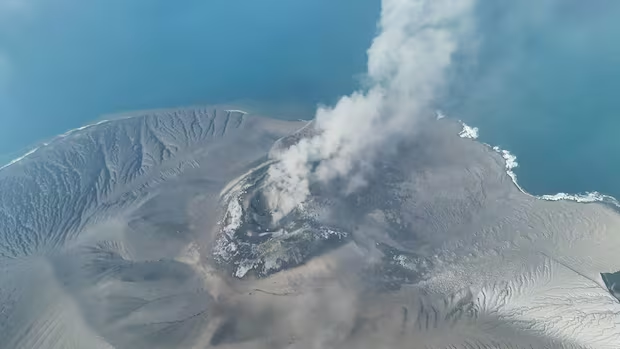
Anak Krakatau volcano erupted in Indonesia early Sunday, prompting the cancellation of all flights at Jakarta's Soekarno-Hatta International Airport and disrupting other domestic airports as volcanic ash drifted across parts of western Indonesia.
The volcanic island located in Indonesia's Sunda Strait, between the main Java and Sumatra islands, had shown signs of activity since Friday before erupting for 30 seconds at 3:53 a.m. local time on Sunday and for 16 seconds about three hours later, Indonesia's Geological Agency said. Closed-circuit camera footage showed lava flares from the volcano.
No casualties were reported, and no evacuation order was issued. The nearest settlement is more than 16 kilometres away, but authorities warned residents and visitors to stay at least three kilometres from the active crater.
Volcanic ash spread across parts of Jakarta and Lampung province on Sumatra's southern tip, Indonesia's Centre for Volcanology and Geological Hazard Mitigation said.
AirNav Indonesia closed airspace around Soekarno-Hatta and Halim Perdanakusuma airports in Jakarta, as well as six other airports, including Radin Inten II airport in Lampung, because of volcanic ash.
Thousands of passengers affected
By Sunday evening, the closure of eight airports had affected 170,000 passengers from 1,558 cancelled flights, including 963 flights in Jakarta's Soekarno-Hatta airport alone. All eight airports were ordered closed until 8:59 a.m. Monday.
"It’s of course an inconvenience," said Diego Urdiales, a Spanish tourist who was supposed to fly home to Madrid. "I was supposed to get input from the airline ... but so far no news."
"It’s a natural disaster, it’s a force majeure, so, what can we do?" said Michele Gouw, an Indonesian passenger. "We just have to accept it and wait for the airline and airport directions."
Volcanic eruption in Indonesia forces evacuations, cancelled flights
Indonesia's Directorate General of Civil Aviation said that it was closely monitoring the eruption's impact on air travel and co-ordinating with airlines, airport operators, air navigation services and the meteorology agency.
"Safety remains our top priority in every operational decision," Lukman F. Laisa, director general of civil aviation at the Ministry of Transportation, said in a statement.
He warned flight schedules could face cascading disruptions affecting aircraft rotations, fleet availability and terminal capacity as airlines work to restore operations. The eruption also disrupted services at Bali’s I Gusti Ngurah Rai International Airport and at Medan.
Indonesia's volcanology agency and the Darwin Volcanic Ash Advisory Centre in Australia identified two ash clouds using satellite imagery. One plume rose to 6,100 metres and drifted northeast over Jakarta, Banten, West Java and nearby waters.
A second cloud reached 15,200 metres and spread over parts of Banten, Lampung and Bengkulu provinces, the southern Sunda Strait and sections of the Indian Ocean west of Sumatra.
Lana Saria, head of Indonesia's Geological Agency, said activity at Anak Krakatau has intensified since July, with Sunday's eruption the strongest during that period.
The repeated eruptions indicate a continued supply of magma and volcanic gases beneath the volcano, she said, though officials can't predict whether a larger eruption will occur.
"We continue to evaluate the volcano's development based on all monitoring data, not solely on the number of eruptions or the height of the ash column," Saria said in a video briefing.
She said the main hazards include volcanic ash, high concentrations of gas and the ejection of hot rocks and other material around the crater area.
Anak Krakatau, which means "child of Krakatau," is the offspring of the famous Krakatau, whose monumental 1883 eruption triggered a period of global cooling.
An eruption of Anak Krakatau in 2018 caused a tsunami that killed at least 430 people in Sumatra and Java. Researchers believe volcanic activity triggered an underwater landslide and caused a large chunk of Anak Krakatau's southwest slope to collapse and displace a large volume of water. Scientists said that Anak Krakatau island was only about a quarter of its original size after that eruption.
Related Stories
 Travel
Update | At least 5 dead after Amazon cargo plane barreled off runway at Miami airport
3 hours ago
 Travel
Anak Krakatau: Volcano eruption closes eight Indonesian airports
9 hours ago
 Travel
‘Wasted effort’: Trade war blocks U.S. tourism groups from winning Canadian visitors
15 hours ago
 Travel
Cross
1 day ago
 Travel
Trump envoys arrive in Moscow ahead of Ukraine talks
1 day ago
 Travel
Regina leans into its own style of pizza
1 day ago
 Travel
Decline in Canadian cross
2 days ago
 Travel
Smarter marketing and stronger connectivity key to tourism growth
3 days ago