
India’s Youth Are Changing the Political Equation
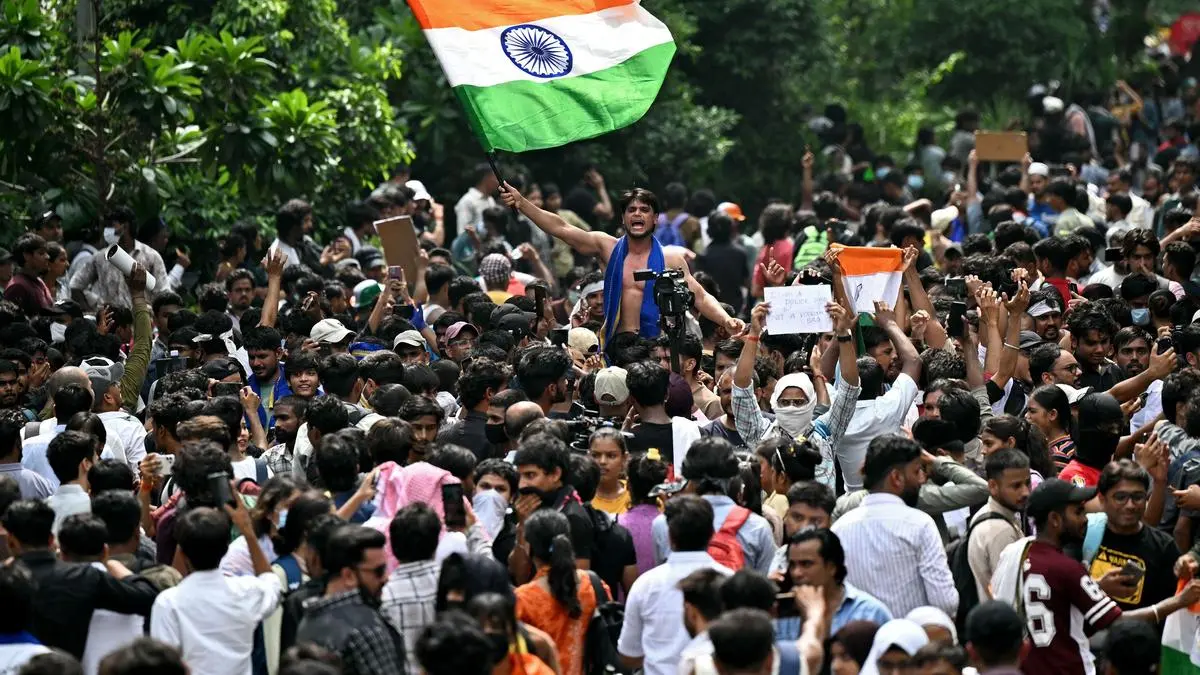
The thread of the BJP’s hubris runs from Jantar Mantar to Bankipur. The last few weeks must count among the most unsettling the BJP has faced since it stormed to power in Delhi 12 years ago. The events have so shaken the saffron forces that their response has been unusually flat-footed. In consequence, where once the regime was viewed with admiration by its supporters and with awe by its opponents, both admiration and awe have diminished as the realisation dawns that the Narendra Modi regime is not forever.
And that the best way to expose them is not through high-blown rhetoric in the formal halls of democracy but through mockery and irreverent humour online and in the streets. Arrogance countered by ridicule. The state, bewildered at anger expressed with such joyous abandon, has found to its utter astonishment that violence and brutality have failed to intimidate the protest.
More importantly, they have discovered that fear, the most powerful weapon in the state’s armoury, has vanished as the young giggle and laugh at the menace. Not even electricity-charged batons, nail-studded lathis, and pellet guns have stilled satirical songs, fun lyrics, wry puns, and hilarious placards and posters.
And when the Prime Minister took to Instagram to woo the students through the medium that the youth had made their own, he came through as an ageing old man, out of touch with both the concerns and the idiom of the young, just not “with it”. Gandhi in jeans has confused the establishment. To its astonishment, the BJP has discovered that it’s like any other party in a lively democracy: here today, gone tomorrow.
Yet, almost no one anticipated this dramatic turn of events. For instance, this column had anchored its hopes on a rejuvenation of the INDIA bloc that almost won its laurels in the 2024 general election. But the unforeseen electoral setbacks suffered by several key regional stars of the alliance in early May this year, followed by discord and dissension at the INDIA bloc meeting on June 8, led one to reluctantly abandon that prop.
What was barely sensed was that even as the political opposition’s challenge to Hindutva was disintegrating, a spontaneous challenge arose from a wholly unorganised quarter: Gen Z students and unemployed youth.
While their challenge was focused on an insistent demand for the removal of the Education Minister (since resigned), Dharmendra Pradhan, the larger demand was aimed at radically reforming an education governance system driven by an ideology of academic perversion and over-centralisation, riddled with conceptual confusion, gross inefficiency, and pervasive corruption, failing the key test of accountability and throwing in jeopardy the future of our children. And, perhaps most disturbing of all, the repeated spectacle of the highest escaping their responsibility, callously leaving minor scapegoats to face the heat.
Had Jantar Mantar been a one-off, one-issue protest, it might have had its day before fading from public memory. But the student agitation tapped into concerns much deeper and wider in society as a whole—a weariness with divisive politics and tired cliches of caste and creed. This fed into the growing fury in society at governance veering away from the promise of “Achche Din” to nurturing a personality cult, leveraging authoritarianism and majoritarianism in the guise of nationalism, and the mortgaging of the economy to easily identified Big Business stalwarts whose stock-in-trade is jobless growth.
The real problem, the students showed the formal opposition, was the reluctance on the part of registered political parties to stare boldly back at the oppressor for fear of losing vote banks. The students had no vote banks to lose. They were drawn together because all were being deprived of their future. Even the few who had crossed the hurdles the Education Ministry had devised found only a small fraction of their number securing meaningful employment.
It was not just education that was broken, the economy too was broken by not being oriented to absorbing proven ability. The demographic dividend of India, which has among the youngest populations of the world, was being turned into demographic catastrophe. Thus, it was not a sectoral breakdown of education and employment at issue but a breakdown of a polity spawned by the saffron ideology and enforced by naked threat.
The agitation resonated far beyond the geographical confines of Jantar Mantar, resounding in society as a whole, transforming student concerns into national concerns. The Prime Minister’s brand has eroded, its durability called into question. The students have ensured that he is no longer seen as “unassailable”.
This became evident as the result of the Bankipur byelection rolled in. Bankipur, on the outskirts of Patna, lies at the heart of the heart of the BJP’s ecosystem, a bastion held continuously by the party for 31 years and among the party’s safest of safe seats. It is such a valued electoral asset that none other than the scion of the family that has dominated Bankipur for three decades and more was chosen as the party’s national president after prolonged deliberation..
Yet, despite the BJP’s organisational strength so meretriciously on display, with massive resources at its disposal, and the deployment of its national leadership for a mere byelection, the BJP came a cropper. The BJP has been put on notice.
Jan Suraaj Party founder Prashant Kishor during a victory march after he took the lead in the Bankipur Assembly byelection, in Patna on August 3. | Photo Credit: Rahul Sharma/ANI
And, the opposition, too. Does the future belong to any party on grounds of historical legacy? Or is a break with the past the new thunder? In Tamil Nadu, C. Joseph Vijay, a political novice, has shown that people young and older are no longer enamoured of the old politics. Prashant Kishor has taught the same lesson in Bihar.
The electorate seeks a new idiom, a fresh engagement with the present. Around us, in Sri Lanka, Bangladesh, and Nepal, regime change has already been wrought by the young, with political formations of the past put into the cupboard and the key thrown away. The demand is for new faces, new ideas, new energy. Can older parties provide this? Has generational clash in India turned into a movement for a Second Republic? Is that what the student slogans of “Azaadi” and “Inquilab Zindabad” stand for?
Perhaps not. No one seeks a replacement of the Constitution. All that is sought is fidelity to constitutional values. No one is seeking the overthrow of Parliament. All that they are asking for is the acceptance of accountability from those whom Parliament has placed in high office. No one is demanding the overthrow of an aged judiciary. All they are seeking is that the judiciary deliver justice and not cringe before the executive. No one suggests the media shut its doors. What they seek is a media that frees itself from subservience to authority.
There is no call to arms. Instead, the call of the youth is amplified by Sonam Wangchuk’s insistence on unflinching non-violence. There is no call for revolution. There is a call for real reform. What is sought is attention to present realities, not past mythologies. What is desired is the removal of the rot in the system, so egregiously displayed in the institutional theft of donations by devotees of the Ram temple in Ayodhya, touted as Hindutva’s great revenge on history.
The political environment has changed. The youth have changed it, not the established political parties. It is those who respond to these rumblings in society who will prevail.
Mani Shankar Aiyar served 26 years in the Indian Foreign Service, is a four-time MP with over two decades in Parliament, and was a Cabinet Minister from 2004 to 2009. He has published nine books, the latest, A Maverick in Politics, the second part of his memoir.
Also Read | The cockroaches and the strongman
Also Read | The day the CJP broke the politics of fear
Related Stories
 India
India
Starlink, Ambani’s venture should get equal treatment, let consumers decide: Shashi Tharoor
10 hours ago
 India
India
Lawrence Bishnoi’s rise: Student politics, first murder and a sprawling crime network | India News
10 hours ago
 India
India
India’s finance minister says market liquidity makes it easier for investors to exit
10 hours ago
 India
India
India news: CJP alleges 'deliberate' delay in leaders' release
12 hours ago
 India
India
Indian Diaspora Holds Pro-Modi Counter
13 hours ago
 India
India
Clashes Erupt in London as Diaspora Divided Over India's Election Chief and Electoral Roll Controversy
13 hours ago
 India
India
London: Indian diaspora rallies in support of PM Modi, criticises CJP protesters
13 hours ago
 India
India
Cabinet Approves Go
13 hours ago