
India’s T
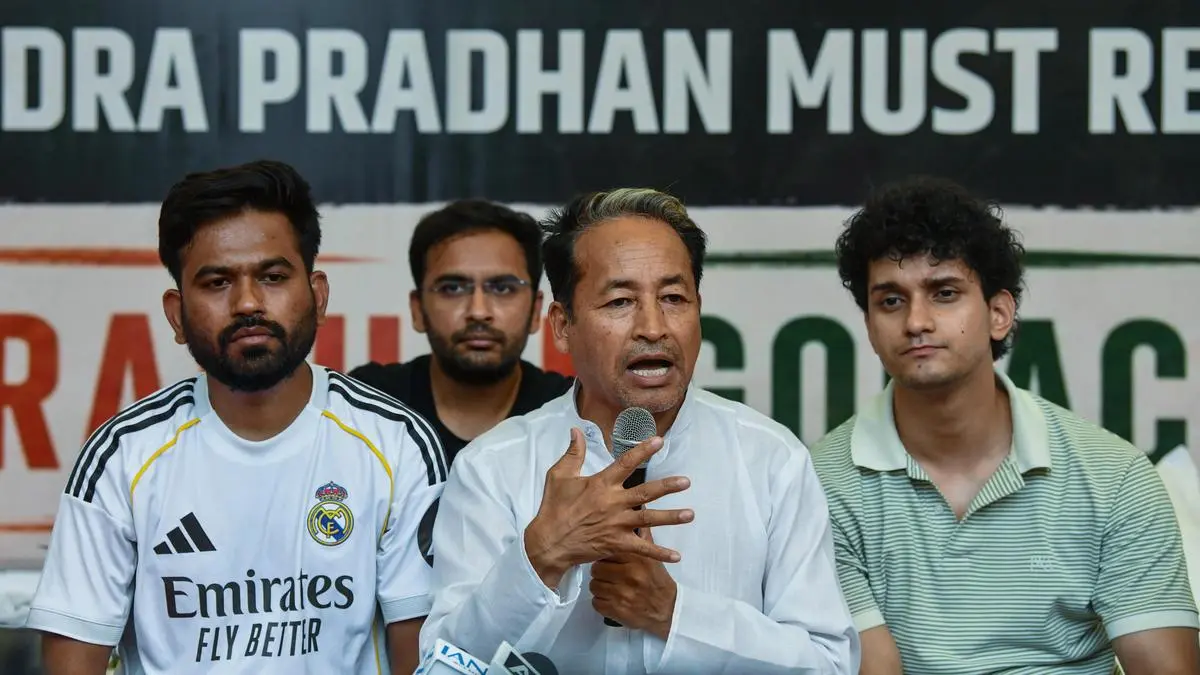
While much has been written about Cockroach Janta Party founder Abhijeet Dipke, I am puzzled by his choice of T-shirt—the white Real Madrid jersey with the ‘Fly Emirates’ logo. He wears it everywhere, all the time: on stage, in interviews, and, perhaps, even while sleeping. (By the way, I just learnt the letter ‘T’ is usually capitalised because it represents the shape of the shirt when laid flat.)
No surprise then that Dipke was wearing it when senior journalist Rajdeep Sardesai went to interview him. Rajdeep, writing in Navhind Times, feels it is a sign of authenticity: “He turned up in a loose white T-shirt with a faded ‘Fly Emirates’ logo. There was something almost deliberate in its ordinariness. Here was someone who seemed unconcerned with television optics or political choreography. Whether by instinct or design, Dipke projected the image of a young, fearless anti-establishment figure for whom authenticity mattered more than appearance.”
Yes, but why only the Real Madrid-Emirates tee? I’m sure he has other faded T-shirts and shirts. Not for a moment am I suggesting that Dipke should overhaul his dressing style. Just that, as a lover of T-shirts, I’m mystified.
All India Students’ Association president Neha Bora—soft-spoken in conversation, fiery when making speeches—provides a study in contrast. She’s been seen in a red T-shirt, which bears the legend: ‘I am Fatima, I am Savitri’, Fatima Sheikh and Savitri Phule being pioneering 19th-century educators and social reformers who went door-to-door trying to persuade families to send daughters to school.
Together, Neha and Abhijeet have shown us it is kosher to lead political movements wearing what you are comfortable wearing. Whether it’s Neha’s deliberate choice to trace a lineage or Abhijeet’s “I couldn’t care less; let’s concentrate on pressing issues at hand” attitude to clothes, they have succeeded in breaking the sartorial mould of India’s politicians, which for years has been some version of national dress: kurta, churidaar, Nehru jacket, dhoti, lungi, and sari. Actually, to be fair, Rahul Gandhi did it first, with his cargos and tees: always black or white, never coloured.
Neha Bora, president of the All India Students’ Association, wearing a T-shirt featuring social reformers Fatima Sheikh and Savitri Phule. | Photo Credit: @neha_aisa/X
Dipke can wear what he wants, but the funny thing is that the movement he spawned has spawned a mini-industry of its own, all trying to capture the current mood of India’s youth. A slogan on a T-shirt put out by one of several small companies says: “Vote chor, paper chor, tax chor, chanda chor, petrol chor”. Another has a sketch of a broken trophy labelled “Merit” lying on a cracked-up broken road, while a bunch of cockroach-persons surround it, one holding a magnifying glass, another a hammer, while a third pushes a wheelbarrow full of debris.
The cockroach-human hybrid is a recurring motif. Given the target audience, the prices are reasonable: Myntra is selling one for Rs.247, while on Flipkart prices are as low as Rs.113 (the government must investigate the role of foreign hand).
The slogans are variations on a theme: “Gen Z Wake Up”; “Size chota, Impact bada”; “Built to Survive”; “Power To The Resilient”; “No Cap. No Limit. Just Gen Z”; “I Am Cockroach. Deal With It”; “Kripya Mujhe Gyaan Na De. Mera Apna NahinSamhal Raha”; “No Darr. No Spray. CJP All The Way”.
Not all stick to CJP imagery. There’s one with a picture of Sonam Wangchuk, juxtaposed with an image of the rising sun: “Janta Jagegi, Desh Badlega.” Others draw directly from placards seen at the protest, or try and capture the rebellious national mood—the air has turned: “Freedom Of Speech Article 19 (1)(a)”; “Sab Yaad Rakha Jayega”; “Dissent Is Not The Opposite Of Patriotism. Indifference Is”; “You Can Question The Throne. Without Betraying The Land”; “My Name Is Student. I Am Not A Terrorist” (image of a blindfolded face); “We Demand Equitable Space In Education” (image of a bloody hand writing this, the top half of the thumb/ distal phalanx is cut off); “Raja Beta No More. Done Meeting Expectations I Never Agreed To”; “Bolo Azadi”, with the now-iconic image of a hooded Rhiya Ahir—the Mumbai girl who stood in front of a police van. There are some cerebral ones too: an image of Mahatma Gandhi with the slogan: “Too Many Critics With No Credentials”, and “Make Orwell Fiction Again”.
An injured supporter of the Cockroach Janta Party rests during a protest at Jantar Mantar in New Delhi on July 22, 2026. | Photo Credit: SHASHI SHEKHAR KASHYAP
Seen against this light, Dipke choosing not to wear statement T-shirts inspired by his own movement becomes a statement in itself.
Which brings us to the larger T-shirt revolution in India; it’s all happened on Instagram—these days, everything of consequence seems to happen on IG. In the 1980s and 1990s our T-shirt scene was pretty sad. We wore what we got; desi T-shirts were not big on slogans or statements. Very often father and son would buy the same plain-coloured T-shirt from the same sale.
Fed up with boring T-shirts in garment stores, I tried making my own slogan tees. I took an old T-shirt, cut off the sleeves by an inch and wrote ‘Conscience Is A Pest’ on the front. This line I got from a U2 video that was on heavy rotation on MTV. I let the paint dry.
The next day I scrawled another line, this time on the back, with a borrowed fabric pen: “Ask me no questions, and I’ll tell you no fibs”. I got this from a book of quotations (the line first appeared in Oliver Goldsmith’s 1773 play, She Stoops to Conquer). The kids in my tuition class were confused. They gathered around me, jabbed at the handwriting, spelt out every word, then threw up their hands in despair: what does this mean? There ended my experiments with T-shirt truth.
I remember buying one from an environmental NGO who’d set up a stall one afternoon in my college. It said: “I Love Trees”, with a minimalist image of a mushroom-looking tree sprouting some green leaves. I was thrilled because it was different from normal T-shirts. That’s all it took to make one happy. I was as excited when I found a Jim Morrison T-shirt in Delhi’s Khan Market. Band T-shirts were hard to find, unless one was a metalhead. You can imagine my disappointment when, in college, folks pointed out: “Hey, that’s not Jim, it’s Val Kilmer!” Oliver Stone’s biopic The Doors had just been released.
T-shirts featuring the image of B.R. Ambedkar are displayed during a protest rally by Bhim Sena supporters demanding the immediate release of party chief Chandrashekhar Azad at Parliament Street, in New Delhi, on August 19, 2018. | Photo Credit: Manvender Vashist/PTI
Then, in the middle of all this, I discovered graphic artist Orijit Sen’s People Tree store in Connaught Place. What a saviour that was. I remember one with a picture of a braying ass, a hole punched in its belly: “There’s A Hole In My Ass. So Why Shouldn’t There Be One In My Mint”. Nestle had just launched its flagship Polo mint brand in India—the early days of economic liberalisation. The rest of the T-shirt spelt out a socialist manifesto: “Consumerism Creates Choices. Yes—Between One Cellphone And Another, Between Twenty Buttons On The TV Remote, And Twenty New Fast Cars With Nowhere to Go—And Of Course Between Brands Of Mints With Holes, And Without...While Our Real Choices: Social, Political And Cultural, Quietly Disappear. Do We Really Have To Swallow The Whole Thing?”
The Indian T-shirt scene has really thrived in the last couple of years. My favourite tee, of which I have two shades—black and white—has a Venn’s diagram: one circle says ‘Crippling Self-doubt, the other “Absolute Narcissism”, with the legend “Art” in the overlapping middle area. These days, one can buy T-shirts with classic images from art, film, music and literature.
I’ve had late-night conversations with the people behind these T-shirts. Like when I bought one with the Dostoevsky line: “Above All, Never Lie To Yourself”. In the witching hour, fortified by a couple of stiff ones, and wearing a T-shirt bought from Westside that said “When I Read About The Evils of Drinking, I Gave Up Reading”, I pinged the company on Instagram chat: “Is this line for real, or did you make it up?” A person replied: “It’s real!” I said, “Man, the sentence might be real, but am I chatting to a bot?” The person responded with an LOL: “No, Palash. I’m Abhinav and I’m for real. The line is from The Brothers Karamazov.” How civilised!
A man wearing a Preamble T-shirt on the 13th day of the Mumbai Bagh agitation on February 8, 2020. | Photo Credit: VIVEK BENDRE
Another thing about T-shirts is that, like books and music, they remind one of a moment in time; they have evocative sentimental value. I started my writing career doing pieces for The Rock Street Journal, which used to come out from my hometown, Allahabad. The founder-editor Amit Saigal passed away, but I still, on occasion, wear the RSJ tee, which Amit had presented me once at an IIT rock gig. It reminds me of him, the nineties and the noughties.
The next T-shirt I’ll buy features an image of a Bajaj Chetak, with the legend: “Tilt right to start”. The copywriting in the product description is quirky and hits home: “The ritual was always the same—find the angle, feel the resistance, kick with conviction.” My father had a Bajaj Chetak, and our family of three would fit snugly on it. I remember him tilting it to start. T-shirts peddle nostalgia for Gen-X, and we happily buy into it. I’ll choose the grey-coloured one because our scooter was grey in colour.
Speaking of nostalgia, does anyone remember the “Free Tibet” tees that were all over Delhi’s Janpath and Bombay’s Fashion Street? They were the first political T-shirts one could buy. Erm, but I haven’t seen a ‘Free Palestine’ tee in India yet. Hmm.
The T-shirt scene in India has seen a revolution, but even then, there are some tees you cannot get your hands on. When my old friend Margot was coming from Portland, she asked if I wanted her to get something from the States. I immediately said: a Mamdani T-shirt. She got me one; it says: “Hot Boys For Zohran”. I’m wearing it as I write this.
The writer is the author of The Butterfly Generation: A Personal Journey into the Passions and Follies of India’s Technicolour Youth, and the editor of House Spirit: Drinking in India.
Also Read | Beyond the Gen Z protest: Who does the movement represent?
Related Stories
Stay connected with The Vibe of Young India. Get news that’s Real, Relevant & Relatable
2 hours ago
The reality of the Aam Aadmi Party, which does politics in the name of women's empowerment, has come to light in the Nabha Municipal Council meeting
3 hours ago
 India
India
African Union-India: Ndayishimiye and Modi seek to reschedule India
7 hours ago
 India
India
Nigeria
8 hours ago
 India
India
India's women team refuses to accept Asia Cup trophy from ACC president Mohsin Naqvi
8 hours ago
 India
India
PM Modi flags ‘weaponisation’ of technology, critical minerals at Brics Summit 2026: 'Hinders shared progress' | India News
8 hours ago
 India
India
Congress seeks PM Modi's response after his meeting with Chinese President Xi Jinping
11 hours ago
 India
India
Young workforce is India's advantage in manufacturing: Cedrik Neike
15 hours ago