
India’s politics must reflect the ambitions of its women | Hindustan Times
India’s politics must reflect the ambitions of its women
Women have adjusted long enough to the rhythms of contemporary politics. It is time politics adjusted to the ambition of women
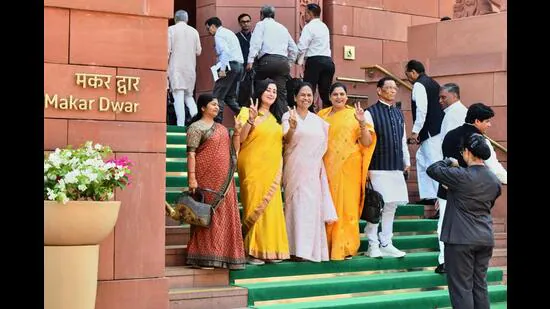
India’s political class often speaks of women with reverence and negotiates with them with caution. Every election celebrates the woman voter through promises of dignity, safety, welfare and empowerment. Every party now recognises that women are a decisive electoral force. But when the question shifts from women as voters to women as lawmakers, the system suddenly becomes procedural, hesitant and slow. What recently unfolded in Parliament on the question of women’s representation is a reminder of that contradiction.
Indian politics remains structurally patriarchal, not merely because men dominate it numerically but because power itself is shaped through masculine habits, networks, codes and incentives that exclude women while appearing open to them. Women are welcomed as symbols, beneficiaries, campaign faces and turnout multipliers but reluctantly as autonomous centres of authority. This is not merely a moment to debate numerical representation. It is a moment to ask whether India’s democracy is prepared to share power.
For decades, parties have celebrated women voters through welfare schemes and targeted messaging. However, issues such as candidate selection remain concentrated in closed circles of loyalty, lineage, money, caste arithmetic and factional convenience. Women are often introduced into politics as relatives, proxies, placeholders, or crisis managers. Even highly capable women leaders are frequently required to prove more, wait longer and negotiate harder for spaces many men access more easily.
Modern patriarchy rarely shuts the door openly. It permits entry but only after demanding constant proof of alignment with the existing order. Women are expected not only to demonstrate competence but to reassure entrenched structures that they will not disturb inherited hierarchies, patronage networks, behavioural codes or established chains of command. Acceptance becomes conditional on conformity.
Historic reforms require seriousness, coalition-building, disciplined attendance and relentless legislative follow-through. This is where women politicians fell short of converting a moral cause into coordinated parliamentary pressure. Women parliamentarians across party lines should have recognised the need for collective action and done more to translate moral legitimacy into procedural success. Otherwise, male-dominated party machines will continue to dictate the pace and terms of reform.
But this moment is also an opportunity. Women within political parties must seize this opening with equal force. This is the time to build constituency networks, master policy briefs, control booth structures, lead local agitations, negotiate tickets and claim organisational command. In politics, power is rarely invited in. It is claimed through competence, credibility, and persistence.
India’s women voters are among the most consequential democratic actors in the world today. Women, rivalling and often surpassing men in polling booths, are attentive to prices, welfare, jobs, security, education and dignity. But a harder question is this. Where is a coherent women-led political agenda that moves beyond symbolism and speaks directly to everyday anxieties and national ambition alike? A cross-party women’s parliamentary compact on representation, candidate pipelines, campaign finance access and internal party democracy should already exist. Its absence is telling. Leadership requires initiative from the entire political community. Political leaders across parties should understand that supporting women’s leadership is no longer charity or symbolism but competitive politics. Parties that cultivate capable women leaders at every rung will build trust among ordinary women voters who increasingly ask a simple question: If you seek our votes, why not trust us with power?
The next phase of Indian democracy will not be decided merely by passing reservation laws, though those matter greatly. It will be decided by whether parties internalise women’s leadership as normal, winnable and necessary. Patriarchal politics survives by making women visible without making them powerful. That cynical bargain must end.
India does not need women only at rallies, on posters, or in long queues outside polling booths. It needs them at the table where tickets are distributed, resources allocated, strategies framed and agendas crafted.
Shubhrastha teaches electoral sense making at the School of Global Leadership, Gurugram. The views expressed are personal
Related Stories
 India
India
Home Minister Sudan Gurung to visit India next week
5 minutes ago
 India
India
Mass protests demanding poll chief resignation shake India for third day
6 minutes ago
'Russia stood by India when much of the world backed Pakistan': Jaishankar hails Delhi
2 hours ago
 India
India
India's 'Cockroach' protests intensify as police probe harassment claims
3 hours ago
 India
India
Anurag Thakur lauds Asian Games athletes, flags need to end politics within sports associations
6 hours ago
 India
India
Google celebrates India’s 80th Independence Day with colourful patchwork Doodle: It honors our rich heritag...
8 hours ago
 India
India
Trade: How India became dangerously addicted to Chinese imports
9 hours ago
 India
India
Anurag Thakur lauds Asian Games athletes, flags need to end "politics within sports associations"
9 hours ago