
India's meme
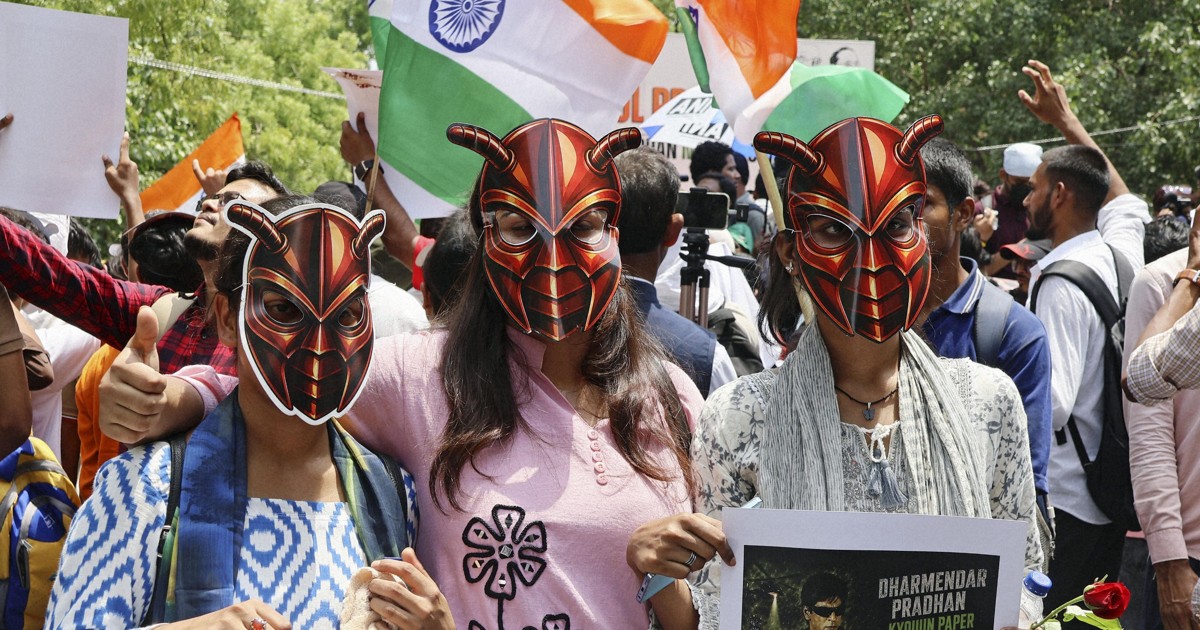
NEW DELH (Kyodo) -- Indian protesters wearing cockroach face masks and carrying roses gathered at New Delhi's Jantar Mantar near parliament in late June, demanding the resignation of the education minister over examination leaks.
The peaceful demonstrations, inspired by Mahatma Gandhi's principles of nonviolent resistance, started with Abhijeet Dipke launching a satirical social media page called the Cockroach Janta Party, following remarks by India's chief justice likening unemployed young people to the insect in May.
Since then, the CJP has grown into a political movement, mobilizing students and raising questions about the future of youth politics in the world's largest democracy.
Dipke said the movement, which has attracted about 22 million followers on Instagram, emerged almost by accident.
"I posted online asking, 'What if all the cockroaches came together?' and the response was overwhelming," Dipke told Kyodo News in a recent interview.
The 30-year-old completed his studies in Boston earlier this year and returned to India in early June. The movement soon expanded from social media to rallies in several cities, including Delhi.
The CJP is not registered as a political party with the Election Commission of India and describes itself as a youth platform rather than an electoral organization.
"We are a platform for the youth, of the youth and by the youth," he said.
The movement's principal demand is the resignation of Education Minister Dharmendra Pradhan over alleged failures in handling examination irregularities and paper leak controversies.
Its campaign gained momentum following reports of several student suicides that intensified public concern over examination pressures and alleged irregularities in India's highly competitive entrance examination system.
Over 2.27 million candidates registered for the National Eligibility Cum Entrance Test 2025, competing for roughly 129,000 undergraduate medical places, according to the National Testing Agency.
More than 2.2 million candidates reportedly registered for NEET 2026, but the paper leak caused a drop of about 9 percent in candidates reappearing for the June 21 examination.
Mental health has also emerged as a growing concern. India's National Crime Records Bureau recorded 14,488 student suicides and 14,778 suicides among unemployed people in 2024.
Still, for many middle-class families, success in competitive examinations represents one of the few paths to a better future.
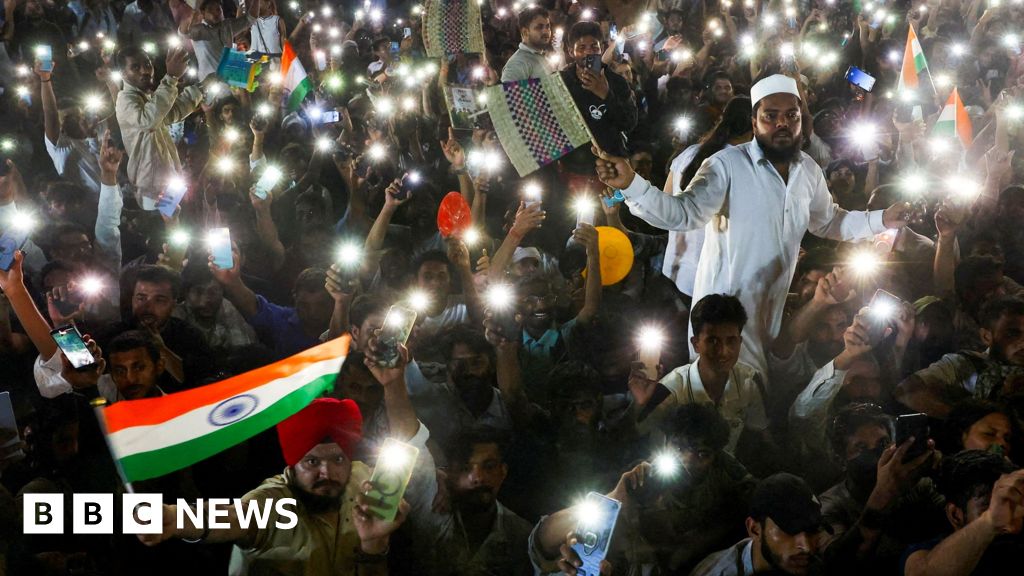
The protest site resembles less a conventional political rally than a temporary community, with students sleeping on carpets while volunteers distribute food, drinking water, medicines and mobile charging facilities.
Unlike many Indian political rallies, party flags are largely absent. Instead, Indian national flags and portraits of Bhimrao Ramji Ambedkar -- the principal architect of India's Constitution are visible throughout the site.
Among the supporters is Mita Shah, a 48-year-old former corporate executive from Gurugram who has been bringing homemade food to protesters every day.
"They may not be my own children, but I see them as someone else's children, just like mine," she said.
For others like 18-year-old Mahi Sharma, the issue is deeply personal. She traveled 100 kilometers from Meerut to attend her first protest after the death of an acquaintance, Shreya Tyagi, who had spent two years preparing for the NEET examination and hoped to become a doctor.
"Students spend years preparing for these exams. We want a fair system where students don't suffer because of someone else's mistakes," Sharma said.
The movement has also attracted entrepreneurs, professionals and parents who say social media succeeded where conventional politics failed.
"Without social media, this movement would never have reached so many people," said Sayan Kundu, a 24-year-old founder of an artificial intelligence start-up.
"Traditional television gave very little coverage, but Instagram allowed people to organize themselves," he added.
The movement has also begun attracting support from outside the student community.
Environmental activist Sonam Wangchuk joined the protest on June 28 and began an indefinite hunger strike in support of greater accountability in India's education system. He also used the protest to draw attention to concerns relating to Ladakh, the northern territory bordering China.
His participation marked one of the highest-profile endorsements of the movement since it began on June 20.
Dipke rejects comparisons with youth-led movements elsewhere in Asia, arguing that India possesses its own democratic traditions.
"India has its own history of peaceful public mobilization, from Mahatma Gandhi's freedom struggle to Jayaprakash Narayan's movement to restore democracy," he said. "This movement belongs to that tradition."
Whether the movement survives beyond the current protests remains uncertain.
Dipke insists that becoming another political party is not the objective.
"Young people were looking for a platform where their concerns could finally be heard," Dipke told Kyodo News.
As evening fell on Jantar Mantar, volunteers once again began arranging food and bedding for protesters preparing to spend another night on the road, suggesting that, for now at least, the movement is not ready to leave the streets.
Related Stories
 India
India
Maharashtra: What is India's 'luxury resort politics'?
4 minutes ago
 India
India
Trudeau's India trip cost more than the government first disclosed
4 minutes ago
 India
India
Chinnaiah Jangam Writes Article on Hate Politics for The Indian Express
4 minutes ago
 India
India
Lok Sabha 2024: The influencers driving India's big election
4 minutes ago
 India
India
YS Jagan Reddy Revisits Election Commissioner Appointment Law, Calls for CJI’s Return to Selection Panel
4 minutes ago
 India
India
Channi honoured with Punjab Politics Eminence Award in Dubai
2 hours ago
 India
India
Jantar Mantar: Is this the end for iconic Delhi protest site?
3 hours ago
 India
India
Rajnath Singh to Represent India at SCO Meeting in Tajikistan on October 19
4 hours ago