
In Canada's drone
In Canada's drone-killing 'Sandbox,' companies compete for a $1M prize
Machines do battle as Canada seeks to turbocharge drone, counter-drone industries
The Suffield Research Centre is in the heart of Alberta's Big Sky country, and is also blessed with Canada's sunniest skies, making it the perfect testing ground for one of Canada's most critical areas of innovation: drone and counter-drone technology.
Once the main training ground for the tank crews of the British Army, the British gradually withdrew and left entirely by 2024.
But today, the base is buzzing with activity as militaries urgently rearm with new technologies.
Even the British are back, in smaller numbers for now, and not to drive tanks but fly drones — and shoot them down.
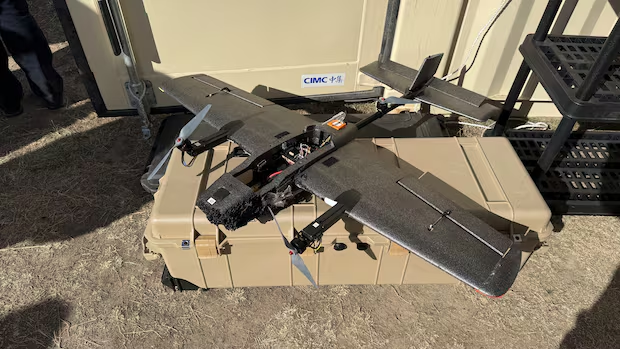
Canada's Department of National Defence this month used Suffield to hold its fourth Counter-Uncrewed Aircraft Sandbox, a drone-killing contest with a million-dollar prize for the most promising innovation.
Companies from Canada, Australia, Finland and the U.S. showcased new methods of detecting and intercepting drones, closely watched by members of the Canadian, Dutch, German, British, American and Ukrainian militaries.
New drone-defence technology put to the test at Canadian showcase
All of the armies are there to learn and observe. But the Ukrainians, as the only military at the Sandbox with real-world experience in drone warfare, are also there to teach.
"They're creating the environment that we want to emulate," said Col. Gabriel Doré of the Royal Canadian Air Force. "They're on the battlefield. They're the ones who are innovating the fastest. And they can tell us immediately if something's going to work or not just by looking at it, because they're living it."
The conflict in Ukraine has turbocharged the pace of scientific innovation in all forms of drone warfare: aerial, ground-based, marine surface and underwater.
There are now even drones that can transition from underwater to aerial flight.
"We need to be the number one in drones to fight against Russia," said Ukrainian Army Maj. Sergiy Kuzyara.
Kuzyara said those drones include cheap, simple first-person view (FPV) quadcopter drones used on the front lines to marine drones to "deep-strike drones which are reaching Russian refineries or military production plants."
A sign at the Suffield Research Centre, about five kilometres north of Suffield, Alta. (Evan Dyer/CBC)
Kuzyara says his mission in Canada is not only to check out the latest designs, but also "help your producers to understand what's needed at the front line, what direction they need to go to be successful."
Radio-frequency jammers that were cutting-edge tech at the 2022 CUAS Sandbox would already be obsolete on Ukraine's front lines, where jamming is so intense that drone operators have given up almost entirely on radio remote control, opting instead to guide their drones through hair-thin fibre-optic wires trailing from spools many kilometres long.
Some of the technology showcased this year at the Sandbox would not be practical in Ukraine's direct combat zones — although useful for other applications.
Signals jamming influences every aspect of the drone war in Ukraine. Ukrainian Army Lt-Col. Maxim Velychenko says satellite-powered navigation (such as GPS) is also jammed on the front lines.
One example of the frenetic pace of innovation in the drone war: the feared Iranian Shahed drones — fixed-wing kamikaze drones that can travel over 2,000 kilometres — have undergone a recent threatening upgrade.
"We know how to shoot down the Shaheds powered by the internal combustion engines," said Kuzyara. "But they switched to jet-powered and so we need to use something new: jet-powered interceptors or missiles."
The new Shaheds are sometimes mixed with the older kind in what Kuzyara calls a "tricky" manoeuvre to deceive air defence crews — flying together at about 180 kilometres per hour before the jet-powered drones more than double their speed to attack.
Firefighters work at the site of Ukraine's Academy of Sciences building hit by a Russian jet-powered drone strike last month. (Sergiy Chalyi/Reuters)
Paul Ziadé thinks he has the solution.
The CEO of Calgary's North Vector Dynamics has been a regular at the Sandbox. He's designed a metre-long, laser-guided missile with the jet-powered Shahed in mind.
"Our missile does not need to achieve a direct hit on the target," he said. "Similar to many other air defence missiles, all we need to do is get to the proximity of the threat and then the warhead takes care of the rest."
Unlike other air defence missiles, however, this prototype is designed to defeat drones — and is both smaller and cheaper.
In the test witnessed by CBC News, North Vector's missile almost brushed a target drone, considered a kill for a weapon that carries a proximity fuse and uses a warhead to blast a forward-conical explosion.
Having shown its ability to connect with the target, the next round of testing will likely include the warhead.
Weapons already exist that can reliably destroy even a jet-powered Shahed. The problem is their cost.
At the start of the U.S. and Israel-Iran war, the United States and Gulf kingdoms were forced to use Patriot PAC-3 missiles ($5 million Cdn each) and other expensive interceptors to defeat much cheaper Iranian drones.
Ukraine has succeeded in inventing lower-cost interceptors, but jet-powered drones such as the new Shahed and the Geran-5 have forced the use of pricier alternatives.
"Otherwise it's really easy to send a bunch of drones our way that's going to make us, you know, use very exquisite, very expensive systems," he said.
Suspicious drones are stalking NATO skies with impunity
"We're going to empty our magazines very rapidly."
Reducing cost-per-shot and ensuring you don't run out of firepower are key goals of drone developers, with all sides expecting to see more drone "swarms" in the future, and greater use of AI in targeting and guidance.
Armin Strobel of St. John's-based StrobelTEK did a PhD thesis on drone swarms in 2010, when it was still an exotic and little-researched subject. Today he is competing in the Sandbox as the designer of a cheap, portable optically guided kinetic missile meant to defeat those swarms.
He told CBC News that fully autonomous attack drones are on the horizon.
"There might be some steps in between, but you'll basically just send out drones and say, 'Look for those targets and take care of them.'"
Kuzyara says larger, fixed-wing drones will increasingly come to resemble missiles, as they speed up to defeat interceptors.
The Department of National Defence doesn't tell competitors how to neutralize drones. Those who show the most promise in innovation win the prize, say organizers.
Examples this year include an explosive 12-gauge shotgun round from Colt Canada, fitted with a proximity fuse that allows a shooter to kill FPV drones without a direct hit.
Alabama-based SCI Technology has a long, tubular drone with six rotors that carries a net. Nets have been used for a while to entangle drones and make them crash, but SCI's solution is for situations where it's not safe to knock an explosive drone out of the sky because of the presence of people or sensitive infrastructure on the ground.
The growing drone campaign stalking NATO's skies
Ukraine can adapt if Starlink access restricted, experts say
How NATO is prepping in the Baltic skies
SCI's AeroGuard fires a net that captures the enemy drone, but the net stays tethered to the AeroGuard, which then carries the captured drone to a safe location.
Australia's AIM Defence, which won first prize in 2024, brought two laser units to the 2026 event.
Jenelle Frewen, the company's director of strategic initiatives, says AIM used its $1-million prize to set up a Canadian division that now employs 10 people. Its laser system has since become more powerful, more accurate and lighter.
"We've had a lot of fantastic support from Canada," she said. "We were originally an Australian company, we're now a joint Australian-Canadian company."
'Obsolete in a couple of weeks'
The Department of National Defence finds it worthwhile to provide a free testing facility and cash prizes because its mission in Suffield has a double purpose.
The first is to find the best counter-drone technologies for the Canadian Forces, which recognize a need to catch up in the fastest-growing area of modern warfare.
The second, though, is to foster a domestic drone manufacturing industry. The Carney government's Defence Drone Initiative is focused on developing capabilities in marine drones, underwater drones, uncrewed ground vehicles, explosive payloads, long-range precision-strike drones and the counter-drone interceptors being tested at Suffield.
Hamilton drone maker isn't bothered by threats from Russia
Military commander vows fast action on AI and robots
That means creating an environment of constant innovation, says Doré.
"Even if we could come up with a perfect solution today, it would probably be obsolete in a couple of weeks," he said. "It's not so much about finding the perfect solution now, it's about finding the right process and having the ability to iterate rapidly."
He expects that Canadian drone companies will soon "be as competitive as any around the world" if the support from the government continues.
Under those conditions, he said "both counter and drone companies should be able to find a market for themselves, and answer the call when it comes to developing a sovereign capability."
Evan Dyer has been a journalist with CBC for 25 years, after an early career as a freelancer in Argentina. He works in the Parliamentary Bureau and can be reached at evan.dyer@cbc.ca.
Related Stories
 Canada
Rallies planned in final weekend before Alberta separation referendum
56 minutes ago
 Canada
Support for Alberta remaining in Canada steadily rises ahead of Oct. 19 referendum: Leger poll
56 minutes ago
 Canada
Parks Canada investigation of Banff superintendent key for 'trust in public institutions': expert
56 minutes ago
 Canada
6 charts showing Canada’s dramatic immigration changes and economic trends, from Trudeau to Carney
56 minutes ago
 Canada
Cause of fiery Calgary bus crash that killed 3 passengers, injured 16 under investigation
1 hour ago
 Canada
Waymo is coming to Toronto. Will its self-driving cars be winter
1 hour ago
 Canada
Canada war
1 hour ago
 Canada
Why Canadian Starlink subscribers (probably) shouldn't worry about U.S interference
2 hours ago