
iHUB Selects 12 Kenyan EdTech Startups for Mastercard Foundation Fellowship
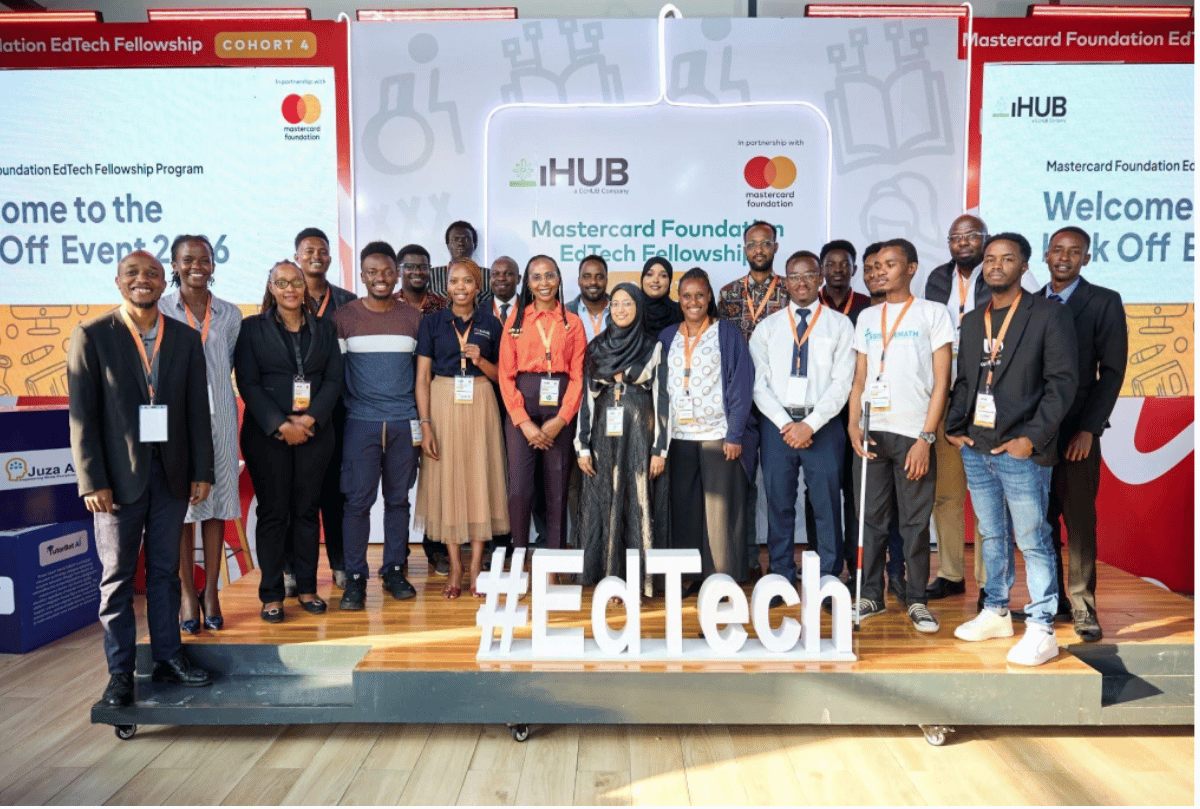
iHUB Selects 12 Kenyan EdTech Startups for Mastercard Foundation Fellowship
Cohort 4 marks a deliberate evolution of the EdTech Fellowship in Kenya, with a renewed focus on founders developing solutions for learners who have been excluded from technology-enabled education.
iHUB, in partnership with the Mastercard Foundation , has selected 12 startups for Cohort 4 of the Mastercard Foundation EdTech Fellowship in Kenya.
The selected start-ups were chosen across four thematic areas that address some of the most persistent barriers to equitable education: learners living with disabilities, refugees, displaced and underserved communities, and girls and young women. Together, they represent a new generation of innovators designing solutions that make quality education more accessible, inclusive, and relevant for every learner.
Innovation has the greatest impact when it begins with the learners who have historically been excluded. Cohort 4 reflects that belief. noted Nissi Madu, Managing Partner at iHUB. These founders are tackling some of the most persistent barriers to equitable education through solutions designed with inclusion at their core. Over the next 18 months, our role is to help them test, refine, and generate evidence for their solutions while building sustainable businesses that can scale their impact. Through this support, we are working to ensure no learner is left behind and that these solutions contribute to more inclusive education systems and Africa’s long-term prosperity.
The 12 startups reflect this shared commitment. DEAFHEALTH, AssistiveMath, Signvrse, Deaf Outreach Program, SmartSteamMinds Edtech, and Chipurobo are improving accessibility through assistive technologies, inclusive learning platforms, digital skills, and specialised education solutions for learners living with disabilities. Neurollect Audread, JUZA AI LTD, Ubuntu Universe Limited, and RYEH CBO are expanding access to quality education through multilingual, offline, AI-enabled, and technology-supported learning for refugee, displaced, rural, and underserved communities. Gwiji for Women and Tausi App are equipping girls and young women with entrepreneurial, vocational, and digital skills that strengthen pathways from learning to livelihoods.
Since its launch in Kenya in 2023, the Mastercard Foundation EdTech Fellowship has supported 36 EdTech companies. Collectively, these ventures have reached more than 700,000 learners, empowered over 11,000 educators, partnered with more than 2,100 schools nationwide, and extended access to learning for over 6,000 learners with hearing and visual disabilities.
“Through the Mastercard Foundation EdTech Fellowship, we gained the tools, networks, and support needed to strengthen our solution and expand our impact. The program helped us move beyond building technology to creating meaningful learning experiences for 14,000 learners across 35 counties, particularly in underserved communities where access to quality education remains a challenge. M-Lugha has since been downloaded in 130 countries by users seeking to learn their local languages. The Fellowship has shown us the power of investing in local innovators who are building solutions for Africa’s education needs.”
– Abdinoor Ali Mahdi, founder, M-Lugha, and 2025 Fellow
The 12 selected Founders will also gain access to iHUB’s network of ecosystem partners, as well as media readiness and stakeholder engagement support to help refine, validate, and scale their solutions through strategic partnerships and investment opportunities.
“At its best, EdTech does not just digitize education; it redistributes opportunity, and that’s where the Mastercard Foundation EdTech Fellowship comes in. The Fellowship sits at the intersection of three powerful forces – education system transformation, inclusive technology-enabled solutions and sustainability of Africa’s EdTech entrepreneurship”
– Wariko Waita, Director of the Centre for Innovative Teaching and Learning (CITL), Mastercard Foundation
While previous cohorts had an eight-month acceleration period and focused on growth-stage companies, cohort four is targeting early-stage start-ups and an 18-month journey. During the period, each start-up will receive up to USD $ 100,000 in equity-free funding, alongside tailored technical assistance across product development, business strategy, communications, and evidence generation through a dedicated pilot framework.
Related Stories
 Technology
When Tech Companies Die, What Happens To The Products They Leave Behind?
2 days ago
 Technology
Two Finns supplying Russia with missile tech worth tens of millions
2 days ago
 Technology
Drones with pepper spray, four
3 days ago
 Technology
Micron Technology stock pre-market at EUR 800.50: memory storage - ad
3 days ago
 Technology
TAIEX Ends at 4
3 days ago
 Technology
ZAWYA: Technology, start-ups can double India
3 days ago
 Technology
Czech government to consider CZK 1 billion fund for startups
3 days ago
 Technology
GDIN Supports Eight Startups at CEATEC 2026 in Japan, Opens Door to Local Investor Collaboration
3 days ago