
Hydromea, FAU Receive AUKUS Grant to Unlock Subsea Data Communication
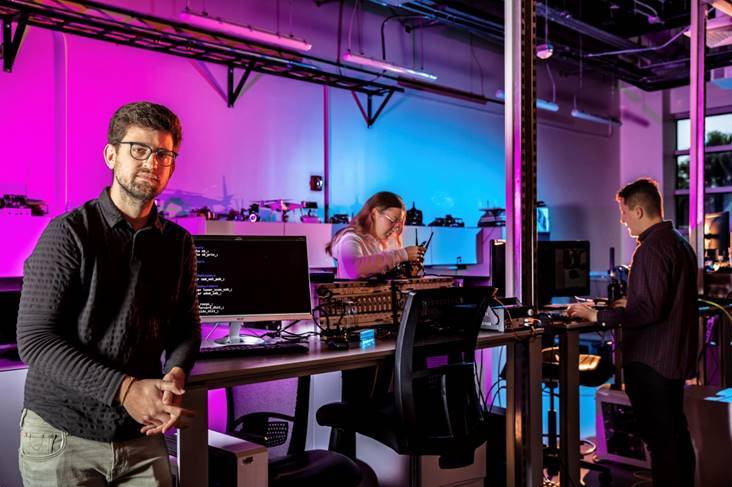
Hydromea, FAU Receive AUKUS Grant
Hydromea SA and Florida Atlantic University (FAU) won a $1 million award granted through the AUKUS Maritime Innovation Challenge.
The trilateral defense initiative, backed by the United States Defense Innovation Unit (DIU), Australia's Advanced Strategic Capabilities Accelerator (ASCA), and the United Kingdom's Defense and Security Accelerator (DASA), is funding the joint team to develop a next-generation underwater communication and networking system capable of operating in contested and congested environments.
The project was selected from a highly competitive international pool of proposals from universities, research institutions, and industry across the US, UK, and Australia.
Despite hosting the world's most critical infrastructure, like subsea energy pipelines, transcontinental data cables, and defense sensor networks, the ocean remains strikingly data-poor. Real-time wireless data exchange at depth is practically impossible with conventional technologies: radio waves and GPS do not penetrate seawater, and acoustic systems offer severely limited bandwidth. Vast volumes of sensor data sit stranded on the seabed, inaccessible unless a vessel physically retrieves them.
The joint FAU-Hydromea platform integrates two complementary technologies: long-range acoustic links for resilient wide-area command and control, and Hydromea's high-speed LUMA FSO optical modems for rapid, high-bandwidth data harvesting. This hybrid architecture resolves the fundamental trade-off that has constrained underwater operations for decades—the choice between range and throughput.
Hydromea's LUMA platform transmits at up to 10 Mbps, is pressure-certified to 12,000 meters depth, and delivers approximately 1,000× greater speed and 1,500× greater energy efficiency than acoustic alternatives. Its inherently low probability of intercept (LPI) profile makes it uniquely suited for covert, stealth data exchange in tactical underwater environments.
Testing will move from controlled lab environments in Switzerland and Florida to advanced field demonstrations off the coast of Australia, involving autonomous surface vessels, underwater vehicles, and stationary seabed systems. The project is estimated to be delivered in less than a year.
The same hybrid architecture applicable to defense—persistent covert surveillance, anti-submarine warfare sensor nets, seabed domain awareness—applies equally to offshore energy monitoring, environmental science, and networked autonomous vehicle swarms. Together, acoustic and optical technologies open an entirely new category: subsea wireless broadband infrastructure, the ocean equivalent of the networks that transformed situational awareness above the waterline.
Related Stories
 Technology
Ørsted Orders Third Saab Seaeye Cougar ROV
15 minutes ago
 Technology
Sagar Defence, Lloyd’s Register to Advance Pathways for Autonomous Systems Certification
15 minutes ago
 Technology
MTN Opens 2026 Technology Hackathon to African Innovators and Employees
15 minutes ago
 Technology
High ticket gates installed to deter fare dodgers
1 hour ago
 Technology
REG - Bytes Technology Grp
1 hour ago
 Technology
A new technology chief will oversee EagleNXT’s drone, sensor and software strategy
1 hour ago
 Technology
What's next for Micron Technology after blockbuster Q4, guidance beat?
1 hour ago
 Technology
Have Insiders Sold Firan Technology Group Shares Recently?
1 hour ago