
How a Saint John man found the oldest fossils in Atlantic Canada
How a Saint John man found the oldest fossils in Atlantic Canada
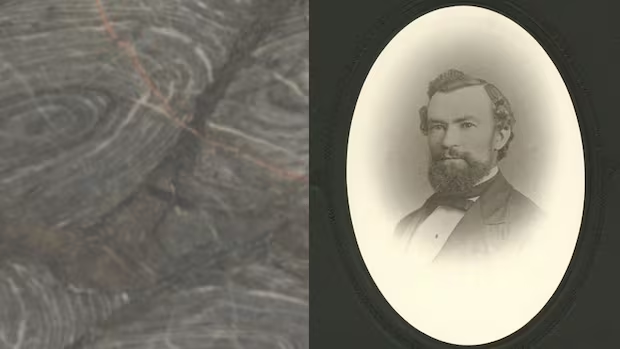
At first, George Matthew wasn't sure what he'd found in Red Head Cove, at what is now Dominion Park
Six hundred and fifty million years ago, during the Precambrian era, Saint John was a much different place.
First off, no people, animals or trees of any kind.
Second it was much farther south, below the equator.
But there was life here, and we can thank one Saint John man, George Matthew, for proving that there was, even if many don’t recognize his work.
“Although the American geologist Charles Doolittle Walcott is viewed as the founder of Precambrian paleobiology, Matthew deserves acknowledgement for his early recognition of Precambrian life,” Randall Miller, a former curator of paleontology at the New Brunswick Museum wrote in an article about Matthew for Geoscience Canada.
Matthew was born in Saint John in 1837.
His day job saw him working in the city’s busy customs office, but his love was science.
“Even though Matthew did not attend university, the intellectual atmosphere in Saint John supported his interest in natural history, and its complicated geology challenged his curiosity,” wrote Miller, this time in the Dictionary of Canadian Biography.
New Brunswick Museum home to 650-million-year-old fossil
“In 1857, at age 20, he helped found the Steinhammer Club, composed of five young men interested in local geology.”
The club, whose German name translates to stone hammer, came along at a good time to make scientifically important discoveries.
“The fossil record in New Brunswick, and in this particular area specifically, is absolutely insane,” popular historian James Upham said during a tour of Dominion Park for his Roadside History column on CBC.
“This area specifically has been on the absolute cutting edge of geological research since the very beginning.”
One day in 1872, Matthew and L.W. Bailey travelled to Green Head Cove, now a part of Dominion Park, site of a popular beach on the west side of Saint John.
There the two enthusiasts discovered a fossil that would put the Fundy region on the map for fossils.
In their notes, they described it as “large numbers of concentric nodular masses, bearing much resemblance to some genera of corals.”
What Matthew and Bailey had found were stromatolite, basically ancient tiny organisms such as algae that were crushed together and made fossils that look like psychedelic geometric shapes.
“They described these structures but didn't realize what they had exactly at the time,” said Matt Stimson, the acting curator of paleontology at the New Brunswick Museum.
It's not difficult to see why Matthew didn’t know exactly what he had.
Miller said the field of paleontology was still in its infancy and the term stromatolite didn’t come into use until 1908.
Plus, in a bit of bad luck, Matthew just missed the more conclusive fossils on the other side of the cove.
“Had they gone a little farther along the shore and seen the better exposure perhaps [they] would have changed the study of Precambrian paleontology,” Miller said.
It wasn’t until 1890, when another man, William Murdoch, sent Mathew a slab of marble with embedded stromatolite from a cliff at Green Head Cove that he was able to confirm his previous discovery.
“At that point, they realized that they had early evidence of life in the Precambrian,” Stimson said.
The Precambrian period spanned from the beginning of time until about 540 million years ago.
The fossils are from about 650 million years ago, which makes them the oldest fossil record in Atlantic Canada, Stimson said.
Matthew named the fossil formation Archaeozoon acadiense.
Some of the original stromatolites he found were sent for study at McGill University, while much of his collection was later sold to the Royal Ontario Museum.
While the fossils are important for our understanding of natural history, they're not the only examples in the Saint John area.
The Stonehammer Geopark is a 2,500-square-kilometre UNESCO park spread throughout southern New Brunswick.
And if you have some time, and a canoe, you can even visit Green Head Cove and see stromatolites.
But whatever you do, don’t bring your own stone hammer.
“Fossils are protected and the fossil locality is protected under what we call the Heritage Conservation Act,” Stimson said.
“This is in particular a designated fossil site, a designated heritage site. So it is a special protected site.”
Jordan Gill is a reporter based in Fredericton, New Brunswick.
With files from Information Morning Summer
Related Stories
 Canada
As Canada
6 minutes ago
 Canada
Quebec must unite with Canada amid Trump’s trade war, Liberal leader says
1 hour ago
 Canada
'The single largest obstacle': Expert questions whether Canada can trust another U.S. trade deal
1 hour ago
 Canada
Canada widens permanent residence track for French speakers in Sudbury
1 hour ago
 Canada
Geoff Russ: Conservatives have ceded love of Canada to Liberal vanity
2 hours ago
 Canada
As Carney advances Vancouver port expansion, environmentalists raise concern for at
2 hours ago
 Canada
Canada’s tariffs are coming for Michigan
2 hours ago
 Canada
Canadians back turning down U.S. trade deal, most support counter
2 hours ago