
Health
Health-care groups call on Ottawa to stop Alberta’s dual medical practice model
Alberta gets nearly 400 expressions of interest from physicians
Canadian and provincial health-care groups are calling on the federal government to stop Alberta from allowing physicians to practise in both the public and private system.
The change is enabled by the Health Statutes Amendment Act, 2025 (No. 2), commonly called Bill 11, which takes effect on Tuesday.
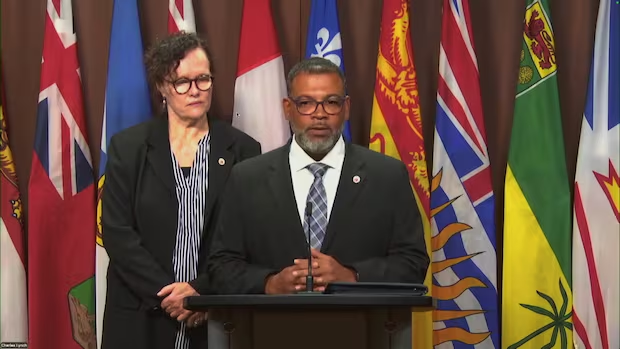
“[Bill 11 is] the biggest threat against health care since the Canada Health Act was passed in 1984,” Jason MacLean, chair of the Canadian Health Coalition, said at a news conference in Ottawa Monday.
The group is planning rallies in 30 locations across Canada on its so-called Day of Action on Tuesday. The rallies will be followed by 50 town halls this fall as part of its national campaign against the bill.
MacLean said he believes changes enabled by the bill will make access to health care unequal. He said when physicians are able to practise in both systems, resources tend to migrate towards the private pay system, creating long waitlists in the public system.
MacLean called on federal Health Minister Marjorie Michel to take action before other provinces follow suit.
“We don't understand why the federal government is mute on this. This is an issue of national consequence,” he said.
“We all know what happens in Alberta won't just stay in Alberta.”
Federal health minister voices concern as Alberta implements dual-practice health-care model
Bill 11 was introduced and passed in Alberta’s legislature in the fall 2025 sitting, allowing doctors to apply to be able to practise in both the public and private spheres.
In order to be eligible to apply for dual practice in Alberta, physicians need to work a prescribed number of hours in the public system. Family physicians are not allowed to practise in both systems at this time.
According to the province, surgeries under the dual-practice model likely won’t start until later in the fall because physicians must get approved by the government first. They can start applying in mid-September.
Maddison McKee, press secretary for Alberta’s Hospital and Surgical Health Services Minister Adriana LaGrange, told CBC News that the province is reviewing nearly 400 expressions of interest received from physicians about the new dual-practice option over the summer.
“This will help us gauge interest, understand what specialists are contemplating dual practice and prepare for the formal application process,” she wrote.
“Applications will be reviewed to ensure eligibility criteria and government requirements are met, including public surgery hour requirements, monitoring and new reporting requirements.”
Province insists dual practice is allowed
McKee dismissed concerns raised by the Canadian Health Coalition about what it sees as Alberta moving to a U.S.-style health-care system as “fearmongering.” She said dual practice doesn’t violate the Canada Health Act.
“Our priority is a strong public system and ensuring Albertans never have to pay out of pocket for medically necessary care — which is a commitment we have made under our Public Health Care Guarantee,” she wrote.
“Expanding access through dual practice does not take away from that. It adds to it. This is not an either/or debate. It is about giving Albertans more choice.”
Earlier this month, Michel told the Toronto Star she was concerned about Bill 11. On Monday, her spokesperson, Alexandre Bergeron, said the federal government was collaborating with Alberta on any changes “that respects their jurisdiction to explore innovative ways to improve access and care while strengthening the public, universal health-care system.”
“Minister Michel is advancing targeted discussions with her counterpart focused on ensuring access to medically necessary care and the core principles of the public system are protected,” he wrote.
“A collaborative approach between our governments has always produced strong results for all Albertans and we will continue to work in that direction.”
Eligible doctors in Alberta can work in both public, private systems starting this fall
The federal government sent a letter to the province on July 24 confirming it had reviewed the regulations and the June 18 ministerial order, and that both levels of government should continue their collaboration.
Bergeron said Ottawa is in close contact with the province to ensure possible adverse impacts on the public system are mitigated and that changes are in compliance with the principles of the Canada Health Act.
Michelle Bellefontaine covers the Alberta legislature for CBC News in Edmonton. She has also worked as a reporter in the Maritimes and in northern Canada.
Related Stories
 Canada
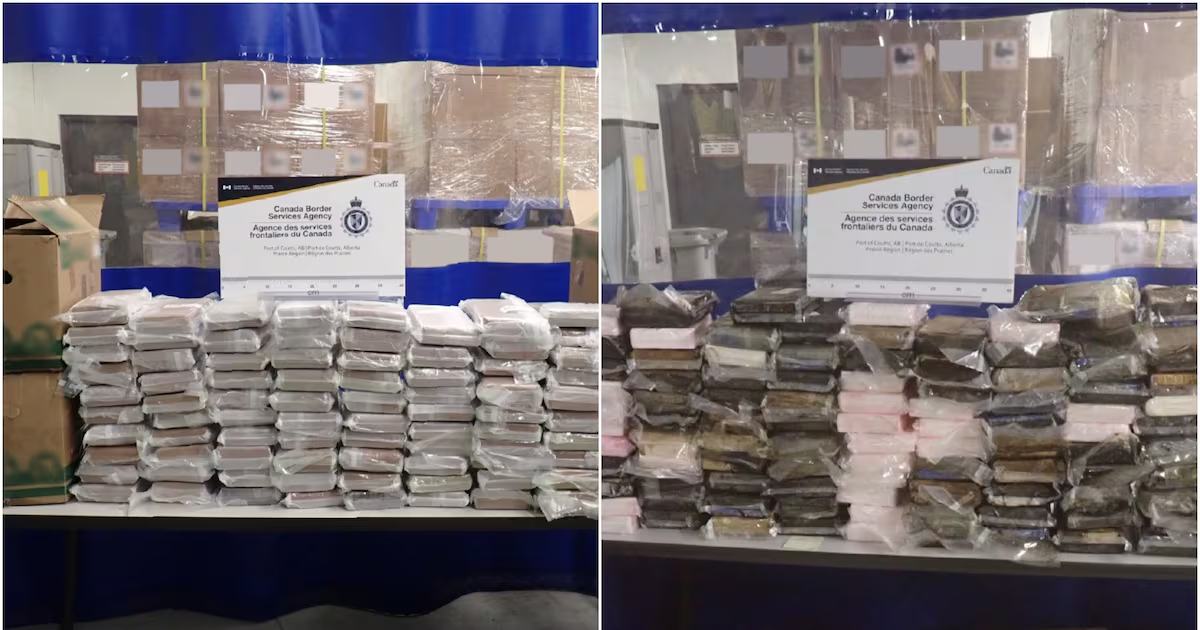
475 pounds of cocaine seized from trucks trying to enter Canada from U.S.: CBSA
53 minutes ago
Anishinabek Nation statement on the Canada Investment Summit 2026
53 minutes ago
 Canada
Latest U.S. tariffs on Canadian goods take effect, with some changes
53 minutes ago
 Canada
Latest U.S. tariffs hit a small number of Canadian goods while others are lifted
1 hour ago
 Canada
The first Canada Investment Summit unleashes nearly $500 billion of new investment in Canada
1 hour ago
 Canada
Talk turns to potential for Labrador wind power at Churchill River special session
1 hour ago
 Canada
Sally Field wins lead actress Emmy for ‘Remarkably Bright Creatures,’ setting a record
1 hour ago
 Canada
NATO jets shoot down drone over Lithuania and Russian ship fires flares at Danish helicopter
2 hours ago