
He was ready to fight in the 'war on terror.' This post
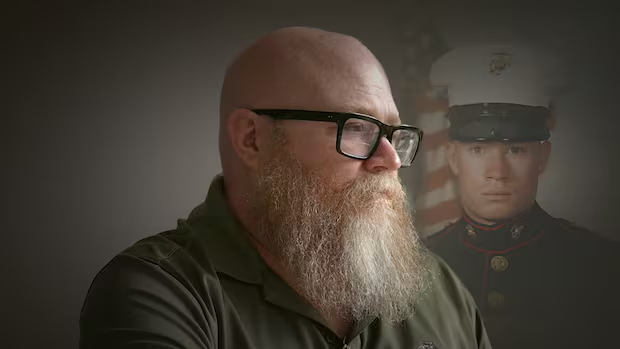
He was ready to fight in the 'war on terror.' This post-9/11 veteran looks back at his decision to enlist
First interviewed by CBC News as a new recruit, Barry Sward recounts his war experience 24 years later
He went to war after 9/11. It changed him forever
On Sept. 11, 2001, Barry Sward, a high school senior in Woodbridge, Va., watched the collapse of the twin towers on TV and knew he had made the right decision.
He had already enlisted to become a U.S. marine. Emboldened by a national tragedy, he now had an enemy to fight.
"There was a spike of revenge … and I did want to get the people that did this and hurt them really bad. I don't know why they're doing it," he told CBC News chief correspondent Adrienne Arsenault, who at the time was reporting on post-9/11 military recruitment.
In July 2002, he would start basic training at Parris Island, S.C., and just months later was part of the first units to enter Iraq as part of U.S. President George W. Bush's so-called "war on terror."
After Sept. 11, 2001, U.S. veterans are about twice as likely as those who signed up before them to have served in a combat zone, according to a 2019 Pew Research survey that polled 1,284 veterans. As a result, they are more likely to have been scarred by the battle wounds of war — not only physically, but mentally, too.
In that same survey, half of the respondents said they had emotionally traumatic or distressing experiences, yet only a third sought help to deal with what they faced.
CBC News chief correspondent Adrienne Arsenault, left, sits with U.S. marine vetreran Barry Sward, who shares photos and mementoes he saved from his time serving in Iraq in 2003, including a half pack of cigarettes, cassettes and his service cap. (Roxanna Woloshyn/CBC News)
In August of this year, Arsenault tracked down an almost unrecognizable Sward in Falmouth, Va., 24 years after their first interview.
She asked him: "Are you the same person you were when you went in?"
"No, definitely not," said Sward, now facing the effects of that deployment to Iraq — a resulting back injury and a PTSD diagnosis.
The post-9/11 patriotic recruits
In the days and months after the Sept. 11 terrorist attacks, media reports described long lines at military recruitment offices made up of young people who wanted to fight for their country.
"Post-9/11, you have a burst of patriotism and a need to serve, and there are plenty of stories of people who immediately left their jobs, went down to a recruiting station, or finally decided that they were gonna join," said Jason Dempsey, a scholar of American civil military relations at Columbia University.
"But that was not the majority of folks entering service. And in the grand scheme of things was a very temporary blip."
Sward, seen here in 2002, participated in basic training at Parris Island, S.C., as part of his preparations in the U.S. marine corps beginning in July 2002. (CBC News)
Numbers provided by the four primary branches of the military don't show a dramatic rise in enlistment immediately following Sept. 11 compared to other years.
Dempsey said the most common reasons for someone to join the military is a history of service in their families, a desire for financial security or educational opportunities and enlisting during a period of high unemployment.
Regardless of their reason for signing up, that generation of post-9/11 fighters would go on to participate in long-lasting wars in Afghanistan and Iraq — the latter of which saw U.S. foces officially withdraw just last month.
Serving in Iraq was 'frustrating'
In March 2003, as part of the global war on terror, U.S. President Bush announced forces would be invading Iraq if then-president Saddam Hussein did not leave.
Days later, Sward's unit, the 2nd Battalion, 8th Marines, crossed into the country. Their mission was to secure bridges in a highly defended enemy territory so troops could ultimately make their way to Baghdad.
March 23, 2003, is a day that haunts Sward. It was the beginning of a deadly fight known as the Battle of Nasiriyah.
Eighteen of his fellow marines died, including a friend he met in basic training.
"It was tough. There was a lot of screaming, obviously, and we could hear it happening," said Sward. "And that was the frustrating part — knowing that something else was going on, not too far away from you, but can't do anything about it."
U.S. marines from Task Force Tarawa duck as a helicopter fires a missile that destroys a building during a deadly gun battle on March 23, 2003, in the southern Iraqi city of Nasiriyah. (Joe Raedle/Getty Images)
While there, his unit was tasked with patrolling inside the city and looking for leadership and evidence of weapons of mass destruction.
Bush rationalized the invasion of Iraq on unverified U.S. intelligence that the country's leadership was harbouring destructive devices that would cause massive damage to populations if deployed. In the years since, no evidence was ever found that those weapons existed.
During the interview in August, Arsenault asked Sward what it was like knowing this in hindsight.
"It's frustrating. Still proud to have served, but maybe there were some political aspects that were at play in the background," said Sward.
More than 7,000 troops died in post-9/11 wars, according to research from Brown University's Costs of War project, and four times as many U.S. military personnel have died by suicide in the years since.
Since then, those wars have been looked at with a critical eye as to whether they accomplished what they set out to do.
That same Pew Research survey found that 64 per cent of veterans say the war in Iraq was not worthwhile, and similarly, 58 per cent said the same about Afghanistan.
Post-9/11 vets made progress addressing PTSD
Sward's time serving in Iraq was cut short. He suffered chronic back pain due to a spinal issue, and he returned to the base in Camp Lejeune, N.C., that same year, and was eventually processed out of the marine corps.
But it would take 14 years for Sward to get a diagnosis for the deeper pain he was struggling with: PTSD.
"Mine tends to show up as anger. I was either sad or I was pissed off and there wasn't any in-between. It took me a lot of therapy and I learned a lot from my wife," said Sward. His wife, Rebecca, is a licensed psychotherapist.
"I was either going to get help or I was going to lose my wife and my wonderful kids. I definitely made the right choice."
"As he's gotten older, I think he's been more open to unpacking trauma and trying to heal," said Rebecca, whom he met after he returned home. They’ve been married 21 years and have four children.
Sward poses with his wife, Rebecca, right, and four children. (Roxanna Woloshyn/CBC News)
According to the U.S. Department of Veteran Affairs, 29 per cent of veterans who served in Iraq or Afghanistan will have had PTSD at some point in life, compared to 10 per cent who served in Vietnam and three per cent who served in the Second World War and the Korean War.
"Back in those times, I don't think the rates were really lower if we look at actual cases, but I think a lot of people could not come forward. They couldn't say that they were still struggling with nightmares or with flashbacks or other reminders of the war," said Timothy Hoyt, chief mental health officer with the U.S. Defence Health Agency in Falls Church, Va.
"We've seen a lot of progress in addressing those stigma concerns in the last 20 years."
Despite the trauma he faced, Sward says he still takes great pride in the time he served in the marines, he just won't encourage his children to sign up.
"I have no regrets. All my choices have led me here to this moment where I have my beautiful wife and four kids."
Roxanna Woloshyn is a producer at CBC's The National and Adrienne Arsenault is CBC's chief correspondent and host of The National.
With files from Lillie-Anne Coussée
Related Stories
 Careers
Film shares 'rich tapestry' of Windrush children's lives
1 hour ago
 Careers
Laid-off Stelco steelworkers stressed about company's future
2 hours ago
 Careers
White House blocks Microsoft from foreign worker hiring programme
13 hours ago
 Careers
Canadian economy lost 68,000 jobs in September, marking second straight month of declines
18 hours ago
 Careers
Canada sheds 68,000 jobs, unemployment rate up to 6.5% in September
19 hours ago
 Careers
Canada’s employment surprisingly shrinks in September, jobless rate inches up
19 hours ago
 Careers
Canadian economy lost 68,000 jobs in September
19 hours ago
 Careers
Egyptian journalists plan weekend protest over detention of six colleagues
22 hours ago