
Haifa 1918: India, Israel and the politics of memory
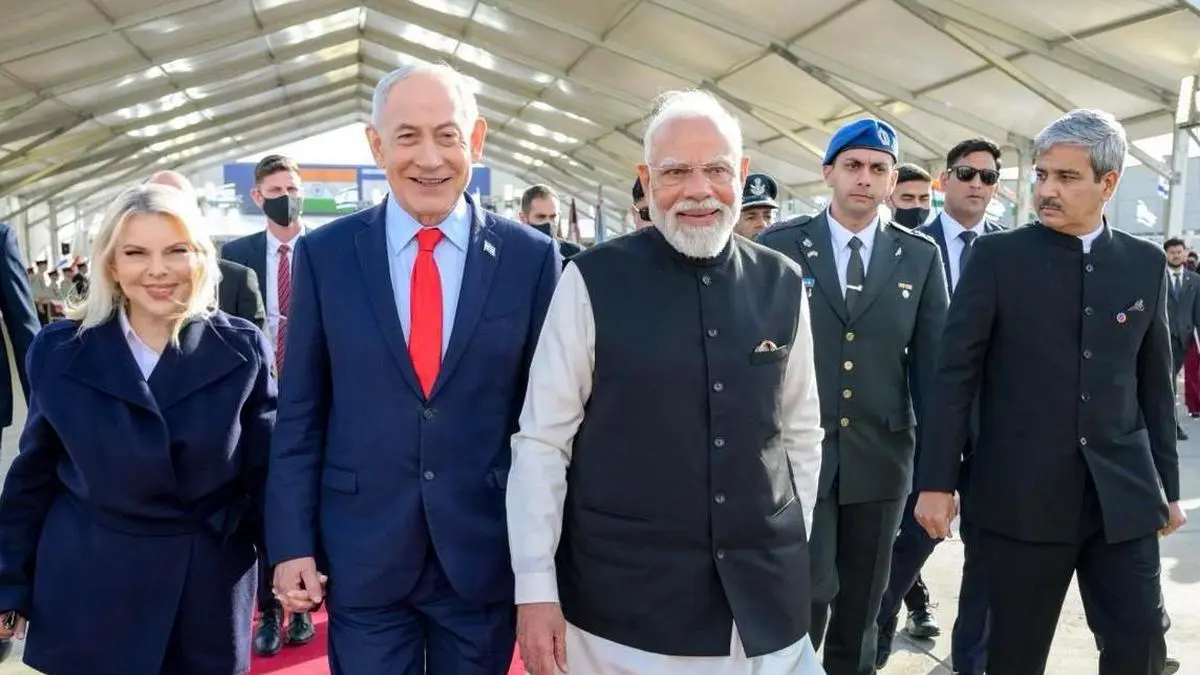
A little over a century ago, on September 23, 1918, an anniversary the BJP government will be celebrating along with Israel, the eastern Mediterranean port of Haifa on the Palestinian seafront fell to the British Indian army, specifically to the cavalry of Colonel Sir Pratap Singh, the Maharajah of Idar and Regent of Jodhpur, who accomplished the fall of Haifa within a few hours on the morning of that day.
The “Battle of Haifa” is, however, difficult to find in records of the battles fought by the Brits because it was a minor part of the larger Battle of Megiddo, fought on a 20-mile coastal plain along the East Mediterranean, crisscrossed by German and Turkish trenches, on which Haifa, then little more than a fishing village, was located.
The taking of Haifa was incidental to the larger strategic goal of capturing Damascus, to the north of Haifa, to give a “final blow” to Turkey, complementing the march of British Indian forces in Iraq towards the oil fields of Kirkuk near the border of the Sultanate of Turkey, which had joined the Germans at the start of the First World War.
The military action was accompanied by political deception. While making a claim to the Arab Sheikhs, particularly Sharif Hussain, who aspired to become the Khalifa (Caliph) and Keeper of the Two Mosques after the Sultan of Turkey had been defeated and deprived of his Arab territories, the perfidious British undertook through their leading Arabist, Sir Mark Sykes, to secretly discuss with his French counterpart, Francois Georges-Picot, the division of “liberated” Arabia between France and the UK.
Sykes was instructed to ensure that Palestine, in particular, fell to the UK, even if that meant ceding some of the Levant (Syria and Lebanon) to the French. Second, the Brits, who were running short of ready money to prosecute the Great War, turned to the Rothschilds to save them from bankruptcy.
Lord Walter Rothschild lent them vast sums but bargained for a Declaration from the UK Foreign Office that would announce the grant of a homeland in Arab Palestine for the diaspora Jews. At the same time, the British befooled the Palestinians into imagining that they would acquire self-rule once hostilities ended. Thus, Palestine, which the Jews regarded as the “Promised Land”, promised to them by Jehovah, became, as a British wit remarked, a “Twice-Promised Land”, promised to both the Palestinian Arabs and the diaspora Jews.
To put the taking of Haifa in perspective, it is useful to remember that around 15 lakh Indian soldiers were deployed in all theatres of the First World War stretching from the Western Front in Europe along the French trenches running parallel to the German through the Arab lands and through the Horn of Africa to the German colony of Tanganyika.
It was only with the disastrous misadventure of the Battle of Kut in 1915 that the deployment of Indian soldiers in the Middle East began, first in Mesopotamia, extended later to the Arabian Peninsula, Gaza and north towards Damascus. Of the lakhs of Indian jawans fighting on almost all fronts for the British Empire, Sir Pratap Singh’s Jodhpur Lancers constituted some 600 horsemen.
There is little sense in celebrating the skills and valour of the Jodhpur cavalry while brushing from living memory the unparalleled heroism and courage displayed in related theatres of war by 15 lakh Indian soldiers. And it passes belief that we choose to celebrate the Haifa victory in the company of Zionist Israel, which did not even exist at the time, even while keeping in mind that Zionist loyalty to the British Empire was being bought in cold cash.
Sir Pratap, the oldest serving officer when the Great War started, had two passionate loves: his horses and his British masters. While the horses reciprocated his love to the extent of the Maharajah bedding down with the 12 thoroughbreds he had bought himself in England to race on the tracks in India, the British mocked his rather eccentric English (“I am going knocking over one German, dying for my King-Emperor”; refusing leave, saying, “me not liking propaganda, me fighting man, me thinking charging time coming soon”).
In consequence, when it was time for the Brits to express their gratitude for help rendered, they thought it adequate to appoint a representative of the Princely Order to the Imperial Legislative Council. They passed over Sir Pratap Singh because they could not forgive his slaughter of the noble tongue of Shakespeare and Milton, and gave the nomination instead to Sir Ganga Singh, the Maharajah of Bikaner. Thus was fulfilled the British chant:
“We don’t want to fight; but, by Jingo, if we do
We won’t go the Front ourselves, we’ll send the mild Hindoo.”
To commemorate the immense contribution of Indian soldiers to the victory of the Allies, especially in the Arab territories of the Ottoman Empire, Sir Edwin Lutyens, who was in charge of designing the British Indian capital of New Delhi, decided to install a monument to the Indian soldiers who had enabled the Allied victory in the roundabout outside the residence of the British Commander-in-Chief. That is the origin of the Teen Murti statues that stand in front of what became the Prime Minister’s House after Independence, later the Nehru Museum and Library, and now the Prime Ministers’ Museum and Library.
The Embassy of India in Tel Aviv, in association with the Municipality of Haifa, on September 16, 2026, commemorated the extraordinary valour and sacrifice of the Jodhpur and Mysore Lancers who fought in the Battle of Haifa on September 23, 1918. Here, Ambassador J.P. Singh pays tribute to the fallen Indian soldiers by laying a wreath at Haifa Cemetery. | Photo Credit: X.com/@indemtel
On September 23, 2026, India and Israel will jointly commemorate the “liberation” of Haifa. It would be perfectly in order if India alone were to commemorate the heroism and sacrifice of its soldiers.
But why bring in Israel, which did not even come into existence until three decades later? The only possible explanation is the ideological affinity between Hindutva and Zionism, to which expression is being given so fiercely by the Narendra Modi regime.
In any case, does stealing from Paul to give to Peter amount to “liberation”? The Brits could never have defeated Turkey in their Arab possessions without the help of the Arabs. Yet, they deftly snatched the Arab territories from the Turks not to give these lands to their rightful owners, the Palestinian Arabs, but only to gift these lands to themselves and their partners in crime, the French.
Caught in the crossfire of Arabs and Jews, they were eventually driven out of Palestine by vicious Zionist terrorists, at least two of whom became Prime Minister of Israel.
So, what were we celebrating with these genocidal war criminals on Haifa Day? The filching of Haifa port from Arab hands to serve as the entry point for the Jewish Exodus from Holocaust Europe? And how could Albion perfide get away with such deception? By placing Palestine under a military administration known as the Occupied Enemy Territory Administration, somewhat distant, would you not say, from “Independence”? Thus, Turkish Occupation was replaced by British Occupation.
So, whom did Sir Pratap Singh’s cavalry “liberate” Palestine from, and who was the beneficiary of that “liberation”? There were many contenders for the “honour”, but no one cared to ask the local inhabitants, the Palestinians themselves.
For their impudence in demanding liberation, the Palestinian Arabs were granted Al-Naqba, the “Catastrophe” of the creation, by ruthless armed force and inhuman terrorism, of Israel as a state for only those of the Jewish “race” (although genuine Jews were of the same Semitic race as the Arabs, if not the blue-eyed east European version that emerged from the ghettoes of Poland and Russia to dominate Israel).
Moreover, as compared to the 491 Indian soldiers buried at the Ramleh cemetery and 109 buried in the cemeteries at Gaza and Deir al-Balah, the number of dead at Haifa is only 47. Then why single out Haifa, where the Adani group is developing a port, when Indian soldiers served all over the Arab lands from the Suez Canal and Gaza and Jerusalem to Damascus, Aleppo, and Mosul/Erbil/Kirkuk (where I served as a diplomat)?
Israel is accountable for nearly 75,000 innocent civilians, including the thousands of children, women, and elderly it brutally murdered in Gaza. We should be distancing ourselves from these awful brutes, not embracing them. It is like celebrating Deepavali with Ravana.
Mani Shankar Aiyar served 26 years in the Indian Foreign Service, is a four-time MP with over two decades in Parliament, and was a Cabinet Minister from 2004 to 2009. He has published nine books, the latest, A Maverick in Politics, the second part of his memoir.
Also Read | The India link in Israel’s Gaza war
Also Read | Vishwaguru cannot be a bystander in West Asia
Related Stories
 India
India
Sri Lankan court to deliver verdict on deadly Easter bombings
5 minutes ago
 India
India
Sachin Tendulkar
6 hours ago
 India
India
Families of Air India bombing victims 'utterly shocked' to learn investigation is inactive
10 hours ago
 India
India
Instagrams Takedown of Digital Rights Groups Post Exposes Metas Politics of Censorship
19 hours ago
 India
India
The CFO Code: Decoding How India’s Top CFOs Think, Build And Scale
21 hours ago
 India
India
India Free Trade finale brings odd pairings
1 day ago
J&K assembly chaos: Opposition, ruling party MLAs clash amid slogans
1 day ago
 India
India
Why a new Pakistan
1 day ago