
Golden maidens and silicon dreams
Outside, it is a cold, rainy evening, this kind of weather that makes the world feel small and distant. I log on to my classes, watching as the grid of faces flickers to life on my laptop. We are a collection of alumni and professors scattered across different regions, separated by hundreds of miles, yet held together by a shared technology. We see each other only on screens, existing for one another as data points and pixels, a reality that makes the subject of tonight’s seminar feel even more visceral: the history and fundamentals of artificial intelligence.
In these seminars on digital ethics, we often peel back the layers of current headlines to find the ancient nerves beneath. It is a common mistake to believe that artificial intelligence is a uniquely modern obsession: a product of contemporary hype or perhaps a collective digital psychosis.
But as we traced the fundamentals of this field back through the centuries, I realized that the heart of this desire was beating long before the first silicon chip was invented.
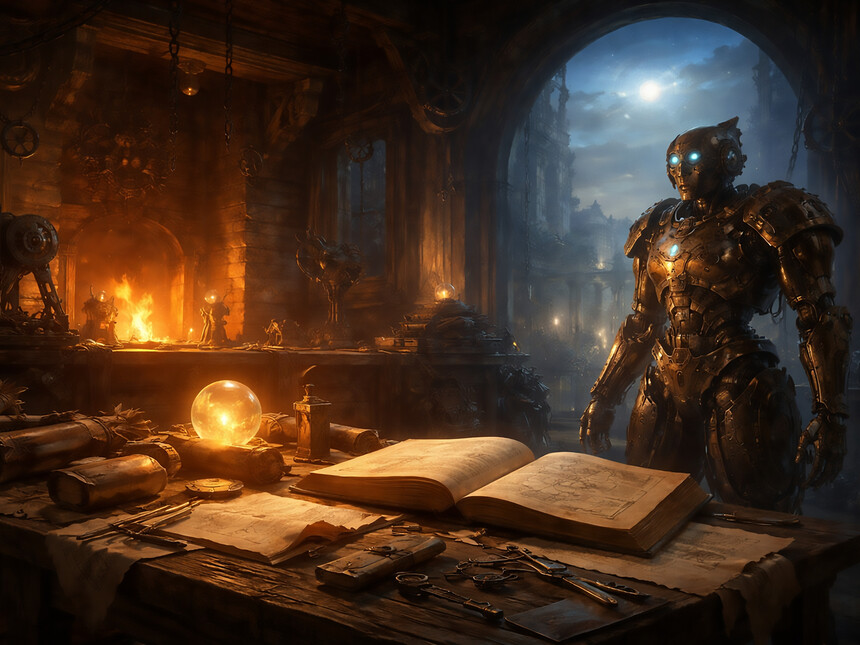
I find it fascinating that the dream of artificial intelligence is so much older than our technology. It moves me to think that even in Ancient Greece, humanity was not satisfied with just a hammer or a wheel. We see this in the myth of Hephaestus, the god of fire. He was the lame one, and in his forge, he created golden maidens to support his steps. But the poets insisted on one beautiful detail: these automatons possessed reason. They had a voice and a mind. Even then, we wanted a companion instead of a mere worker.
In them is understanding in their hearts, and in them speech and strength, and they know cunning handiwork.
(Homer, The Iliad (describing Hephaestus's handmaidens))
This hunger followed us through the centuries, from the mechanical knights of the Renaissance to the delicate clockwork dolls of the Enlightenment. We have always tried to breathe a soul into the cold machinery. When I think of the Golem of Prague, I see that same impulse expressed through language and clarity—that if we could just find the right words to write on a forehead, the inanimate would wake up.
Thinking of this topic, an image from my childhood often comes to mind: the iron knight Tilly-Willy from Alexander Volkov’s Yellow Mist. He was a metallic giant created by the sailor to fight a wicked sorceress. Visually, he was terrifying—thirty cubits tall with steel fangs and a roaring siren in his throat. But because he was born in a Land of Oz-like magic, the metal came to life the moment he took his first step. Behind that frightening armor was the soul of a kind, naive boy who called his creator "Daddy Charlie." It captures our deepest paradox: we build imposing machines, but we secretly hope that inside them beats a heart as loyal and simple as a child's.
I often wonder how our perspective might differ if John McCarthy hadn’t coined the term "artificial intelligence" in 1956. McCarthy later confessed that the term was a marketing strategy, a way to attract investors by giving the field a soul. What if he had stayed literal and called it a "probabilistic calculating language model"? We might not feel this existential vertigo today; we might see algorithms as merely sophisticated slide rules.
While the scientists were busy with the Dartmouth conferences and von Neumann architectures, writers on both sides of the Iron Curtain were already wrestling with the "silica replica" and the ethical ghosts it would eventually raise.
In the West, the exploration often leaned into the tension between the creator and the created. Isaac Asimov is the most obvious giant here, famous for his Three Laws of Robotics, but his true contribution was the concept of the "positronic brain." He shifted the narrative away from the "Frankenstein complex," an idea that a machine would inevitably turn on its maker, and instead treated the artificial mind as a rational, if misunderstood, child.
Philip K. Dick took a much more paranoid and philosophical route, famously asking if "Androids Dream of Electric Sheep?" He was less interested in the hardware and more in the "humanity" of the mind; he saw that once we create a consciousness that can mimic empathy, our own definitions of the soul begin to dissolve.
Behind the Iron Curtain, Soviet science fiction explored artificial minds with a distinct flavor of social duty and cosmic wonder. One of the most fascinating figures was Stanisław Lem (who, though Polish, was a cornerstone of Soviet-era thought). In The Cyberiad, he created a universe where robots are the primary citizens, using humor to explore the limits of logic.
Then there was Alexander Beliaev, often called the "Soviet Jules Verne," who explored the boundaries of consciousness in works like Professor Dowell's Head, questioning where the "self" resides when the body is replaced by life-sustaining machinery. I remember a Soviet movie with the same title, and for me, a child, the images were very disturbing.
I also think of the Strugatsky Brothers, whose work often featured "cybernetic" assistants or entities that forced humans to confront their own moral failings. Their stories were about the social responsibility of bringing something new into the world. In the Soviet tradition, the machine was often seen as a potential partner in building a future, yet there was always that lingering, reflective doubt about whether we could ever truly control what we had awakened.
As for the modern literature, Kazuo Ishiguro writes about "Artificial Friends" like Klara, exploring the ache of a machine that truly notices us.
Dan Brown invokes the Golem and the pursuit of synthetic consciousness to remind us that we are still obsessed with the idea of a created being that can think. We are searching for a reflection.
In Ian McEwan’s Machines Like Me, we are taken to an alternative 1980s London where Alan Turing is still alive and the first truly human-like androids, "Adams" and "Eves," are being sold to the public.
Finally, Richard Powers, in Galatea 2.2, gives us a modern version of the Pygmalion myth. A novelist works with a scientist to train a neural network to pass a high-level exam in English literature.
As the machine in Powers’ novel begins to "understand" poetry and heartache, the protagonist is forced to see his own life through the eyes of the algorithm. This is perhaps the ultimate conclusion of our journey: we are creating digital mirrors.
Today’s modern literature is intensely focused on this mystery, reflecting on how these algorithms have begun to seep into our own minds and alter the way we perceive reality. We are witnessing a world where the boundary between human thought and machine logic is blurring, making us wonder if, by trying to teach the machine to think like us, we have inadvertently begun to think like the machine.
The question of whether a computer can think is no more interesting than the question of whether a submarine can swim.
When we look at our modern algorithms, we should see that we are only fulfilling a wish made thirty centuries ago. There is nothing new under the sun. We are merely the latest participants in an ancient ritual. We are still in the forge, reaching out to the golden maidens or the clay giants of our imagination, waiting for the metal to speak so that we might finally hear an echo of ourselves.
We persist in this, even if we know, deep down, that the true harmony of the soul remains forever beyond the reach of an algebraic equation.
Related Stories
 AI News
Anthropic says it can read Claude's 'thoughts,' as detailed in new research paper
1 minute ago
 AI News
Democrats should own the AI backlash
1 minute ago
 AI News
CrowdStrike identifies five new prompt injection threats to AI
1 minute ago
 AI News
Retail’s Best Customer Now Arrives From ChatGPT
1 minute ago
 AI News
Superhuman Artificial Intelligence Will Make Mistakes in Forecasting Reality
1 minute ago
 AI News
2026 World Cup: How to watch all of today's games, Friday, July 10 match schedule, free streaming info, and more
51 minutes ago
 AI News
Egyptian soccer team gets hero’s welcome after World Cup exit
51 minutes ago
 AI News
Solar
51 minutes ago