
Gaza has become frozen in 'humanitarian purgatory'
Gaza has become frozen in 'humanitarian purgatory' — and it could get worse
International interest has dwindled in 9 months since the ceasefire, leaving Gaza in limbo
Gaza stuck in ‘humanitarian purgatory’ 9 months into ceasefire
Nine months after Hamas and Israel agreed to a hard-fought ceasefire in Gaza, the term has become a cruel irony for the two million Palestinians trapped inside the territory.
The situation has become what one analyst described as a permanent state of "humanitarian purgatory" amid a landscape of ongoing violence.
The war has not ended; it has simply slowed its pace.
"It's hard to say that the deal has in any way brought peace," said Amjad Iraqi, senior analyst with the Crisis Group think-tank in London.
"You're still seeing a lot of airstrikes, drone strikes and other continued military activities, and so you're finding that Palestinians on the ground are still very caught in this limbo or this humanitarian purgatory."
The ceasefire was meant to be the start of a three-phase plan to end the fighting, restore life-supporting infrastructure and transition Gaza to a non-Hamas-led government. But the United States, the key power broker on the Board of Peace established to oversee Gaza's transition, has been distracted by other conflicts and international issues.
In a statement posted to social media last week, the Board of Peace "stressed the importance of demilitarization in Gaza" and "reaffirmed" support for U.S. President Donald Trump's peace plan.
Trump's Board of Peace struggles to progress beyond far-from-perfect ceasefire in Gaza
What does Gaza's future look like?
Far-right members of Israel's government have also taken advantage of Gaza's diminished international profile to push their own agenda of grabbing more Palestinian territory with the aim of establishing Jewish settlements in Gaza.
Meanwhile, Hamas, the militant group responsible for the Oct. 7, 2023 attacks that left 1,200 people dead and about 250 taken hostage, remains firmly in both military and political control of the enclave.
For civilians on the ground, this political paralysis manifests as a direct, daily threat to physical survival.
Hayat Al-Maquois, a 58-year-old mother of seven who lives in the Jabalia refugee camp in Gaza's north, told a freelance videographer working for CBC News that when she hangs her family's laundry out to dry, she has to dodge gunfire.
"We are living near the yellow line and we wash our clothes, but when we hang them up, the bullets fly right through," she said.
"When my sons wear their clothes, there are holes in them."
The yellow line is the physical embodiment of Gaza's de facto new borders, often delineated by concrete blocks painted yellow by the IDF. With Israeli troops and Hamas militants in the area, it's impossible to know who is firing at who.
Israel's push for more control in Gaza
After the ceasefire, Israel's army withdrew to Gaza's northern and eastern areas bordering Israel. It also remained in a large swath of the territory's south, including Rafah. Much of the city was destroyed in Israeli attacks or by subsequent demolitions, which the IDF says were necessary to destroy Hamas's tunnel network.
Israel's military has slowly but relentlessly expanded the area of Gaza under its control.
It occupied roughly 53 per cent of the territory at the start of the ceasefire, per the agreement, and international aid agencies say the Israeli-controlled area has grown to over 60 per cent. Last month, Prime Minister Benjamin Netanyahu vowed to expand the zone to 70 per cent.
In a statement to CBC News, Israel's military said, "every IDF operation is directed at military objectives, with the aim of neutralizing terrorist capabilities and protecting Israeli civilians, not harming the civilian population."
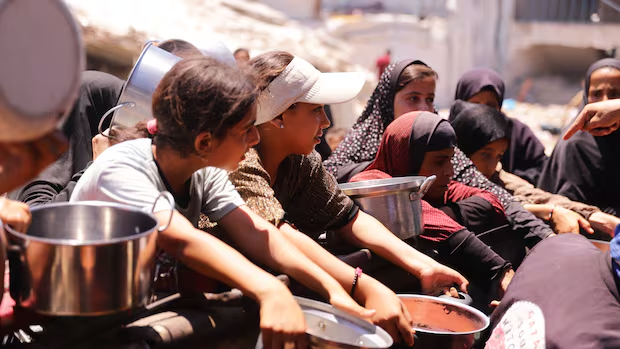
The IDF's actions have left little room for more than two million Palestinians crammed into filthy conditions.
In a statement earlier this week, a key UN team implored the Israeli government to halt its advance, saying squeezing together so many people is making recovery impossible and creating a dangerous situation.
"Some partners have had to scale down or temporarily suspend life-saving activities, particularly following the killing of service providers in those areas," said the UN's humanitarian country team that is co-ordinating the aid response in Gaza.
Separately, a senior International Red Cross official who visited Gaza this week, posted on social media that "the suffering is far from over."
Nicolas von Arx said he was overwhelmed by the horrendous living conditions he witnessed in Gaza City, saying with so many tents packed together, families are experiencing a "suffocating density."
Public infrastructure is practically non-existent and the territory's water grid has completely collapsed, say international aid agencies. Muhammad Al-Ayoubi, 46, who now lives in a tent just west of Gaza City, says his family spends their days chasing down water trucks — the only source of drinking water.
"Every time we see a water tank, we go running," he said. "We have to wait to see if the water coming from tankers is drinkable or not. If not, we use it for washing."
The Mediterranean Sea provides only modest relief from the heat and filthy conditions, because the beach is heavily polluted as a result of the war, says Umm Sharif Jabr, a mother from Gaza City.
"The kids basically take their shower at the beach, but when they get back, they need to wash up quickly with a bit of water because ... they get rashes all over their bodies," she said.
How much aid is getting into Gaza?
In response to a request from CBC News over claims that living conditions remain dire, COGAT, the Israeli government agency tasked with co-ordinating the delivery of aid into Gaza, denied Gaza is facing a humanitarian crisis.
"These are biased claims promoted by interested parties seeking to create a false impression … as part of an effort to discredit Israel," the agency said in an email Thursday.
"COGAT is operating in accordance with the ceasefire agreement and allows and facilitates the entry of 600 humanitarian aid trucks into the Gaza Strip every day, carrying food, water, shelter supplies, medical equipment, medicines, fuel, and cooking gas."
Critics inside Gaza point out, however, that often, that aid isn't immediately distributed due to logistical challenges and looting. UNWRA says the challenges are compounded by the poor condition of many local delivery vehicles and a lack of fuel.
More than 1,000 Palestinians killed since Israel-Hamas ceasefire, says Gaza Health Ministry
Israel committed genocide in Gaza, deliberately targeted Palestinian children: UN report
Among the major impediments preventing progress is the issue of Hamas's continued refusal to disarm, says Iraqi, the Crisis Group analyst.
"Israel has put forward a rather maximalist position that they expect Hamas and other armed groups to give up all their weapons," he said.
Hamas's position, as communicated to meditators in Egypt last month, is that it is prepared to disarm its heavy weapons but only within the context of a larger plan that will end Israel's occupation in Gaza.
Israel's efforts to get the militants to disarm without guaranteeing a path forward on other issues will not be successful, Hamas spokesperson Hazem Qasim told CBC's freelance videographer earlier this week.
"There are some who try to cherry-pick some elements of the peace plan," he said.
"We want full implementation of it — full reconstruction of Gaza, withdrawal of the occupation to the designated area we agreed, opening of border crossings — all these elements will lead to true peace, stability, relief and reconstruction."
Israeli media reported this week that the Trump-directed Board of Peace is preparing to proceed with a plan to relocate Palestinians in Gaza to Israeli-controlled areas in the territory's south.
Supporters claim the goal is "disconnecting" the broader Palestinian population from Hamas, whereas critics, including human rights lawyer Zaha Hassan, have slammed the move as the first step in the establishment of "concentration centres."
Under the proposal, originally floated by Israeli Defence Minister Israel Katz last July, Palestinians in the Israeli-controlled south would be able to leave Gaza but would be prevented from returning.
"The plan is to make [Gaza] uninhabitable for Palestinians and to induce Palestinian flight," Hassan, a senior fellow at the Carnegie Endowment for International Peace in Washington, D.C., told CBC News earlier this week.
"The idea of the rebuilding of Gaza is not meant to be for the habitation of Palestinians in Gaza."
The UN has condemned any move that involves the relocation of Palestinians, while the Board of Peace shared a statement on its social media account last week that says "no one will be forced to leave Gaza, and those who wish to leave will be free to return."
Here are the countries joining Trump's 'Board of Peace' so far
'God helped the Gazans to stay'
Despite Gaza's terrible conditions, however, the ceasefire has allowed for a few rare moments of celebration.
In the Jabalia camp last week, more than 50 young couples gathered for a mass wedding ceremony.
"Israel wanted to empty Gaza, but God helped the Gazans to stay. This is the message we want to send through our celebrations," said groom Mohammed Al-Salawi, 26.
Tamer Abu Al-Aba, who co-ordinated the mass wedding, said events such as this should demonstrate to the world that despite the daily battles for survival, people are finding ways to hold on to hope.
"People can create happiness and rebuild life despite the destruction."
Palestinian death toll in Gaza tops 73,000, officials say, as Israel strikes despite ceasefire
Chris Brown is a foreign correspondent based in the CBC’s London bureau. Previously in Moscow, Chris has a passion for great stories and has travelled all over Canada and the world to find them.
With files from Mohamed El Saife
Related Stories
 World
World
Zomi Frankcom was killed by IDF drones. Australia says Israel’s response ‘falls far short’. How did it happen and what’s next?
48 minutes ago
 World
World
Post Malone engaged to girlfriend Christy Lee
49 minutes ago
 World
World
ET World Leaders Forum 2026: Smriti Irani on politics, power and the price of being a woman
49 minutes ago
 World
World
World Athletics releases Ultimate Anthem: 'Gold' by Mondo Duplantis
1 hour ago
 World
World
Russia’s missile tests around disputed islands anger Japan
1 hour ago
 World
World
Ukrainian publishers call for support after Russian attacks destroy 10m books
2 hours ago
 World
World
Hungary drained its waters for generations. Now drought is exposing the cost
3 hours ago
 World
World
World's oldest person celebrates turning 117 in Lightwater
3 hours ago