
From Pakistan to Trump, Modi’s foreign policy has cost India its moral authority, says Salman Khurshid
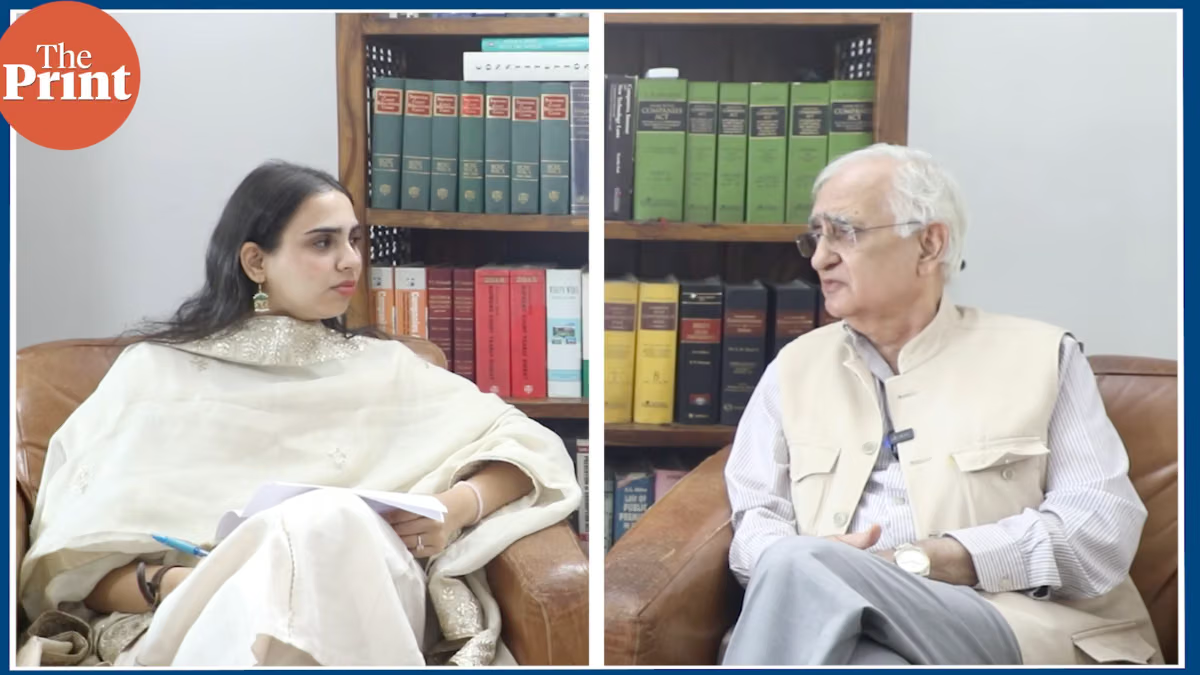
New Delhi: Former external affairs minister Salman Khurshid mounted a scathing attack on the Narendra Modi government’s foreign policy, accusing it of reducing diplomacy to a “transactional” exercise stripped of the authority that once defined India’s place in the world.
In an exclusive interview with ThePrint, the senior Congress leader said India’s voice had grown weaker during major international crises, questioned the government’s handling of ties with the US and Pakistan, and suggested that External Affairs Minister S. Jaishankar had failed to translate his diplomatic experience into political leadership.
He also maintained that despite the complete breakdown in ties, India and Pakistan would eventually have to return to the negotiating table.
The criticism comes at a time when the Modi government has projected foreign policy as one of its biggest achievements, pointing to India’s G20 presidency, closer strategic partnerships with major powers and New Delhi’s emergence as a leading voice of the developing world.
Khurshid, however, said those achievements told only part of the story. “Indian foreign policy has always had an ethical and a moral dimension. That seems completely and utterly missing now.”
According to Khurshid, governments since Independence ensured that India’s foreign policy carried a moral and political weight which gave it influence well beyond its economic or military strength. Today, he argued, that legacy is fading.
He pointed to India’s muted response during the wars in Gaza and Ukraine, and more recently during the Iran-Israel conflict, saying New Delhi had stepped back from the role it once played during major international crises.
“People looked to India and took India’s voice seriously,” he said. “That is why India came to be regarded as a serious candidate for permanent membership of the UN Security Council.”
He said foreign policy today appears to be driven almost entirely by immediate national interests. “There is nothing wrong with pursuing self-interest, but self-interest can be enlightened or unenlightened.”
He described the government’s approach as increasingly “transactional”.
“If you are transactional, other people also become transactional. Then, which transaction succeeds on which day becomes a matter of chance.”
Khurshid questioned whether India had emerged diplomatically stronger after Operation Sindoor.
While acknowledging that national security had to remain the government’s foremost priority, he noted that several countries openly backed Pakistan during the crisis while India struggled to mobilise visible international support.
“But foreign policy has always been more than that,” he said, rejecting the government’s argument that diplomacy should be guided solely by India’s interests. Strategic interests and moral leadership, he maintained, were never mutually exclusive.
Also Read: This is Amit Shah’s badla after Delimitation Bill failed, Jairam Ramesh says on wave of defections
‘Peace doesn’t happen unless you talk’
Khurshid also differed with the government’s approach towards Pakistan, arguing that dialogue would eventually become unavoidable despite the present freeze in relations.
Bilateral ties have remained suspended after Operation Sindoor, with the Indus Waters Treaty in abeyance and diplomatic engagement virtually non-existent. Yet, he said, history showed that countries locked in conflict ultimately returned to negotiations.
“Peace doesn’t happen unless you talk,” he said. “You either completely obliterate somebody and then you have the peace of the graveyard, or you talk to them and make sense.”
He clarified that he was not advocating immediate talks, saying India’s past attempts at engagement had repeatedly been undermined by Pakistan.
“Our attempts to talk in the past have all been betrayed,” he said. “There should be a genuine desire to talk on both sides.”
Khurshid also took issue with Jaishankar’s reported remarks during an all-party meeting that India was “not a dalal like Pakistan”. “If you’re not a dalal, it doesn’t mean that you cannot use your good offices for peace in the world,” he said.
Despite his criticism, Khurshid lauded Jaishankar’s abilities as a diplomat. Calling him “an exceptionally bright person”, he acknowledged the minister’s long diplomatic career but said political leadership demanded something different.
“It takes more than diplomatic expertise to become a political person who can apply political perceptions to foreign policy.”
He added that the minister might himself be constrained by the political priorities of the government he serves. “The bottom line is that India is not looking very pretty in terms of foreign policy.”
Khurshid also questioned whether India was negotiating effectively with the US as both countries continued discussions on a bilateral trade agreement.
His remarks come even as the government has repeatedly showcased the prime minister’s overseas visits as evidence of India’s growing international stature.
“There are agreements, there are opportunities and those cannot be dismissed,” he said. “But where is India standing in the world? How does the world perceive India?”
He also raised concerns over India’s engagement with Washington, pointing to unresolved issues in the proposed trade agreement that could affect farmers and the MSME sector.
“No one says India should give up relations with the US, Russia or Israel,” he said. “But if they are our friends, do we have the courage to tell our friends when something is going wrong?”
The same principle, he argued, applied to India’s calibrated responses to the humanitarian crisis in Gaza and the continuing war in Ukraine.
On US President Donald Trump’s recent remarks suggesting the Iran ceasefire could unravel, Khurshid advised against overreacting.
“I wouldn’t react too quickly,” he said, describing Trump as an unconventional and impulsive leader whose public statements often differed from the actual course the US took.
He said that countries like India should respond with patience rather than react instantly to every statement from Washington.
Khurshid also took aim at the anti-defection law, saying legislation meant to curb political horse-trading had been misused.
“The least one can say is that the law is in a mess,” he said.
According to Khurshid, the law has failed to keep pace with political reality, allowing legislators to switch loyalties without paying a political price.
The biggest gap, he argued, is the absence of a clear legal test to determine when an “original political party” can be said to have merged with another.
He said the Supreme Court should use the current litigation to examine the larger constitutional implications of repeated defections instead of confining itself to technical questions.
“It is almost like saying there is no need for people to vote,” he remarked.
He was equally critical of the Centre’s approach to delimitation. He questioned the government’s decision to link the Women’s Reservation Act with the proposed delimitation exercise. Khurshid said there was no reason to delay the implementation of a law Parliament had already passed.
“You make the reservation now. Why wait for something else to happen?” he asked.
He also echoed concerns raised by several southern states over the likely redistribution of Lok Sabha seats after delimitation, warning that any exercise affecting India’s federal balance should be carried out only after consultation and consensus.
Khurshid also defended Rahul Gandhi’s repeated attacks on the government over Operation Sindoor and other national security issues, rejecting the BJP’s allegation that the Congress leader was undermining the country’s interests.
“He spends time understanding these issues. He speaks to experts before raising questions, and he should be trusted,” Khurshid said.
Instead of responding to those questions, he said, the government routinely questioned Gandhi’s patriotism.
“When he asks questions, instead of getting answers, he is told he is anti-national. Being patriotic is not the monopoly of one party.”
As leader of the opposition, Khurshid argued, Gandhi had every right to seek answers from the government. If some information could not be disclosed publicly because of national security concerns, it could still be shared confidentially.
On speculation over the future of the INDIA bloc after recent differences among alliance partners, Khurshid insisted reports of its decline were untrue.
“The INDIA alliance is there. It’s there for good,” he said.
He said regional parties would inevitably have local political compulsions, but those differences should not be mistaken for the collapse of the broader Opposition alliance.
“As the common objective becomes stronger, many of these local contradictions will become easier to manage,” he said.
Khurshid said institutions associated with the faith of millions must be held to the highest standards of accountability.
“When something unethical happens in an institution of such importance, it becomes a matter of concern for everybody,” he said.
The issue, he said, was larger than politics because it involved public faith in one of the country’s most important religious institutions.
Also Read: Capt Amarinder, Bahuguna, Ravneet Bittu: Amid TMC exodus, a look at fate of Congress defectors to BJP
Related Stories
 India
India
Jamaat-e
2 hours ago
 India
India
‘Political differences can always exist but…’: BJP MP Bansuri Swaraj on 3 Congress CMs ‘skipping’ BRICS dinner
6 hours ago
 India
India
PAS warns Zakir Naik must not become ‘political victim’ in Malaysia
6 hours ago
 India
India
Vendetta politics possibility can’t be denied, says Supriya after CBI names Aaditya Thackeray in Disha Sa
8 hours ago
 India
India
From Gen Z to politics: 21-year
9 hours ago
 India
India
India: Meta to report child abuse cases to law enforcement
9 hours ago
 India
India
BJP effect: Beef is vanishing from India’s Bengal, forcing diet changes
12 hours ago
 India
India
BJP largest party in Jaipur, Congress gains big in Ajmer: Rajasthan civic poll verdict redraws urban political map | India News
16 hours ago