
French "lycée" protests spread to Quebec as Montreal students take to streets in solidarity
French 'lycée' protests spread to Quebec as Montreal students take to streets in solidarity
Local protesters demonstrated Saturday, focused on difficult financial realities
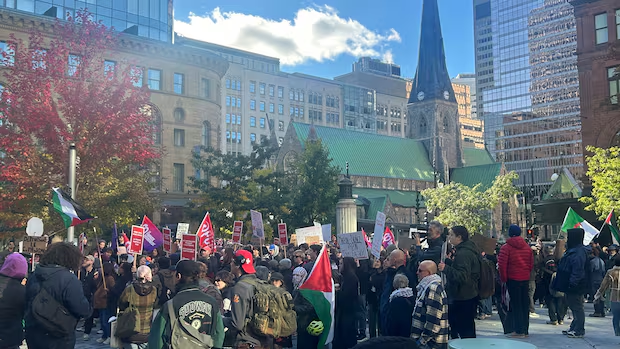
Hundreds of people gathered in downtown Montreal on Saturday, chanting "Solidarity with the students of France" and expressing their support for student-led protests that began in the French capital and have since spread across Europe.
Protests at a Paris-region high school in mid-September have quickly grown into nationwide large-scale demonstrations, with hundreds of thousands of people taking to the streets to support French students in their calls for improved learning conditions.
"There's a movement in France and all over European countries — people want some change, and the students of Quebec are not going to sit and wait until something happens in another country," said Abdelmajid El-Mouhib, president of the Fédération étudiante collégiale du Québec (FECQ), an organization representing CEGEP-level students across the province.
Saturday at 3 p.m., several student organizations and unions gathered alongside protestors at Phillips Square to denounce student financial insecurity and austerity in higher education. (Djeneba Dosso/CBC)
He says Quebec students are also growing unhappy with their learning conditions, citing the rising cost of living, unpaid internships, low government funding in public schools and high tuition fees for university students.
Montrealers show solidarity for students in France, and rally against police violence amid new allegations
Main demands focus on financial realities
They're calling on the government to invest in student financial aid, including grants and loans, mandate paid internships for all students and come up with solutions to address food and housing insecurity.
Noah Seguin, head of the Cégep Saint-Jean-sur-Richelieu student union, says the cost of living is so high, he often has to make concessions when it comes to basic necessities.
"I think, 'If I eat now, I'm going to have to skip this,' or 'I have to put gas in my car, so I'm just going to have to skip this meal' — that shouldn't have to be a thing."
Student-led protesters clash with riot police in France
Tear gas, arrests and chaos as protests grip France
Seguin says that reality is true for many students across Quebec also facing high rents, rising grocery prices, shrinking employment opportunities and unpaid internships.
"Not every student has the privilege of living with parents or having support from parents," he notes.
A sign at the Montreal student protest Saturday. (Djeneba Dosso/CBC)
While high school students in France cited concerns with overcrowded classrooms, deteriorating buildings and pest infestations, students at the solidarity rally in Montreal were primarily vocal about social and financial challenges.
Frédéric Beaudet, spokesperson for the Fédération des associations étudiantes du campus de l'Université de Montréal (FAECUM) points out those barriers are hitting students hard.
"It's bigger than just the student population, but it does affect students and their capacity to stay in higher education," he said.
Are Quebec students better off than those in France?
Some at the protest didn't feel French and Quebec students face the same realities, however.
"This situation is tense and complicated. There's a lot more tension between the French government and its people. I think it's harder out there because they were the first ones to raise their voices," said one participant who is French, but currently studying in Quebec.
The participant, who declined to identify herself, says she prefers her student experience in the province, citing more mental health support and easier access to social resources, but admits her perspective may not reflect the experience of other students who have spent their entire education in Quebec.
Quebec students rally in solidarity with counterparts in France over school underfunding, cost of living
"If we were in France, we would've supported high school students who are only asking to study in normal conditions," said another French exchange student at the protest who also felt conditions in Quebec were better, but came to show solidarity nonetheless.
Student organizations and unions plan to gather again to continue denouncing learning conditions and rising living costs, but Seguin predicts that Quebec students will be more passive than those in France.
"It's hard, it's scary to [demonstrate] to the extent they do in France because it's like, 'If I do that, am I going to get my diploma, am I going to have to redo classes?' That's scary for all of us," he said.
Repeat of 2012 unlikely in Quebec
In 2012, the Quebec government's decision to increase tuition fees at universities by $325 over five years sparked a student strike. The strike snowballed into months of protests, including one that brought more than 200,000 people to the streets of Montreal.
One of the more violent protests during the 2012 student movement took place in Victoriaville, Que. and resulted in one demonstrator losing his eyesight. (Jacques Boissinot/Canadian Press)
Student violence and police repression seemed to increase with each successive demonstration, plunging Quebec into a serious social crisis that attracted attention from around the world.
The 100th nighttime demonstration took place in the streets of Montreal on Aug. 1, 2012. The following month, former premier Jean Charest was defeated in the provincial election by the Parti Québécois.
The incoming Pauline Marois government cancelled the tuition fee increase by decree, and replaced it with an annual indexation.
Jean-François Trudelle is a lawyer now, but was a McGill student in 2012. At the time, Trudelle was a spokesperson for the Mouvement des étudiants socialement responsables du Québec, an organization in favour of the tuition hikes.
France shaken by fiery street protests uniting students, workers and 'yellow vests'
He says students today are fighting a different fight than students in 2012, mainly because student life was at the center of their cause at the time, as opposed to the cost of living crisis today.
"Then, the debate in Quebec was really about student fees and accessibility to universities," Trudelle points out.
"Yes, it kind of spilled over [into] some broader debate about the welfare state, but still, the core was about accessibility to university," he says. "And now what we're seeing is that everything has gotten too expensive, and people are angry at their government for it."
Trudelle doesn't envision that protests in Quebec today will ever escalate to the point they did in 2012, but applauds students for continuing to demand change peacefully.
"We don't have this revolutionary band to our culture, and I think that speaks volumes about Quebec society — we're able to have tough, really tough debates, [without] burning down Montreal's city hall."
Djeneba Dosso is a journalist based in Montreal. She previously worked as an associate producer for CBC Manitoba and did a brief internship with CBC Ottawa. You can reach her at djeneba.dosso@cbc.ca
Related Stories
 Canada
Albertans head to polls in historic referendum on whether they want to stay in Canada
13 hours ago
 Canada
In the news today: four soldiers killed, Alberta referendum, AI privacy fears
13 hours ago
 Canada
How a grass fire at a Canadian military base killed four soldiers
13 hours ago
 Canada
How will household electricity rebate reduction, temporary winter pricing change impact Ontarians?
14 hours ago
 Canada
Residents told to boil tap water due to bacteria
14 hours ago
 Canada
Oil
15 hours ago
 Canada
Albertans vote on path to independence as Carney fights to keep Canada united
15 hours ago
 Canada
Two of 4 soldiers killed in fast
16 hours ago