
Foundations of Construction: Coste, “The Father of Natural Gas in Canada”
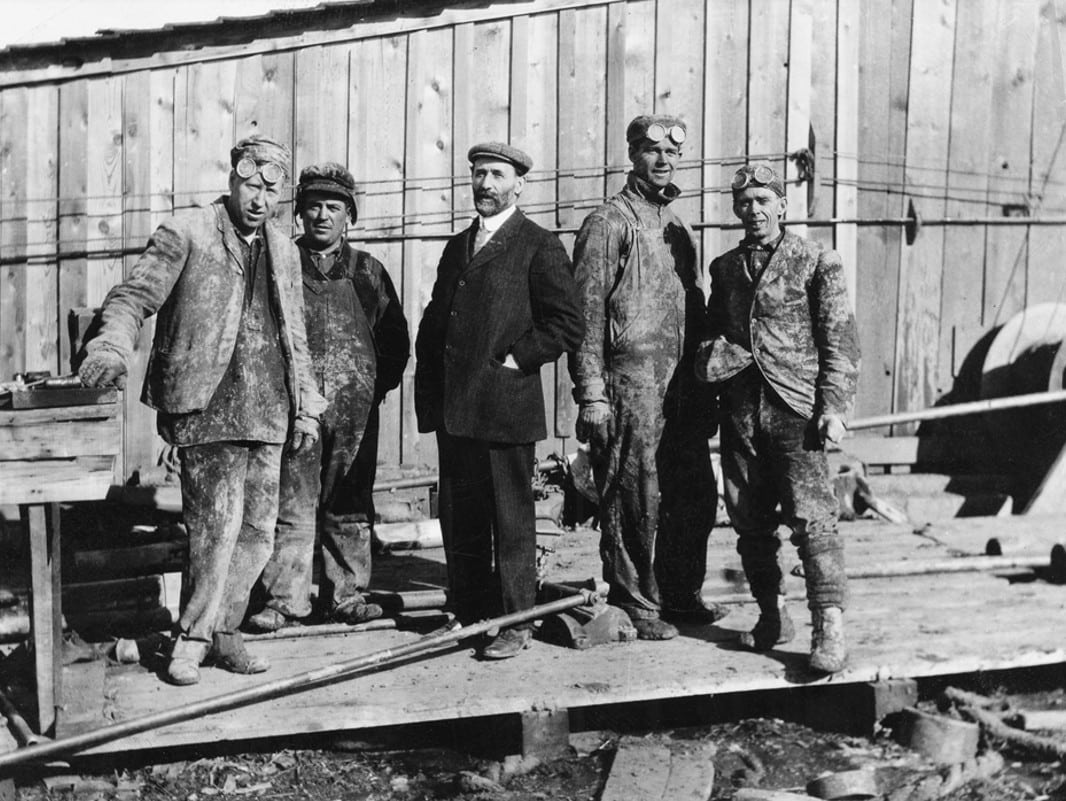
Energy resources are in high demand, brought to market through an enduring history of innovation. In 1859, wells at Oil Springs in southern Ontario became one of the world’s first commercial oil fields. In New Brunswick that same year, natural gas was burned as unwanted waste at the oil well site. Natural gas took centre stage at Essex, Ontario when Eugene Coste intentionally drilled wells in 1883. Coste then pioneered a transmission pipeline to supply the new fuel to customers.
Spending his earliest years in Amherstburg, Ontario, Eugene Coste (b. July 8, 1859) and his five siblings moved overseas for their father’s engineering career. Settling in Egypt when Coste was four years old, his father “was involved with the construction of the Suez Canal,” said Donald G. Wetherell in Dictionary of Canadian Biography, Vol. 16, revised 2021. Sent to France for schooling with his siblings, Coste earned a Bachelor of Science degree in 1876. Attending Paris’s École Supérieure des Mines, the young man followed his father’s footsteps, graduating in 1883 as a qualified mining engineer.
Returning to Canada, Coste was hired in 1883as a mining geologist with Geological Survey of Canada (GSC). Four years later, he was promoted to mining engineer. He also married Louisa Catherine Tims; they would become parents to five children. As a member of the prestigious Logan Club for GSC scientists, Coste gave occasional speeches, such as “Are Archaean rocks metamorphic?” according to Morris Zaslow in Reading the Rocks (Macmillan Company of Canada, 1975).
In 1888, the motivated Coste established the Provincial Natural Gas and Fuel Company of Ontario Limited. Reading a geological report “that associated petroleum deposits with an anticline structure in Ohio, in 1889 Coste chose the site for his first drilling attempt in Essex County,” said Alberta Energy Resources Heritage (AERH).
Opening an independent mining engineering practice in 1889, Coste left the GSC under a cloud. GSC officers were not permitted to engage “in private mining activities that overlapped with their public duties,” noted Wetherell. The young professional had a goal in mind—while others were zeroed in on finding oil, Coste explored for natural gas.
Coste’s geological instincts were proved accurate. The natural gas well at Gosfield Township “was completed on January 23, 1889, at the depth of 1,031 feet [314.24 m], with an initial open flow of 10,000,000 cubic feet per day,” described W.A. Roloff in “Salina-Guelph Fields of Southwestern Ontario” in Bulletin of the American Association of Petroleum Geologists, Vol. 33, Number 2. Pioneering the country’s first commercial natural gas well, Coste was dubbed “The Father of Natural Gas in Canada.”
The first well sprouted into a field of 30 wells by 1894, each producing natural gas. Selling to local customers, the new industrialist also constructed a 20-cm-diametre pipeline in 1895, running under the Detroit River to transport gas from Ontario to patrons in Buffalo, New York. “These shipments to Buffalo were the first exports of Canadian natural gas,” stated Wetherell.
The reserves at Essex dwindled were limited. Within a decade, the gas fields were depleted.
In 1906, Coste drilled natural gas wells at Tilbury, Kent County, about 55 kms east of Windsor, Ontario. Appointing his brother Denis as management, Coste “established the Volcanic Oil and Gas Company Limited,” Wetherell noted. Five years later, the firm amalgamated with two other enterprises, forming Union Natural Gas Company Limited.
Coste was only getting started. The mining engineer was engaged by Canadian Pacific Railway (CPR) in 1906 to explore for oil in the western provinces. Three years later, Coste’s well drilling team struck a vast field of natural gas reserves in central Alberta. To Coste’s advantage, the CPR executive officer was interested in oil, not natural gas. Understanding the process of natural gas exploration, Coste accepted the risks of development, said Wetherell. CPR kept ultimate control but gave the engineer “the right to extract and sell gas from Bow Island and other properties.”
In 1912, Coste constructed “a pipeline running 274 km (170 mi.) from the Bow Island field,” said AERH, supplying customers in Calgary “with the miracle fuel.” Over the coming decades natural gas pipelines underwent development, increasing in diameter and manufactured in high-strength carbon steel for transmission to processing plants. The purified natural gas is transported to industrial customers and to local distributors.
Fearless and innovative, Coste earned immense wealth in the natural gas industry, including a mansion in Calgary. Respected and admired, he remained accessible and down-to-earth. Visiting drilling sites, Coste was occasionally required to stay overnight in the field. If “no extra cots were available, he would roll up in a blanket and sleep on the floor of the tent,” said AERH. Eugene Coste died in Toronto on January 23, 1940.
Large-scale natural gas projects and pipelines are in development, preparing to provide the Canadian resources to global customers.
Susanna McLeod is a Kingston-based writer specializing in Canadian history.
Related Stories
 Canada
France won't grant crab licence off Newfoundland without discussion, ambassador says
57 minutes ago
 Canada
Founder of Canada
57 minutes ago
 Canada
Shark Tank star Robert Herjavec opens doors to Muskoka home
1 hour ago
 Canada
Western Quebec doctors' group urges PQ to tackle physician shortage
1 hour ago
 Canada
Canadians are staying away from Las Vegas
1 hour ago
 Canada
Billions more for defence, but Canada's military still faces an old budget squeeze
1 hour ago
 Canada
1 dead, several injured in incident on Six Flags ride
2 hours ago
 Canada
Here's why this Thanksgiving banner flew over the Detroit River
2 hours ago