
Ford says Canada could ’dismantle the U.S. if we wanted to’ as premiers gather in P.E.I.
'The one way to embolden a bully is to capitulate,' says Eby
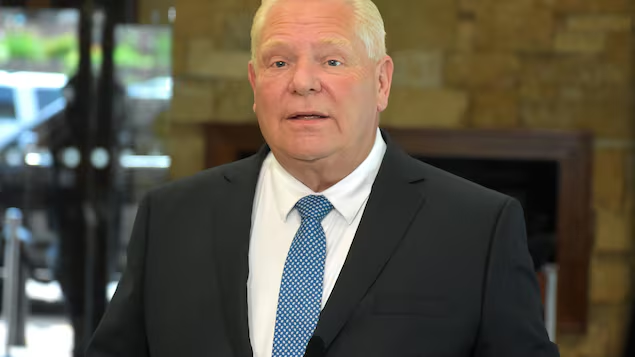
Ontario Premier Doug Ford said on Tuesday that Team Canada needs to stand up to the U.S. president.
Photo: La Presse canadienne / Eli J. Ridder
Catharine Tunney (new window) · CBC News
Ontario Premier Doug Ford says he's losing patience following U.S. President Donald Trump's latest tariff hit and urged the federal government to hit him back as hard as we can.
I'm tired of the bully trying to take our lunch money all the time. We always seem to be on our back heels. We need to be on the offence, not constantly on the defence with President Trump, said Ford as he arrived in Charlottetown for three days of meetings with his provincial and territorial counterparts.
I'm losing patience … we can't keep rolling over.
Ford resurrected his suggestion Canada cut off energy supplies to its southern neighbour.
We are an energy powerhouse and we could dismantle the U.S. if we wanted to, said Ford, stressing he wasn't speaking for the other premiers.
The potash, the oil, we're their number-one customer in the world, they need to feel the pain rather than us constantly feeling the pain.
Washington's announcement that it will impose 50 per cent tariffs on a range of goods (new window) has cast a pall over the premiers' annual summer meeting.
The move is in response to what a senior U.S. administration official described as Canada's retaliation against U.S. trade policy and its discrimination against U.S. motor vehicles, dairy and alcohol.
Speaking in the Oval Office on Tuesday, Trump said he loves Canada but it has been very, very tough on the U.S. for years.
They need us to survive. Without us, there's no way they can survive, Trump said.
The LCBO, along with much of the country, removed American wine and spirits from store shelves last year.
Photo: Radio-Canada / Evan Mitsui
The squeeze from Canada's neighbour puts pressure on the premiers to respond. Already there's division on what to do with the majority of provinces' decision to stop selling American alcohol in retaliation to Trump's previous tariffs on things like the auto sector, steel and aluminum.
Only Alberta and Saskatchewan, which both have privatized alcohol retail sales systems, still offer U.S. booze.
The boycotts have become an irritant for the Americans as U.S. exports of wine, beer and spirits to Canada have plummeted, making them a leverage point in ongoing trade negotiations. (new window)
WATCH | Carney says changes to booze bans should be part of larger deal:
Prime Minister Mark Carney, who spoke with Trump on Tuesday morning, is holding a virtual meeting with the premiers where the negotiations, and what to do with the booze boycotts, will likely be discussed.
The decision to change that, first and foremost, will be taken by the provinces themselves, each individually, and should only be taken, in my view, as part of an overall agreement. And that's what we'll work to accomplish, Carney said.
He said the two leaders have agreed to ramp up trade discussions.
Saskatchewan Premier Scott Moe said he expects the federal government to at some point ask the provinces to relent.
That will be a decision each province will have to make, he said. But that ask should come from the federal government. They're at the negotiating table. They'll know the sensitivities.
But some premiers are showing no signs of backing down.
B.C. Premier David Eby said there is not a chance in hell that U.S. alcohol is going back on the shelf in his province.
The one way to embolden a bully is to capitulate. And I don't think we should embolden Mr. Trump, who clearly is a bully, he said at the onset of the meetings.
WATCH | Eby says U.S. booze not going back on B.C. shelves:
Eby said earlier that he has asked staff to contact the U.S. Embassy to have his government's statement marking the two countries' friendship removed from the U.S. 250th birthday website, adding he feels sorry for Americans.
Ford has also been vocal that he won't back down without seeing changes. The Liquor Control Board of Ontario (LCBO) is one of the largest alcohol retailers in the world.
It can't always be Ontario. It has to be a Team Canada approach and that's my message to my great friends, my premier friends, that we have to be united, he said.
P.E.I. Premier Rob Lantz, the host of this year's conference, said the debate over alcohol will be discussed and how it fits into this 30-day discussion about hammering out a deal over these irritants.
Health care, energy projects also on the agenda
While the tariffs are expected to dominate the conversation, Lantz said there's still room to discuss other agenda items. Before Monday's bombshell news, premiers had listed health-care transfers, energy development, economic growth and the wildfires destroying swaths of northwestern Ontario as priorities for their meetings.
WATCH | Quebec premier says supply management 'non-negotiable':
In 2023, the federal government, under prime minister Justin Trudeau, hiked the annual Canada Health Transfer by five per cent for five years. With the transfers reverting back to three per cent increases come March 2028, the provinces are beating the drum for more federal funding.
It's very important that before we expand responsibilities, for example, do more on dental care or do more defence spending, that we do honour our commitments to Canadian citizens of providing quality public health care, Quebec Finance Minister Eric Girard told CBC's Power & Politics (new window) last week.
Referendums off the official agenda
The meetings also come ahead of what could be internal tests to Canadian unity.
Alberta Premier Danielle Smith is going ahead with a series of referendum questions in October — including whether Alberta should remain a province of Canada or commence the legal process of holding a second binding referendum on leaving the country.
The question of Quebec independence has also been resurrected, with Parti Québécois Leader Paul St-Pierre Plamondon promising to hold a referendum on separation if he secures a mandate in the fall provincial election. While St-Pierre Plamondon's party has been dominating in the polls over the last year, recent surveys suggest the race is tightening.
In an interview late last week, New Brunswick Premier Susan Holt said the referendums aren't on the official agenda, "but there are also conversations that we have around the coffee pot or as we're moving in and out of different discussions.
We were one of the four that set Canada up and I believe very firmly in the beauty of this nation from coast to coast to coast, and New Brunswick will do whatever we can to keep our country strong and united, said Holt.
Catharine Tunney is a reporter with CBC's Parliament Hill bureau, where she covers national security and the RCMP. She worked previously for CBC in Nova Scotia. You can reach her at catharine.tunney@cbc.ca
Related Stories
 Canada
Trump selects Katie Zacharia as next White House press secretary
1 minute ago
 Canada
How good is this year's flu shot? Here's what to know about flu season
2 minutes ago
 Canada
Workers rescued from Montreal highrise after platform malfunction
1 hour ago
 Canada
Poilievre shrugs off Musk's pro
1 hour ago
 Canada
Canadian woman who married ISIS fighter pleads guilty to terrorism charge
1 hour ago
 Canada
Thieves make off with tens of thousands of wine bottles worth millions
2 hours ago
 Canada
Farmers grapple with equipment damage and theft as ‘chaotic’ harvesting stretch hits
2 hours ago
 Canada
North Saanich athlete selected for Team Canada U18 softball team
2 hours ago