
Food Politics in India: The Push for One Nation, One Diet
King George’s Medical University (KGMU) in Lucknow ordered its 18 hostel messes to stop cooking and serving non-vegetarian food from July 15, 2026. Nearly 7,000 students reside in the hostels. The order followed a visit by Uttar Pradesh Governor Anandiben Patel to the campus, where she raised concerns about hygiene and the preparation of non-vegetarian food.
Patel, who is also the chancellor of state universities, spoke of the matter at KGMU’s convocation ceremony; no written instruction was issued. Within 48 hours, her remarks had been converted into an administrative order, without any formal inspection report on record.
Soniya Nityanand, KGMU’s vice chancellor, called it a “positive suggestion”, arguing that vegetarian food has a better shelf life in the Indian summer. She added that while non-vegetarian food could no longer be cooked or served within the university’s walls, students remained free to eat it off campus.
The Eidgah imam of Lucknow, Maulana Khalid Rashid Firangi Mahali, pointed to an arithmetic the administration had overlooked: more than 61 per cent of Indians are non-vegetarian. A 2017 industry survey of 1,800 respondents found protein deficiency among Indians at nearly 73 per cent, a level some have called a national protein deficit.
Most people in the country suffer from serious protein deficiency, and yet it is at one of its most prestigious medical colleges that non-vegetarian food has been singled out as the problem. This was never a matter of hygiene. It is about who decides what Indians can eat, and increasingly, it is the ruling ideology that is claiming that authority.
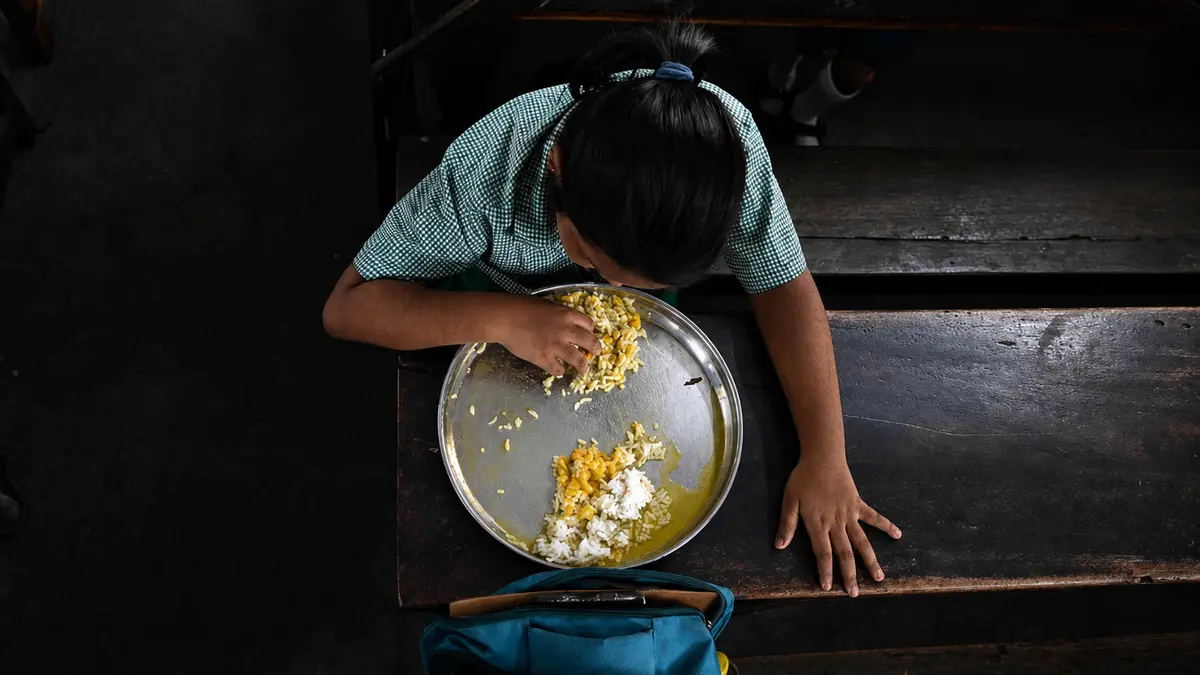
The BJP formed its first government in West Bengal two months ago, displacing the Trinamool Congress, which had ruled for 15 years. One of the new government’s first moves was to hand over the midday meal scheme to the International Society for Krishna Consciousness (ISKCON), beginning with Kolkata’s municipal schools from August 1.
ISKCON treats all food it prepares as prasadam (offering) for Lord Krishna and runs an entirely vegetarian kitchen. Citing the change in contract, the egg, once an inexpensive, nutrient-rich staple of the old menu, has vanished. There was no consultation or debate, only an announcement, and children who relied on free school lunches lost their eggs.
The anthropologist Arjun Appadurai coined a term for this in 1981: gastro-politics, the exercise of social control through food distribution rather than through rules. There was no formal ban on eggs in Bengal. Someone simply gave the cooking contract to an organisation that does not make them.
University and school kitchens fall under bureaucratic orders. On the streets, a rougher machinery operates over the meat markets. Cow protection squads, active in several BJP-ruled States and known as gau raksha dals, block any truck they suspect of carrying beef and assault the drivers. Human Rights Watch has reported that such groups often work alongside, rather than against, local police.
In January, three men in Jhalawar, Rajasthan, attacked a homeless man they suspected of eating beef. He had not killed the animal; he was mentally unwell and had been found sitting beside its carcass. Such attacks recur across Uttar Pradesh, Haryana, Bihar, and Madhya Pradesh, with Muslim meat sellers and Dalit carcass workers among the most frequent victims.
What makes this politically significant, and not merely criminal, is its relationship to power. Convictions are rare, and political criticism is scarce, particularly from the party that governs at the Centre. The government has no need to confront meat vendors directly: the near-total impunity enjoyed by vigilante groups already does that work, leaving official hands clean.
Across South Asia, cooking and sharing meals have long marked caste and religious boundaries, a reflection of the old hierarchy of purity and pollution that placed vegetarian, privileged-caste communities above meat-eating ones.
Hansraj College, Delhi, has seen a similar pattern, invoking Arya Samaj philosophy to keep its hostel vegetarian. The college held to the practice for years despite a majority of students being non-vegetarian and protesting that it infringed on their right to choose their own food. In 2023, 40 student protesters were detained after objecting when hostel wardens confiscated eggs students had carried in from outside.
A Delhi University Students’ Federation of India-led protest outside Hansraj College’s hostel gate against the restriction on non-vegetarian food on campus, in 2023. | Photo Credit: By Special Arrangement
A private trust, a State government, and a Central university each have their own procedural rationale for arriving at the same result. The only difference is the machinery. A hierarchy once upheld through social norms is being reconstructed through institutional authority. Mess committees and mid-day meal contracts now perform quietly what village councils once did informally; highway checkpoints manned by cow vigilantes go several steps further. This is not a new prejudice being created by the state but an old one being industrialised on a national scale, at a reach no panchayat ever approached.
This follows the familiar grammar of majoritarian nationalism, in which diversity reads as disorder, correctable, in the current dispensation’s view, by a single narrative. Talk of “one nation, one election” and “one nation, one tax” is already on the table; food looks to be next, typically traded in the name of “hygiene” or “health”. What it removes is the negotiated plurality that once let a vegetarian and a non-vegetarian coexist in the same market without either having to disappear.
This playbook is not unique to India. The blood-and-soil ideology of Nazi Germany linked a supposedly pure German diet to racial theory. Its agriculture minister, Richard Walther Darré, is often credited with pushing organic farming and vegetarian ideals, though historians remain divided on how far his personal beliefs shaped policy; the regime itself did little to prevent the population from going hungry.
A comparable campaign unfolded in Italy in 1925: Mussolini’s Battle for Grain sought to wean Italians off imported wheat and pasta in favour of home-grown rice. Wheat imports were cast as a national weakness, pasta as a lapse from the virile, self-sufficient fascist body the regime wanted to project. The government declared rice days, and the poet Marinetti campaigned for the elimination of pasta as a patriotic duty. No one was arrested for eating a plate of spaghetti, but for years the state told its citizens that their food stood opposed to the nation they were meant to become.
Both regimes understood something India’s current dispensation understands too: one way to control people is to control what they eat. It is a method that lets food declare who belongs and who does not, without a single law having to be passed.
The KGMU order, the ISKCON contract, and the gau raksha campaigns did not originate from the same place. But each restricts what Indians can eat in a taxpayer-funded institution, or even at home, through means that claim no ideological purpose while producing a plainly ideological effect.
Ideology does not always enter statecraft through legislation. A hostel warden’s administrative order, or a public tender quietly awarded to a religious trust, can do the same work. That is precisely what makes them so difficult to confront. Which is why they deserve to be named for what they are: the slow standardisation of the nation’s plate to fit one ideological agenda.
Himadri Sekhar Mistri is a researcher at the Centre for the Study of Social Systems, Jawaharlal Nehru University, New Delhi, working on questions of violence, democratic erosion, and social movements.
Also Read | Vegetarian-only mid-day meals are state-sponsored discrimination: Sylvia Karpagam
Also Read | Karnataka's Indira canteens starved of funds
Related Stories
 Lifestyle
Mo Gilligan talks new documentary “Big Chicken: A Fast Food Conspiracy”
3 hours ago
 Lifestyle
My London: Kelly Piquet
1 day ago
 Lifestyle
Somalia faces renewed hunger crisis as UN food agency warns of funding shortfall
1 day ago
 Lifestyle
President asks Trump to suspend tariffs to help earthquake recovery
3 days ago
 Lifestyle
Indonesia quake death toll rises to 68, thousands left homeless
4 days ago
 Lifestyle
Thousands in Indonesia await aid after quake kills 54, overshadowing Independence Day
5 days ago
 Lifestyle
If You Loved 'Silo,' There's One Movie You Need to Watch Next
5 days ago
 Lifestyle
Colombian president asks Trump to suspend tariffs to help earthquake recovery
5 days ago