
First September update shows lower processing times for temporary residence applicants

On September 2, Immigration, Refugees and Citizenship Canada (IRCC) released updated timelines for various temporary residence application types, with waits dropping across several categories.
Of the declines seen in IRCC’s latest update, the most notable include:
Schedule a Free Work Permit Consultation
Conversely, the update's most significant increases were a two-week rise in work permit wait times for the Philippines and a one-week rise for India, plus a one-week increase in study permit wait times for in-Canada applicants.
This article compares the temporary residence processing time estimates in IRCC’s September 2 update with those reported on August 26.
The next update to IRCC’s temporary residence processing times is expected on or around September 9, 2026.
Work permit waits fell for both Pakistan and in-Canada applicants, the latter hitting a new 2026 low, whereas India and the Philippines saw increases, with the Philippines posting the larger jump at two weeks.
Study permit wait times improved by two weeks in India, while a one-week increase for in-Canada applicants brought waits to their highest point in at least three months.
Visitor visa processing times saw limited movement, with both decreases and increases confined to a range of one to two days.
Wait times for super visas shortened across all featured countries except India, including sizeable declines of 23 days for Pakistan and 11 days for the Philippines.
*Super visa applications can only be submitted from outside Canada.
The difference between IRCC processing times and service standards
Processing times and service standards serve different purposes in IRCC’s application system.
Processing times are estimates designed to indicate how long a newly submitted application may take to process. These figures are not indicative of firm timelines, nor do they represent a deadline, guarantee, or maximum processing period.
Depending on the application type, IRCC bases its processing time estimates on either:
Service standards, meanwhile, are performance targets. They indicate how quickly IRCC aims to finalize a particular type of application under normal operating conditions—generally 80% of cases.
Actual processing times can fall above or below either measure. Factors such as application complexity, inventory levels, processing capacity, requests for additional documents, and further checks or assessments can all affect how long an individual file takes to finalize.
Temporary residence processing estimates are updated weekly, while permanent residence and citizenship estimates are generally updated monthly. Service standards are revised less frequently, with temporary residence standards last updated in 2018–2019.
IRCC reported that it processed 1,566,455 temporary residence applications during the first six months of 2026, with more than 401,000 still awaiting a final decision at the end of June.
Related Stories
 Immigration
Stablecoin Payments Surge 45% in 2026: What Businesses Must Know
6 days ago
 Immigration
All the president’s women: a familiar downward trajectory on Trump’s team
1 week ago
 Immigration
Trump ‘border czar’ says Ilhan Omar could be ‘of course’ denaturalized and deported
1 week ago
 Immigration
Ilhan Omar’s attorneys say federal search of her home was ‘neither justified nor lawful’
1 week ago
 Immigration
Mamdani welcomes court ruling rejecting Trump administration challenge to NYC sanctuary laws
1 week ago
 Immigration
Labor and the Coalition need the Indian diaspora vote, but the immigration debate has many feeling bruised
1 week ago
 Immigration
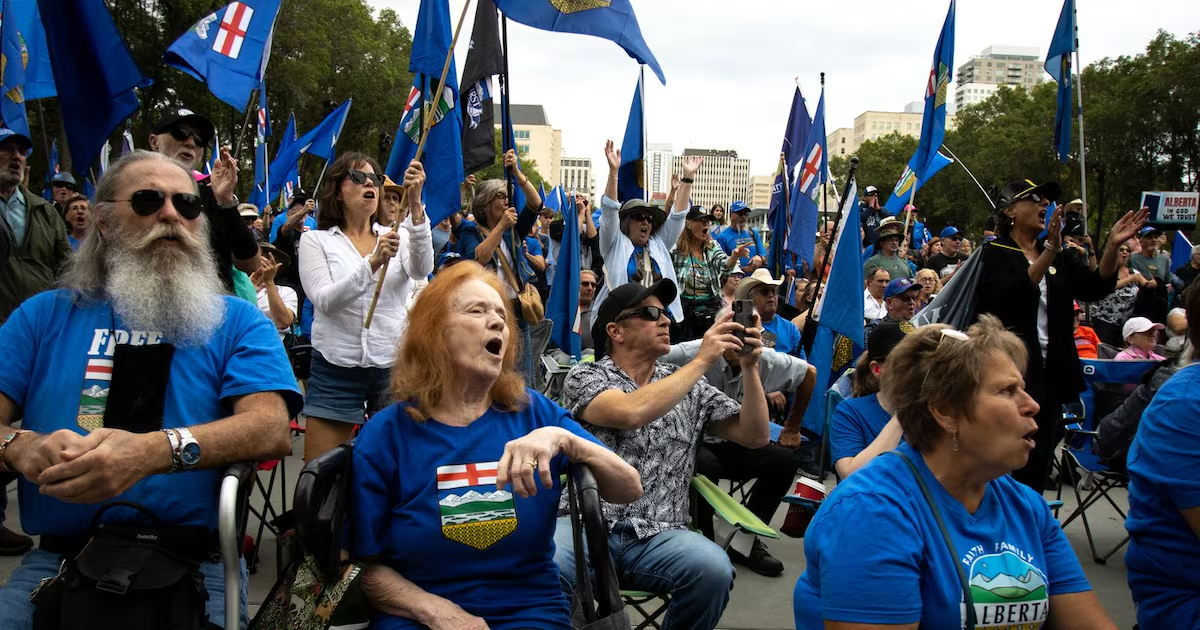
Canadians are divided on immigration and it’s showing at the ballot boxes
1 week ago
 Immigration
Visa Puts Stablecoins Inside Visa Direct to Speed Up Global Payouts
1 week ago