
Financial market participants: Market makers, institutional investors, and you and me
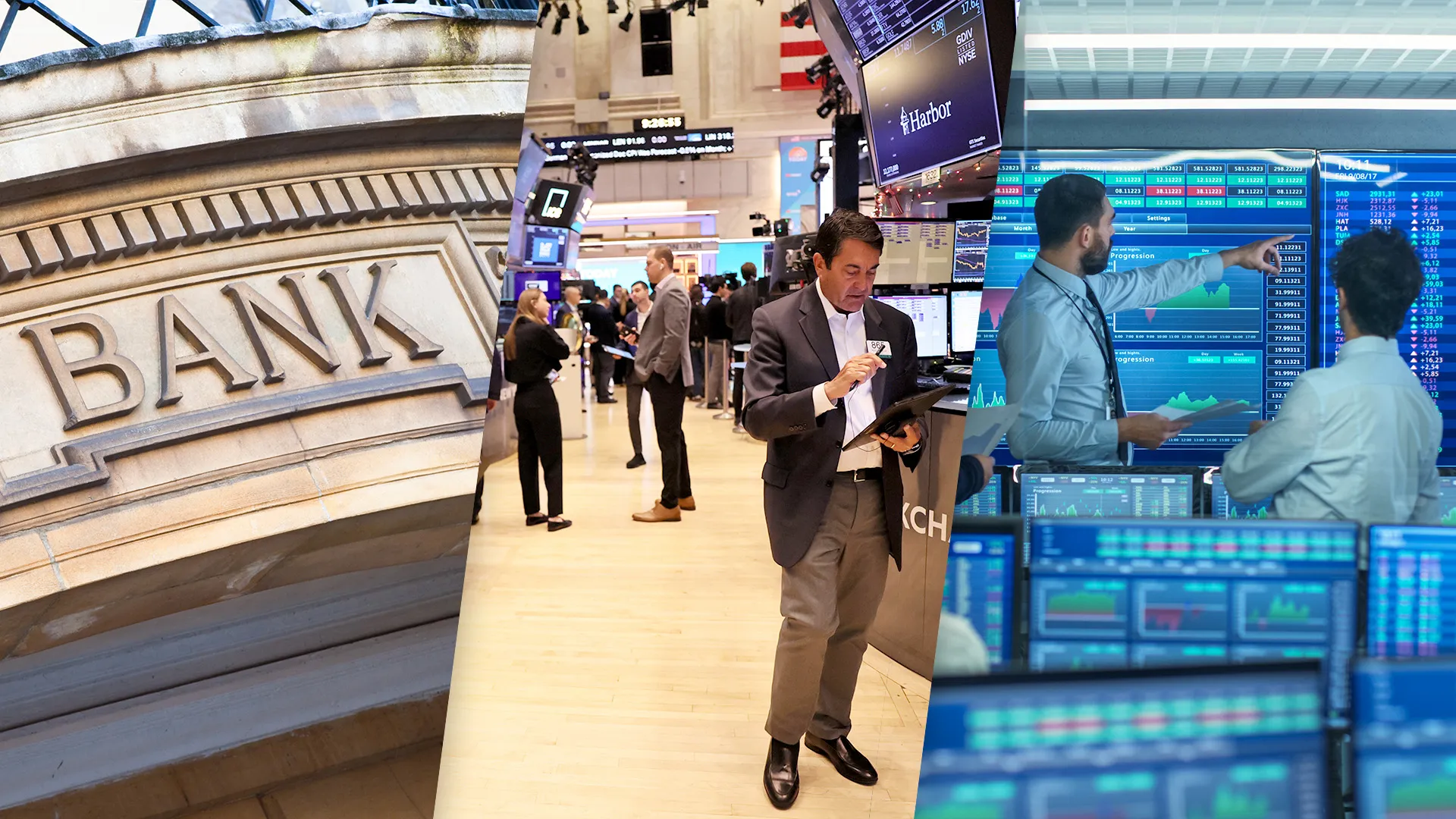
Financial market participants: Market makers, institutional investors, and you and me
Consider these market interactions:
Each of these transactions feels seamless, immediate, and carries no (or very little) cost. How does it all work? It’s a lot to unpack.
First off, to make a market, at least two parties are needed to complete a trade. But to make markets competitive, three or more parties are needed. Competition helps to discover the best price, at any given time, where market participants are willing to buy or sell an asset.
There are many types of investors in the financial markets. Some are individual traders, some are big institutional and commercial investors, and some are intermediaries who buy when others are selling and sell when others are buying.
Some markets have lots of these big institutional and commercial entities buying and selling all the time, while others rely on professional traders to ensure trading is liquid and efficient. Markets bring together different entities for different reasons, and they all help to set values for many different types of assets.
What are the market participant groups?
Markets evolved from ancient times as a way for a producer—such as a farmer, smith, or weaver—and a consumer to trade goods for barter, money, or other legal tender. Modern markets have a host of participants, including producers and consumers, but also ranging from individuals to investment managers.
Why do we need market makers and professional traders?
Some markets, such as the crude oil market or U.S. Treasury bond markets, are deep, liquid markets that see active trading and modest bid/ask spreads. In other markets, some participants are there to provide liquidity on a short-term basis. If every party in a market were a long-term investor, then parties who only need to make short-term trades would have a hard time finding an opposite entity. That’s why a diverse range of participants makes markets efficient.
Some exchanges appoint market makers and specialists to facilitate trade in markets that may be lightly traded. Their role is to help the market function by making sure there is enough volume so trading is efficient.
Market makers and short-term traders earn a profit when there is a difference in the bid-ask spread. Arbitrage is the simultaneous purchase and sale of an asset in different market venues—or in equivalent products—to take advantage of a price inefficiency.
In U.S. listed securities—the stock market, for example—regulations require that orders be filled at the so-called National Best Bid and Offer (NBBO). But if a large order is pressuring prices in one venue, and there’s a buyer in another venue, a high-frequency trading market maker might buy on one exchange, sell on the other, and capture the price spread. The difference might be only a penny or so, but when you consider how much volume changes hands each day, those pennies add up. In this way, investors get tight bid-ask spreads, and market makers are compensated for accepting the other side of the trade.
This is an example of pure arbitrage—closing a price inefficiency in the exact product. There’s also relative value arbitrage, which looks across similar products and keeps them in line. One example is called index arbitrage. A stock index such as the S&P 500 is made up of a defined basket of stocks. Index arbitrageurs will buy and sell futures and options on those indexes, and simultaneously buy and sell each component of the index (yes, for the S&P 500, that’s 500 stocks at once) in order to keep prices in line. It takes a lot of capital and a lot of tech infrastructure to run an arbitrage operation such as this, but the result is ultra-efficient markets.
It takes many entities with different objectives and time horizons to make a market. Different types of market participants help both buyers and sellers enter and exit investments smoothly.
If you’re buying or selling stocks from a trading app on your phone or computer, it might seem like an easy process. You tap or click, and within a second or two you’ve exchanged your money for stock. But behind the scenes is a complex, high-tech, capital-intensive system keeping it all in line.
Related Stories
 Stocks & Markets
Is the stock market open on Columbus Day, Indigenous Peoples Day?
8 hours ago
 Stocks & Markets
Can BWX Technologies' Uranium Processing Capabilities Drive Growth?
19 hours ago
 Stocks & Markets
France struggles to reassure financial markets as Asian investors fuel distrust
1 day ago
 Stocks & Markets
Major bank advises investors that the market is near its peak
1 day ago
 Stocks & Markets
Nexalin Technology notifies Nasdaq compliance on minimum bid price
1 day ago
 Stocks & Markets
Xplora Technologies AS: Notice of Extraordinary General Meeting 2026
2 days ago
 Stocks & Markets
Top Canadian Founder Led Stocks For October 2026
2 days ago
 Stocks & Markets
Guide links Filipino women
2 days ago