
Facing criticism, Carney says he has a 'very clear mandate' to push through major economic changes
Facing criticism, Carney says he has a 'very clear mandate' to push through major economic changes
New bill designed to limit federal project reviews to one year, establish labour peace
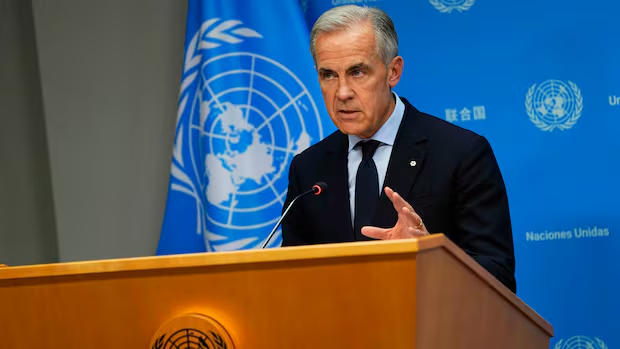
Prime Minister Mark Carney says his government received a clear mandate from voters in the last general election — and in subsequent byelections — to "build Canada strong," and he's pressing ahead with changes to federal project approvals and the Labour Code despite criticism from some circles.
The comments come a day after the government tabled Bill C-39, a 246-page omnibus bill that seeks to end what critics maintain is an unwieldy approvals process for major projects and establish a one-year timeline for federal reviews.
The legislation also includes a provision clarifying that the labour minister can step in and end a work stoppage if it's deemed in the "national interest," which has drawn heat from organized labour leaders who say it infringes on the right to strike.
Carney said Canada is facing U.S. economic assaults and threats to its sovereignty and Ottawa's top priority is to turbocharge development to keep the economy going and people working.
"We've been very clear that we would focus on what we can control, and first and foremost is building at home, building Canada strong, building in a way that builds for all," Carney said.
"The government was elected on a very clear mandate."
A consequential fall in Parliament begins with familiar concerns and a new test
Modi expected to visit Canada in December, Carney says
Carney established the Major Projects Office to help shepherd proposals like port expansions, mines, hydroelectric links and pipelines through the federal approvals process. More than two dozen projects and initiatives have been added to the list since it was established last year.
This latest legislative program is designed to streamline approvals for more projects needing a federal green light.
Speaking to reporters on the sidelines of the United Nations General Assembly in New York, Carney said projects currently face a maze of bureaucratic red tape with multiple agencies sometimes responsible for different aspects of an approval.
Pointing to the more than decade-long fight to build a new rail bypass after the Lac-Mégantic disaster, Carney said he's taking steps to make the approvals process "much more efficient."
"A decision delayed is a project denied," Carney said. "If you're going to say no — decide it within a year."
Carney says he has a mandate to open airports to private investment
Carney said timelines under the last government were so long that businesses effectively "stopped building."
"That's not good for Canadian independence. It's not good for Canadian workers. It means fewer jobs. It means a more expensive life for Canadian families," Carney said.
"This government has elected to turn that around."
AFN chief warns Carney against 'abusing' majority to pass new major projects bill
Regarding union criticism that C-39's labour provisions gut workers' rights, Carney said the bill "absolutely reinforces the right to strike," but it does include new clauses clarifying when a minister can step in to end job action.
Before this legislation, Section 107 of the Canada Labour Code stated that the minister could direct the Canada Industrial Relations Board (CIRB) to "do such things as the minister deems necessary" to maintain or secure industrial peace in federally regulated workplaces.
With the proposed legislative changes, the wording would be somewhat less vague: a minister can direct an end to strikes within its jurisdiction if that action "adversely affects or may adversely affect the national interest."
Major projects bill 'reinforces the right to strike,' Carney says
The government insists this provision will be deployed only in extraordinary circumstances, but unions maintain that the language is ripe for abuse and will incentivize employers to hold out on cutting a deal with workers while waiting for the government to step in.
"A right you cannot exercise is not a right," said Bea Bruske, the president of the Canadian Labour Congress.
"Canada's unions fought for the right to strike, and we will fight to defend it.”
NDP Leader Avi Lewis said he's concerned about what could be federal overreach in the collective bargaining process.
"The NDP stands shoulder-to-shoulder with Canada's labour movement," he said in a statement.
Any new restrictions on right to strike are 'unacceptable': Canadian Labour Congress
Some industry groups, meanwhile, are thrilled with Ottawa's economic proposals.
"The legislation directly targets two longstanding barriers to Canada's prosperity: slow and unpredictable project approvals and labour instability affecting critical supply chains," said Adam Legge, the president of the Business Council of Alberta.
"These actions signal a renewed and much appreciated focus from Ottawa on creating the conditions to grow, invest, hire and compete."
The federal Conservatives have not said how their caucus will vote on this new legislation — and it did not feature prominently in their question period attacks on Tuesday — but leader Pierre Poilievre has criticized what's been proposed.
He said a "real bill" designed to turbocharge the economy would "scrap all anti-development laws."
J.P. Tasker is a journalist in CBC's parliamentary bureau who reports for digital, radio and television. He is also a regular panellist on CBC News Network's Power & Politics. He covers the Conservative Party, Canada-U.S. relations, the Crown in Canada, health policy and the Senate. You can send story ideas and tips to J.P. at jp.tasker@cbc.ca
Related Stories
 Canada
Health Canada suspends collection at Manitoba donation site
24 minutes ago
 Canada
N.W.T. officially ending seasonal time changes
24 minutes ago
 Canada
2 people killed, 1 person arrested following Highway 1 crash in Burnaby
24 minutes ago
 Canada
Israeli bulldozers smash Palestinian olive trees ahead of annual harvest
1 hour ago
 Canada
Trump claims Canada’s ‘Liberal takeover’ will ‘end very badly’
1 hour ago
 Canada
Metro Vancouver gets warrant to seize Parkland refinery documents following 2024 chemical leak | CBC News
1 hour ago
 Canada
As Alberta separatism referendum looms, flags become symbol of voting intention
1 hour ago
 Canada
New federal funds support pandemic preparedness research
1 hour ago