
Exploring new technology in tackling plastic pollution
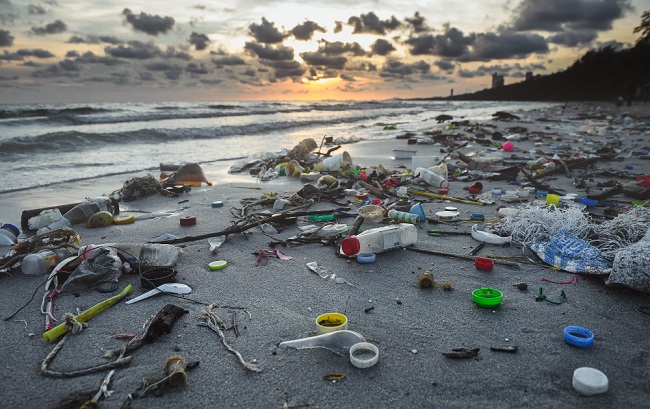
In Lagos, everyday life is powered by convenience. Meals are delivered in plastic containers, groceries are packed in plastic bags, and countless products come wrapped in single-use disposable packaging.
Yet, this reliance on plastic that powers our daily convenience has created a growing environmental strain.
Across the city, plastic waste is increasingly visible, clogging drainage systems, lining streets and eventually washing into waterways.
During the rainy season, the impact becomes more severe. Blocked drains often trigger flooding, disrupting businesses and damaging homes.
Environmental protection experts have long warned that Lagos is struggling to keep pace with the state of its plastic waste.
In response to these concerns, the Lagos State Government began enforcing ban on several categories of single-use plastics in June 2025.
One year later, the circulation of some disposable plastic products has declined, but the problem of plastic pollution persists.
Paper packaging can be expensive, reusable containers require behavioural changes from consumers, and recycling systems often face infrastructure and collection challenges.
Recycling remains a key part of the solution, but stakeholders say it faces significant limitations.
Collection networks remain uneven while many recycling businesses struggle to secure the funding and logistics needed to scale operations.
For Mr. Taiwo Adewole of Recyclespoint, one of the biggest barriers to scaling recycling efforts is not lack of willingness but lack of resources.
“The biggest challenges are logistics and funding,” he said.
His observation highlights a reality that many stakeholders acknowledge.
As policymakers, recyclers and manufacturers search for practical solutions, attention is turning to technologies that promise to tackle plastic waste differently while complementing existing efforts.
One of the newest approaches being explored in Nigeria is coming through a partnership between Nigeria’s Oando Clean Energy and UK-based Polymateria.
The company develops biodegradable plastic technology designed to transform plastic into a wax-like substance after exposure to environmental conditions, thereby reducing the risk of long-term pollution.
According to Mr. Taylor Young, a scientist at Polymateria, the technology is designed to preserve the functionality of conventional plastic products during use.
“The properties of the plastic remain the same after our technology is added,” he said.
During a live demonstration at the company’s laboratory in Imperial College’s I-HUB, White City Campus, Young explained that the degradation process would occur in two stages.
He explained that the plastic would transform into a wax-like substance, a process that can take about three months in tropical environments, before undergoing complete biodegradation within a maximum of two years.
Mr. Ademola Ogunbanjo, President/ Chief Executive Officer of Oando Clean Energy Ltd., said that the project was undergoing regulatory consultations with Lagos State and federal authorities ahead of pilot deployment.
He explained that the project was being structured for implementation through POLYSOL Ltd. incorporated by Oando Clean Energy and its partners.
“This regulatory process is critical to ensure that the technology is properly assessed, meets national standards, and is formally recognised within Nigeria’s plastics and waste management framework before any pilot or scaled deployment is initiated,” he said.
Ogunbanjo said the partnership was driven by the scale and complexity of Nigeria’s waste challenge, arguing that no single intervention could solve the problem.
He added that the goal was not to eliminate plastics overnight, but to support a transition from long-life, persistent plastics to materials designed with a defined end-of-life pathway while recycling and circular economy systems would continue to develop.
From Polymateria’s perspective, the ban on single-use plastics represents an important step toward that transition.
Mr. Steven Altmann-Richer, Chief Corporate Affairs Officer at Polymateria, said the policy signaled progress in moving away from conventional plastics toward more sustainable materials.
According to him, how this transition unfolds across different product categories will be key to long-term success.
Altmann-Richer pointed to international standards such as the British Standards Institution’s PAS 9017 as a potential regulatory framework that could support adoption of fully biodegradable plastics in Nigerian markets.
He emphasised that regulatory standards would be critical to adoption, citing Malaysia as an example where introduction of an eco-label for biodegradable plastics led to a significant increase in deployment of the technology.
According to him, differences in waste management systems between countries should be considered.
He said that while countries, such as United Kingdom, benefit from highly-efficient waste collection systems, Nigeria was still developing its infrastructure, implying that a larger share of plastic materials would end up in Nigeria’s environment.
This, he argued, strengthened the case for technologies designed to address plastic leakage outside formal waste systems.
Altmann-Richer said the technology was originally developed with focus on preventing plastic pollution before it would reach marine environments.
“Much of the attention on plastic pollution focuses on the oceans, but around 80 per cent of that pollution originates on land.
“Our approach is to stop plastic leakage on land before it reaches the oceans.
“Plastic pollution is most acute on the ocean but 80 per cent of that pollution starts on land.
“We expect that over a five-year period, around 500,000 tonnes of plastic waste would be treated with our technology, globally.”
On concerns about affordability of biodegradable plastics, Altmann-Richer said one advantage of the technology is that it could be incorporated into existing manufacturing and supply chains without requiring significant changes.
“Because there is no change to the material or manufacturing process, increase in cost is very limited,” he argued.
Polymateria’s technology has gained international traction, with applications in markets including South-East Asia, India and Malaysia, regions that share climatic and consumption similarities with Nigeria.
The company, which emerged from Imperial College London’s innovation ecosystem, continues to operate from the Imperial College I-HUB in White City.
Still, there are questions about whether biodegradable plastics can compete with conventional alternatives in a cost-sensitive market such as Nigeria.
According to Adewole of the Recyclespoint, affordability may ultimately determine whether such an innovation will gain traction in the Nigerian market.
“This is a welcome development, especially with the ban on single use plastics, but the question is how affordable will this alternative be?
“Are there policies to support manufacturers that embrace the use of these alternatives?” he asked.
Beyond affordability, Adewole urges that recycling should remain central to efforts to tackle plastic pollution.
According to him, recycling remains one of the most accessible solutions, particularly if households and businesses improve waste segregation at source.
He described biodegradable plastics as a potentially useful long-term alternative to the single-use ones, but emphasised that their success would depend largely on cost and consumer acceptance.
Analysts are convinced that while biodegradable plastics may offer another tool in the fight against plastic pollution, lasting progress will depend on a combination of effective regulation, improved recycling systems and continued innovation.
Related Stories
 Technology
When Tech Companies Die, What Happens To The Products They Leave Behind?
1 week ago
 Technology
Two Finns supplying Russia with missile tech worth tens of millions
1 week ago
 Technology
Drones with pepper spray, four
1 week ago
 Technology
Micron Technology stock pre-market at EUR 800.50: memory storage - ad
1 week ago
 Technology
TAIEX Ends at 4
1 week ago
 Technology
ZAWYA: Technology, start-ups can double India
1 week ago
 Technology
Czech government to consider CZK 1 billion fund for startups
1 week ago
 Technology
GDIN Supports Eight Startups at CEATEC 2026 in Japan, Opens Door to Local Investor Collaboration
1 week ago