
Election Boycott: Should India’s Opposition Continue Contesting Elections?
There is fresh buzz over boycotting elections in the wake of “Gyaneshgate”. This time it is a bit louder than in July last year when I argued in Frontlinethat by participating in elections, opposition parties were only legitimising the theft of mandate they were protesting against. The Cockroach Janta Party is now making the same point, mainstreaming a view that has so far been lurking on the fringes.
The boycott idea has found limited traction among opposition parties. The most obvious reason is the fear the BJP will proceed with elections all the same with notional opposition faces. The opposition then loses whatever limited access to state resources and means of patronage they enjoy, and, with that, their ability to keep their organisations engaged and relevant. Basically, hand the rulers a blank cheque and sign their own death warrant.
Also, to be successful, a boycott would have to be a unified opposition move, in itself a Herculean task for a perpetually bickering and mutually suspicious lot with conflicting interests. And, most importantly, any election boycott would also have to come with a civil disobedience movement of withdrawal from all institutional power combined with sustained agitation of collective refusal, obstructions, strikes, marches, sit-ins, and voluntary arrests, possibly for months on end. A tall ask of parties with severely withered organisations.
Like everywhere else, Indian mass parties have weakened, becoming far less embedded in society as their mobilisation wings like unions and other civic networks have shrunk. And, as the political theorists Richard Katz and Peter Mair write in Democracy and the Cartelization of Political Parties, as parties become less rooted in society, they become more like appendages of the state. Indian parties are no exception. State resources and means of patronage—even in crumbs—matter a lot. Especially since the cost of fighting elections has skyrocketed; more money is now spent in elections in India than in the US.
Growing dependence on the state also has the effect of making parties less inclined towards disruptive mass movements and more invested in stability. So, our opposition parties have now landed in this rather strange place wherein they keep telling us the elections are rigged, but urge us to go vote for them all the same.
They demand Chief Election Commissioner Gyanesh Kumar’s head and reversal of the Special Intensive Revision of electoral rolls but do not say what they will do if the demands are not met. All recent elections have been rigged, they say, casting doubt on the legitimacy of all elected legislators and governments in the Centre and the States, including their own. The logical course of action once such an assertion has been made would be to pull out their own parties’ legislators at every level and dismantle the governments in States where they are in power, demand the BJP does the same, and call for civil disobedience until it does; then start the process afresh, this time with institutional amendments to ensure clean elections. Because, if elections are being rigged, the republic is a lie.
Leader of Opposition Rahul Gandhi addressing the media on Chief Election Commissioner Gyanesh Kumar at the Congress headquarters in New Delhi on September 24. | Photo Credit: Sushil Kumar Verma
But the opposition would rather live a stable lie. It has its reasons. One comprehensive study of 171 threatened and actual election boycotts between 1990 and 2009, by Matthew Frankel of the Brookings Institution, shows they worked in only 4 per cent of the cases. Alejandro Toledo’s boycott in Peru in the early 2000s drove Alberto Fujimori from power, but in most cases, boycotts entrenched the ruler, as they did in the case of Hugo Chávez in Venezuela and Robert Mugabe in Zimbabwe.
Such studies are hardly definitive, though. First off, these outcomes are mostly short-term. The long-term consequences of election boycotts are far more complicated and contested, with some studies indicating better chances of electoral reforms and increases in democratisation index scores, and a significantly higher likelihood of an incumbent losing in a future election because of the instability inherent in illegitimate governments.
But the biggest problem with all such studies is that they treat sample countries as comparable units even though the democratic crisis in every country is unique, shaped by its own stage of democratic evolution, civic culture, institutional habits, and the country’s place in the global imagination. Those who argue that Prime Minister Narendra Modi can become a Mugabe if the opposition walks away grossly underestimate India on all three counts. India’s size and diversity make democracy its default setting. An officially undemocratic Indian government would be internally illegitimate and externally unpalatable. Overall, unstable and unworkable. No Indian government would risk putting itself in that situation.
Even in terms of party strategy, every argument against an election boycott can be turned on its head to make exactly the opposite point. If organisational weakness supposedly renders parties incapable of waging long struggles, it is exactly why they need it: to stir up their bases and breathe life into their hollowed-out organisations. Protest movements give rudderless parties a purpose, mobilise voters, energise the grassroots, find new political talents, and rebuild party ties to society. What is there not to like? Modi is offering the chance of a lifetime.
If the argument is that a boycott will make things worse for the opposition, one has to wonder just how. Parliament sessions are already a joke; the legislature, the media, the judiciary, and every level of the executive have been emasculated. Probe agencies are used freely to intimidate and coerce. The party now controls 22 of the 28 States with 78 per cent of the population, making India almost a one-party state. In Bengal, after stealing an election through a curated voter list manufactured by a captured Election Commission of India (ECI) and enabled by a servile Supreme Court, the BJP now controls both the government and the opposition, having peeled away almost the entirety of the Trinamool Congress’ top leadership. Bengal is a one-party State. It cannot get any worse.
Situations like these should naturally lend themselves to radical thinking. But strangely the opposition keeps calling this moment an unprecedented, existential threat to the republic, yet prefers to operate as if it were business as usual: fight elections, complain about election irregularities to the ECI, complain against the ECI to the Supreme Court, etc. In general, keeping the faith in institutions while calling them captured.
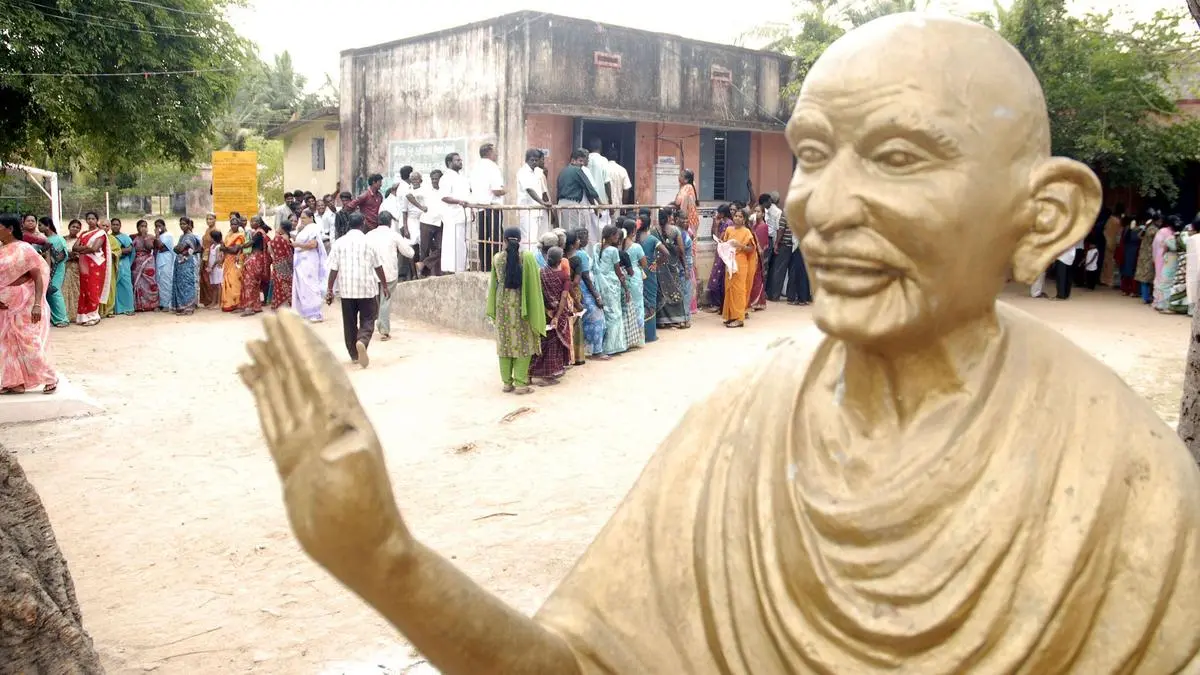
In many ways, an election boycott is a no-brainer. But if the penny still has not dropped for the opposition parties, they—especially the Congress—can simply ask themselves what the nation’s founding leaders they are so fond of invoking would do if they were around today. What would Mahatma Gandhi do?
Would Gandhi look at the disenfranchisement of millions, the gamed elections, the oppression of Muslims and the marginalised, and the disfiguring of governing institutions, and say, “it’s horrible, but let’s work with the system and see how it goes”?
Between garlanding his statues and delivering boring speeches evoking Gandhi’s dreams on his birth anniversary, if opposition leaders took a moment to truthfully ask themselves what Gandhi would do in this moment, they would find the clarity they have been lacking.
They have already missed the boycott bus once. If the opposition had used the threat of boycott when Modi was stacking the ECI in his favour by changing the laws before the last parliamentary election in 2024 and had used boycott as an ultimatum in demanding an institutionally neutral ECI, India would not be here today. The country cannot afford them dragging their feet again.
The debate over election boycott is quite simple. When a democracy reaches a stage where the opposition participates in elections even though it knows they are manipulated, we are already in the territory of managed democracy. By now, elections are mostly a performative ritual to legitimise power rather than a real competition for it. Whether you prefer an electoral boycott and the associated disruption depends on whether you have made your peace with this status quo. Gandhi would never have.
This article was first published by the Toda Peace Institute.
Debasish Roy Chowdhury is co-author of To Kill a Democracy: India’s Passage to Despotism.
Also Read | Decoding the dissent inside ECI
Also Read | The crisis of the secular opposition
Related Stories
 India
India
INDIA bloc coming together in remarkable manner, 2029 Lok Sabha polls will be different story: Salman Khur
10 minutes ago
 India
India
What next for Amarinder Warring after exit as Punjab Congress chief ahead of polls?
10 minutes ago
 India
India
‘I was fighting for my life’: Indian pilot hailed as hero recalls flydubai cockpit attack
1 hour ago
 India
India
I opened cockpit door of plane while being attacked, Indian pilot tells Modi
2 hours ago
 India
India
India’s 'Cockroach' youth protesters are to rally again and demand ouster of election chief
3 hours ago
 India
India
India news: Delhi protesters turn up heat on election chief, police tightens security
3 hours ago
 India
India
What we know about the pilot hailed as a hero for averting crash of Israel
14 hours ago
 India
India
Indian airline captain hailed as hero after cockpit attack on FlyDubai flight
18 hours ago