
E20 petrol under fire! Mileage, engine fears and politics behind India's ethanol debate
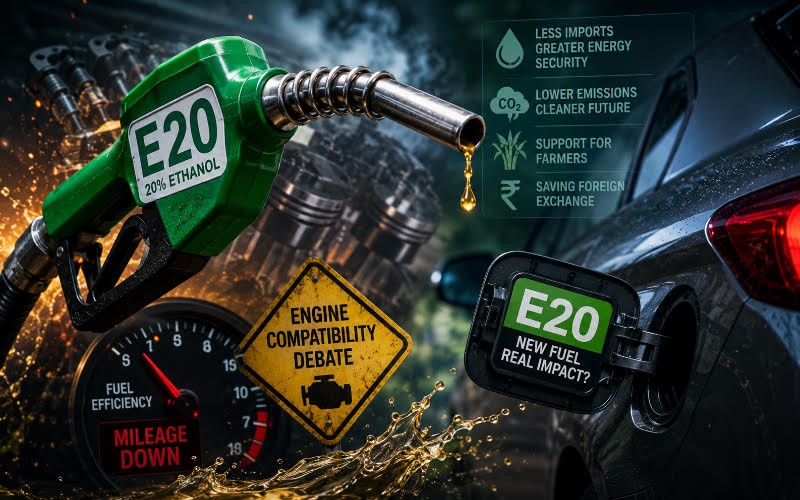
The discussion has intensified in recent months after motorists across the country reported noticeable reductions in mileage, while some owners of older vehicles also expressed concerns over possible long-term mechanical effects.
Although the controversy has generated strong opinions, the central question is not whether ethanol should be used as a transport fuel.
Ethanol is primarily produced from sugarcane, molasses and surplus foodgrains such as maize and rice.
New survey claims E20 fuel may be increasing repair bills. Representational photo: Pexels/Fahad Puthawala
Officials have also indicated that higher ethanol blends could be introduced in the future as India's biofuel programme expands.
Why are motorists complaining about mileage?
The most widespread complaint concerns fuel efficiency.
Many motorists have reported mileage reductions after switching to E20 petrol.
Automobile manufacturers, however, say some reduction in mileage is expected because of ethanol's lower energy density.
"It is not so big as it being made out to be," Gulati said in an interview with ANI, estimating the mileage reduction at around 2–4 percent.
Toyota Kirloskar Motor's Country Head and Executive Vice President for Corporate Affairs and Governance, Vikram Gulati. Photo: Toyota India
The second major area of concern involves engine durability, particularly in vehicles manufactured before E20-compatible specifications became standard.
The government and automobile manufacturers reject claims of widespread engine damage.
"E20 is the standard fuel that will be available and it is compatible with old vehicles and new vehicles," he said.
Government agencies have repeatedly stated that extensive testing has not found evidence of widespread engine failures caused by E20.
How did the 'experiment' controversy begin?
The remark prompted criticism from opposition parties and motorists, who argued that consumers appeared to be participating in a large-scale experiment without adequate information.
Government officials stressed that consumers were not being treated as "guinea pigs" and maintained that ethanol blending had undergone years of scientific evaluation before nationwide implementation.
Political criticism has focused on both the rollout strategy and its economic implications.
They contend that reduced mileage effectively increases the cost of travelling each kilometre.
In many regions, E20 has effectively replaced regular petrol instead of being offered alongside it, leaving owners of older vehicles with limited alternatives.
Some political parties further argue that ethanol policy disproportionately benefits sugar mills, ethanol distilleries and associated industries while distributing the costs among millions of vehicle owners.
Why has Nitin Gadkari become the face of the debate?
Union Minister for Road Transport and Highways, Nitin Gadkari. Photo: Facebook/@nitingadkary
As E20 became the dominant fuel across the country, many motorists who experienced lower mileage began directing criticism towards him, largely because of his long-standing public advocacy of ethanol.
However, the ethanol blending programme is not the initiative of a single minister.
How does the government defend the policy?
Officials argue that reducing crude oil imports strengthens India's energy security while insulating the economy from global oil price volatility and geopolitical disruptions.
Gulati highlighted these wider objectives, saying India's ethanol programme addresses energy security, climate goals and agrarian challenges simultaneously.
"India has always been energy deficient. We import huge amounts of crude," he said, adding that ethanol helps reduce vulnerability to international supply disruptions.
He also noted that the programme has generated substantial financial savings while increasing payments to farmers.
What lies at the heart of the E20 debate?
Supporters argue that ethanol blending strengthens India's energy independence, reduces emissions and provides significant benefits to agriculture.
As India considers higher ethanol blends (E85, E100, etc.) in the coming years, the debate increasingly revolves around balancing national energy objectives with consumer experience, vehicle compatibility and public confidence in the transition.
Related Stories
 India
India
Starlink, Ambani’s venture should get equal treatment, let consumers decide: Shashi Tharoor
5 days ago
 India
India
Lawrence Bishnoi’s rise: Student politics, first murder and a sprawling crime network | India News
5 days ago
 India
India
India’s finance minister says market liquidity makes it easier for investors to exit
5 days ago
 India
India
India news: CJP alleges 'deliberate' delay in leaders' release
5 days ago
 India
India
Indian Diaspora Holds Pro-Modi Counter
5 days ago
 India
India
Clashes Erupt in London as Diaspora Divided Over India's Election Chief and Electoral Roll Controversy
5 days ago
 India
India
London: Indian diaspora rallies in support of PM Modi, criticises CJP protesters
5 days ago
 India
India
Cabinet Approves Go
5 days ago