
Does Canada have ‘no core identity’ or a Judeo
Does Canada have ‘no core identity’ or a Judeo-Christian one? Identity drives referendum debate at this church
CBC News is trying to understand why Albertans feel the way they do about the separation debate
For Daymond Khan, there are the old reasons for western alienation. And there are the new ones.
The old ones are political and economic — they’ve been simmering for years.
The new ones started about 10 years ago, said Khan, speaking at a small group meeting with CBC News at Calgary’s Southside Victory Church.
“Under [former prime minister Justin] Trudeau's leadership, he made his statements … there's ‘no core identity,’ there's ‘no mainstream’ in Canada and that we're a ‘post-national state,’” said Khan.
“The Judeo-Christian values and beliefs that have founded this nation and have persisted and saw us through many challenging times in our history … those are being intentionally challenged.”
“His government really pursued this idea,” he said, “to a level where now we're talking about separation.”
Throughout the referendum campaign, CBC News has been trying to dig into why Albertans on both sides of the debate on independence feel the way they do, seeking out conversations in malls, libraries, political rallies and a powwow.
Follow all of our Alberta referendum coverage
'What's going to happen to us?' At this powwow, a sense of threat shapes views of Alberta independence
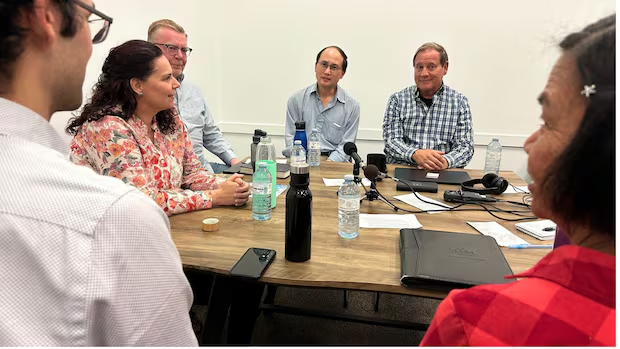
As part of that, we organized a small gathering at one Calgary church, where congregants say support for independence has a lot to do with a changing Canadian identity.
Khan was one of half a dozen people who gathered around a table in the church lobby. His comments about Trudeau saying Canada has “no core identity” refers to a New York Times article published in 2015, shortly after Trudeau was elected.
Trudeau was referring to Canada’s ability to welcome and integrate immigrants, claiming the country has shared values instead, such as openness, respect and the willingness to work hard.
But for Khan, the quote speaks to a conflict between two views of Canada — his sense of alienation stemming from that shift away from a Canada with a history and culture he felt he knew.
“In some ways, we're fighting for a Canada that we thought we all shared, still have hope that we all do share,” Khan said. “But it just seems like there's a federal government that's very opposed to that and they keep getting re-elected.”
“It feels like it's a move away from our shared history, our shared values. Even a small example ... with the passports when they took out the images of Vimy Ridge — it can feel like a small thing, but somebody intentionally chose to do that. Enough people in that party, in that leadership, thought that was a good idea.”
The 1917 Battle of Vimy Ridge is often seen as a point of pride and a critical moment for building Canadian nationalism.
The pastor of Southside Victory Church, near the Chinook transit station, describes it as believing in a literal interpretation of the Bible. It was one of the churches that pushed back against COVID-19 restrictions and was issued a notice of violation from Alberta Health Services for not limiting capacity and requiring masks.
CBC News sought out this church because we are deliberately seeking out views that reflect the political diversity of Alberta, and also because faith is playing a particular role in this separation movement. Rallies often open with prayer, and “faith, family and freedom” is a slogan of the Alberta Prosperity Project.
This piece is not meant to represent how all Christians feel, much less all people of faith. Christians have many different political views — for example, this pastor from Hillhurst United is calling on congregants to hang Canadian flags, and the Catholic Conscience asks Catholics to consider solidarity and resist polarization as they weigh their vote.
This article is one window into one particular viewpoint.
We sat around a table in the lobby of Southside Victory Church. As at many of the separatist rallies, the pastor opened with a prayer, asking that the conversation be “intelligent, truthful and beneficial,” then we went around the circle hearing how each person felt about the topic of separation and how their faith informs that.
Frustration with Canada drives debate
Khan works in the public sector and has held various policy-related positions with the province, local non-profits and the municipal government. He has a young family and became a Christian as a young adult.
He sat beside B.J. Leong-Holloway, who says she found Jesus after someone offered to pray for her at a local Filipino festival, and Anna Girova, who immigrated to Canada from Slovakia seeking greater freedom. There was also Charles VanderGriendt, who started coming to the church during the months it was defying pandemic restrictions, and Adrian Cheuk, a Chinese immigrant who has been praying for the well-being of his new country for eight years.
Around the table, most of the congregants said they were leaning toward Option 2 — a vote to commence the process to have a binding referendum on independence.
But it wasn’t because they longed for an independent Alberta. It was because they were frustrated with Canada.
They wanted change, and were giving up hope.
Buroker said he grew up with a strong sense of western alienation; his father lost two small businesses during the downturn that followed the National Energy Program of the 1980s. He’d like to see Alberta prosper without federal resources and control.
Who’s the boss? Albertans to vote on whether provincial laws should trump federal ones when the two conflict
Everything you need to know about the 10 questions in Alberta's Oct. 19 referendum
But those arguments have existed for decades; it’s the Canadian identity piece that has him fired up today. He said that, like Khan, he believes the federal government has been moving away from the “Judeo-Christian ethic,” which he sees as the foundation of Canadian democracy.
Buroker pointed to the Canadian Charter of Rights and Freedoms, which opens with recognition of “the supremacy of God and the rule of law.” And he defined the Judeo-Christian ethic by pointing to the Ten Commandments — a set of laws given to the Israelites in the Old Testament.
“The Ten Commandments is the basis of the Judeo-Christian ethic. It's how we treat each other,” he said. “You don't steal, you don't lie, you don't covet your neighbour's wife … respect your mom and dad.
“Those Ten Commandments force everybody onto the same plane so you don't have some great ruler that's not under any kind of law.”
Without those basic rules to set a common floor, you risk a government taken over by autocrats, Buroker said. People would lose personal freedoms, which he argues is already happening.
“The latest one is Bill C9. The federal government has now told me that I cannot share from certain books of the Bible because it's hate speech,” he said, referring to the Combatting Hate Act.
That act, which received royal assent in June 2026, protects places of worship and makes it easier to prosecute hate speech. But it repealed a religious exemption, which the federal Conservatives and some civil liberties organizations say criminalizes certain parts of the Bible, Qur'an, Torah and other sacred texts.
The bill comes up frequently in some separatist circles.
Different views on how to welcome immigrants
Buroker says he’s hopeful that an independent Alberta would be less likely to head in that direction, especially given recent moves from the provincial government, such as the ban on transgender participation in women's sports. That aligns with his reading of the Bible.
Going around the table, VanderGriendt also started out with historic and economic arguments, quoting Clifford Sifton — the Canadian Minister of the Interior who, in 1904, argued for the founding of Alberta because “the great trade of the prairies shall go to enrich our people to the East.”
But as the conversation progressed, VanderGriendt also shared his views on a Judeo-Christian vision of Canada.
Trudeau’s comments about “no core identity” relate to the idea that Canada is now multicultural, with leaders whose morality and identity grew from many different traditions.
But saying Canada is founded on Judeo-Christian principles does not mean everyone in Canada must be Christian, said VanderGriendt. It’s just like setting the rules of a house and expecting everyone who lives there to abide by them.
“Do we get in trouble for stealing if we're a Christian or atheist? There should be no distinction,” he said.
“I saw a little video clip with a pastor from Pakistan who was living in England and he was talking about the immigration situation. The analogy he used is if I invited you into my house, can you behave however you want or do you obey the laws of my house? The rules of my house enhance the laws of the country.”
Our meeting at the church took about 90 minutes, and CBC News shared the broad questions ahead of time.
When the others in the group spoke about their support for separatism, they noted problems they see with Canada — the increasing numbers of deaths through MAID (medical assistance in dying), the amount of homelessness despite the level of taxes paid, and the amount of money redistributed to provinces other than Alberta through equalization.
There was little discussion of what an independent Alberta would look like; just a sense that this place has a work ethic and resources to carry it through. They presented independence as the second and perhaps necessary option; the preferred option was to gain more say within Canada.
And not everyone was ready to give up on Canada.
Alberta independence campaigners go for soft sell, even if they want a hard exit
I was pushed to be self-sufficient. I want my province to stand on its own, too
Adrian Cheuk was quiet throughout most of the conversation. He’s originally from Hong Kong and has been in Canada for 32 years. He’s the one who said he began to take an interest in national affairs and deliberately pray for this country eight years ago.
Cheuk didn’t say how he would vote, but he spoke about a vision or a mental picture he had while praying.
“I saw Jesus stretching out his arms, holding the land-mass of Canada in his embrace — it was like a 3D model of the land of Canada — and he was smiling," he said.
“So I knew at that point that Jesus still had hope for Canada. He did not lose hope. So why should I?”
Elise Stolte runs project-based engagement efforts for the CBC Calgary newsroom. She has 20 years of experience telling the stories of her community and has been recognized for feature writing, social impact and community-based journalism. You can reach her at elise.stolte@cbc.ca.
Related Stories
 Canada
'This is not reconciliation,' judge says, scolding Canada for dragging feet on First Nations land debt deal
32 minutes ago
 Canada
Parishioners mourn, hope to rebuild after church burns down in Meadow Lake, Sask.
32 minutes ago
 Canada
Debris spotted from missing Ontario air ambulance
32 minutes ago
 Canada
Montreal rock icon Sass Jordan dies at 63
32 minutes ago
 Canada
How the U.S. midterm elections could affect Canadian tariffs
32 minutes ago
 Canada
U.S. Coast Guard to give update on missing Ontario air ambulance after 'debris field' discovered
1 hour ago
 Canada
Person found dead on Robinson Street, Regina police say
1 hour ago
 Canada
'Super unprecedented': How the Parti Québécois could win a majority with less than a third of the vote
1 hour ago