
Doctors Thought It Was Asthma. A.I. Flagged a Serious Heart Problem.
Artificial intelligence most likely saved Louie Quiros’s life.
Mr. Quiros, a 45-year-old caregiver and security guard, showed up at a Queens emergency room in February 2025. For the past four days, he said, he had been coughing up blood and finding it harder and harder to breathe.
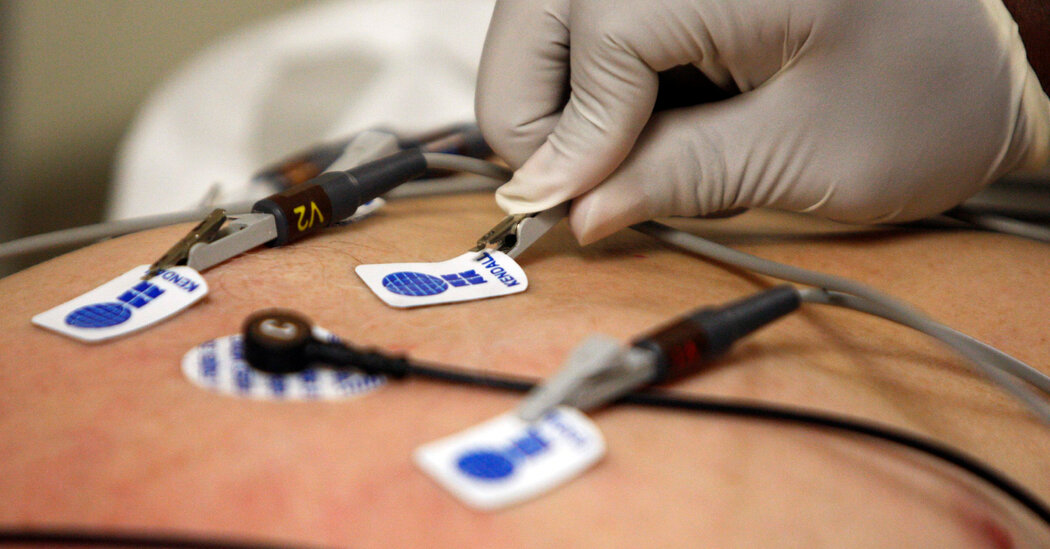
His heart was beating fast, and he wasn’t getting much air to his lungs, but a chest X-ray showed no abnormalities. He also had an electrocardiogram, or ECG, a common test that records the heart’s electrical activity. It was abnormal but showed nothing that would lead to a clear diagnosis. It indicated he might have coronary heart disease — rare in someone his age. But, as it turned out, that was not his problem.
The emergency room doctors learned Mr. Quiros had been exposed to wildfire smoke on a recent visit to California and sent him home with asthma medicine and an inhaler.
Luckily for Mr. Quiros, that emergency room is part of NewYork-Presbyterian’s medical system. Researchers were analyzing all electrocardiograms done on patients in that medical system with an A.I. program, EchoNext, to see if it could find patterns in the scans indicating damage to the heart — patterns a human would not detect.
It’s part of a clinical trial evaluating the A.I. program, which was developed there by Dr. Pierre Elias, medical director of A.I. and cardiologist at NewYork-Presbyterian and Columbia University Irving Medical Center, and his colleagues. Dr. Elias says EchoNext reads an ECG less than 10 minutes after it is performed, and that they analyze nearly 500,000 ECGs a year. Dr. Elias has started a company, Pathway Labs, to market it.
EchoNext found evidence of possible severe heart damage in Mr. Quiros’s electrocardiogram. The team called him back to the hospital one week later for an echocardiogram, a scan that shows the beating heart. What they found was dire. His heart was beating so feebly that just 10 percent of its blood was pumped out with each contraction. At the same time, his mitral valve was leaking blood back into his heart.
Thank you for your patience while we verify access. If you are in Reader mode please exit and log into your Times account, or subscribe for all of The Times.
Want all of The Times? Subscribe.
Related Stories
 AI News
Bill Gross bets AI can help mass
5 days ago
 AI News
Nigeria records 93% rise in AI micro
5 days ago
 AI News
The Italian gelato maker using AI to invent new flavours
5 days ago
 AI News
Closing the Gap Between Agentic CX Pilots and Production
5 days ago
 AI News
New Brunswick data centre debate highlights cross
5 days ago
 AI News
How to Structure an AI Agent Referral Fee Agreement Between Startups
5 days ago
 AI News
No, AI didn’t delete a Swedish reality TV series
5 days ago
 AI News
There is no AI in Armageddon. Artificial intelligence is a tool, not an apocalypse
5 days ago