
Dismaying climate news doesn’t mean the climate fight is over
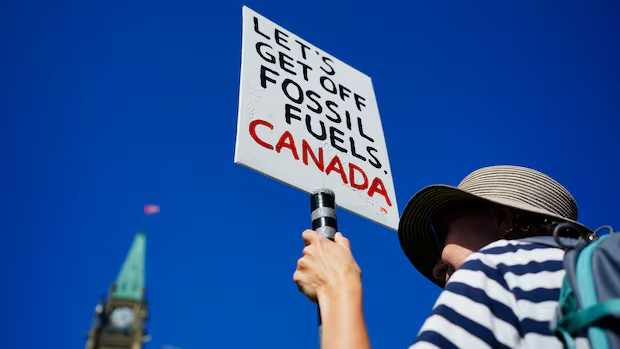
Dismaying climate news doesn’t mean the climate fight is over
Also: a flood prevention solution under a park
Welcome to our weekly newsletter where we highlight environmental trends and solutions that are moving us to a more sustainable world.
Hi, it’s Nicole. I often joke that I write a lot about doom-and-gloom climate change, things such as the warmest years, rising ocean temperatures, etc. But even I had to take a pause when a couple of dire reports were released at the beginning of September. It made me think that perhaps people felt that they are powerless and that the end is nigh. So I wanted to remind people that all is not lost.
Dismaying news doesn’t mean the climate fight is over
There were a few climate stories that came out recently that were, well, not great news.
First there was the United Nations Environment Programme’s (UNEP) report on Sept. 2 that found we will overshoot the 1.5 C threshold set out by the Paris Agreement within the next few years. That threshold aims to limit the dangerous impacts of a warming world.
Then, on Sept. 4, the federal government released its second edition of Canada’s Changing Climate Report, which found that the country could face an average 5 C of warming by 2081 to 2100 relative to 1850 to 1900.
These stories sound dire, and, to be fair, they are. They are an indication that, as we continue to pump fossil fuels into the atmosphere, we will continue to warm.
But that doesn’t have to be the end of the story.
Just because we will surpass 1.5 C doesn’t mean it has to stay that way. And just because Canada could face 5 C of warming by the end of the century doesn’t mean it has to.
Bill Hare, CEO of Climate Analytics, a global climate science and policy institute, welcomed the UNEP report, but, in a news release, said he was concerned that it didn’t do a good enough job of explaining that there is a way out, and that the report risks turning "into a call to apathy rather than a call to arms."
I was intrigued with that statement and decided to reach out to him.
"I think that's the main message that … if we just treat this fatalistically, that, oh well, we busted through one-and-a-half, we're going to have to learn how to cope with three degrees — I don't think that's going to work. I think that that's a recipe for apathy. It's very fatalistic," he told me.
"The message needs to be that we can still rescue this 1.5 limit. We can still get back below it. But it's going to take urgent action and in particular on fossil fuels."
Government regulations on greenhouse gas emissions or creating green projects are big ways that change can happen. But what happens when people elect someone who they believe will make those changes but doesn't?
"I think people need to think about what they do next time when they vote," he said.
If you don’t follow climate scientist Katharine Hayhoe — who is the chief scientist for the Nature Conservancy and a professor at Texas Tech University — you should. She is a big advocate of climate action, not climate doom.
She says most people don’t realize that we’ve already made a difference.
"When the Paris Agreement was signed, we were heading for four- to five-degree Celsius of warming by the end of the century. Now we're heading to a 2.7-degree warming by the end of the century, globally, if we just continue on our current pathway," she told me.
Following its report, UNEP director Inger Andersen told journalists that even if we’re currently on track to pass 1.5 C of warming, that it "is still the goal," as reported by Euractiv, a European media network.
"But now, we need to approach it differently, from above," she said, saying there would need to be "rapid and deep cuts" to fossil fuel emissions.
After that, she said, we can aim for "net negative emissions," meaning we remove more greenhouse gases than we emit.
So we don’t have to remain at 1.5 C. We can move the dial backward. And if more urgent action is taken — climate scientists and UNEP say — there is hope.
"For me, the definition of hope is, if we do something, will it make a difference?” Hayhoe said. “And the science says, yes, if you do something, it will make a difference."
Old issues of What on Earth? are here. The CBC News climate page is here.
Check out our podcast and radio show. In our latest episode: It’s going to be a record-breaking few months of weather. A natural surge of warm ocean water is colliding with a planet hotter than at any point in human history — meaning more heat, more floods, more droughts. Some think this year's Super El Niño offers a window into what climate change will bring, and that it could help us prepare for the decades to come.
What On Earth drops new podcast episodes every Wednesday and Saturday. You can find them on your favourite podcast app or on demand at CBC Listen. The radio show airs Sundays at 11 a.m., 11:30 a.m. in Newfoundland and Labrador.
Check the CBC News Climate Dashboard for live updates on record-breaking weather and current conditions across the country. Set your location to find out how today's temperatures compare to historical trends.
Last week, Bridget Stringer-Holden wrote about Yunfei Li, a UBC student who offers tours of climate solutions hidden around Vancouver.
Karel Ley wrote, "Congratulations, Li, on your positive tour about less obvious efforts to prepare for climate change."
Jon G. Church of St. John's asks: "Does CBC or Ms. Stringer-Holden know if this kind of thing is on the go in any other Canadian city?"
We're not aware of any right now, but if any readers have heard of some, please write to us and we'll share them in the next issue.
Write us at whatonearth@cbc.ca (and send photos there, too!)
The Big Picture: RIP to Canada's last lake of its kind
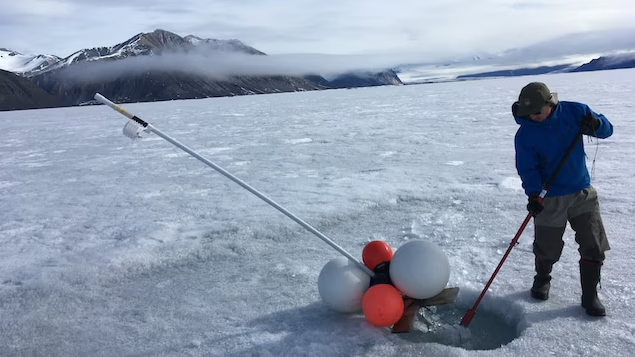
Scientists have confirmed in a new study that Canada's last epishelf lake is gone.
Jérémie Bonneau, the lead author and an assistant professor at Laval University in Quebec City, said its loss is sad, as the Milne Fiord epishelf lake on Ellesmere Island in Nunavut was "the last thing like that in Canada."
"Suddenly, it's … drained away and then everything that was living in there is gone."
The diagram below shows how the lake, made up of freshwater floating on saltwater, formed.
You can read more here about the lake and what its demise says about the irreversible changes transforming the Arctic in a warming climate.
Hot and bothered: Provocative ideas from around the web
Flood protection installed under Saskatoon park
After three summers of construction to help address flooding, Hugh Fraser embraced the reopened Brevoort Park as he stood Tuesday on new grass near newly planted trees.
Fraser gave credit to himself and his neighbours for pressuring the city to open the park a month early so people could enjoy the restored space before the snow falls.
The retired Saskatoon resident joined a group of about 20 people, most of whom were city officials, to mark the reopened park, which now lies atop a concrete basin large enough to accommodate enough water to fill two Olympic-sized swimming pools.
The restored south part of the park, which is located in the Brevoort Park neighbourhood, becomes the fourth completed project as part of a $54-million multi-year city hall plan to prevent flooding in certain neighbourhoods.
"The residents of Brevoort Park are very happy that the park is finally open," Fraser said in an interview. "It took a long time, but it turned out perfect."
Fraser said he was surprised more of his neighbours failed to turn out for the event, given the length of time the park was closed for the project.
However, the flood basin is already proving its worth, according to a city news release, which says the storage system under the park captured an Olympic-size pool of water during a rainstorm on Labour Day.
The storage tanks can hold 8.6 million litres and fill up during rainstorms so that the storm sewer system does not become overwhelmed and water doesn't pool on the streets and wind up in basements.
Russ Munro, director of Saskatoon Water, says 41 homes will be protected from flooding by the Brevoort Park project.
Mayor Cynthia Block recalled her early days as a city councillor when "devastated" residents came to city hall after a flood event.
"The loss was incredible — the amount of damage that was done to their homes," Block told those gathered. "And it was going to be repeated and repeated and repeated and repeated."
Block said she felt "defeated" trying to deal with flooding.
However, she learned about a federal program to address flooding while attending a conference and brought it to the attention of city administration. The federal government is providing $21.6 million toward the city's program.
The system under Brevoort Park represents the first project of its kind in which the infrastructure is hidden underneath a park.
The three other completed projects are known as dry ponds, in which the surface of the park is sunken and usable most of the time, but fills up during flooding and then drains to take the strain off the storm sewer system.
Those dry ponds are located in W. W. Ashley District Park, Churchill Park and Weaver Park. A fourth dry pond is mostly complete in Cumberland Park. There are four other flood strategy projects underway and on track to be completed by next year.
Thanks for reading. If you have questions, criticisms or story tips, please send them to whatonearth@cbc.ca.
What on Earth? comes straight to your inbox every Thursday.
Editor: Emily Chung | Logo design: Sködt McNalty
Related Stories
 Canada
‘Dumbest trade war in history’: How major media outlets are reacting to the Canada
4 minutes ago
 Canada
Manitoba becomes latest province to ditch time switch
32 minutes ago
 Canada
This was the last lake of its kind in Canada. Now it’s gone
32 minutes ago
 Canada
N.B. projects pitched at Canada Investment Summit aren't close to being shovel
1 hour ago
 Canada
RCMP charge 2nd man with fraud, arson over fire that destroyed sports bar in Leader, Sask.
1 hour ago
 Canada
West Kelowna's new mayor aims to restore public confidence
2 hours ago
 Canada
EU's offer to Canada is proof that Europe is ready to stand up to Trump, says lawmaker
2 hours ago
 Canada
Spotted Lanternfly seen in Windsor, Ont., first in Canada
2 hours ago