
De Vinck: AI will never capture our magnificent humanity
Michelangelo suffered great physical pain during the four years he painted the ceiling of the Sistine Chapel. A human hand created such beauty, not blips and compressed numbers, writes Christopher de Vinck. Pictured here, a rare concert at the Sistine Chapel with Harry Christophers, left, conducting Angels Unawares by James MacMillan in March.
The crescendo concerning the approaching whirring march of artificial intelligence coming our way can be heard inside industry, our schools, the creative arts and our politics. Remember the famous Billy Joel song? “We Didn’t Start the Fire.”
From what I have read, AI will become more and more refined and will eventually create good poetry, fine novels, as it will create beautiful works of art: sculptures, paintings, etchings, pottery and write wonderful plays and movie scripts.
But there is something we ought never to forget: the existential sigh, our individual, human search for meaning in what is often described as an absurd world, and meaning comes from what is genuine. What would you rather have on your windowsill: a plastic rose or a rose from the garden?
Article continues below this ad
Yes, we will be in competition with machines writing out speeches and books, interpreting data, plotting vectors, solving logistical problems, managing finances, creating operas, making our meals, building houses, lifting us to the moon and to Mars, but none of that will explain why people entered a dark cave and decorated the walls.
A scientific study, published earlier this year in Nature, described how people on the Indonesian island of Sulawesi stenciled images of their hands on the wall of a cave 60,800 years ago. No algorithm can explain such an impulse.
What magic existed inside the inner ear of Beethoven? What power did Rosa Parks have to sit in the front seat of that bus? What inspired Charles Elmer Doolin in 1932 to start a company in San Antonio based on what he called Fritos? What inspired Michelangelo to carve the Pietà from a block of marble?
A machine does not have life, blood, bones, a mind capable of infusing a spirit into marble, or onto the wall of an ancient cave. AI will never hold grief and sorrow within its wires and chips the way Picasso did when he created his famous painting Guernica in response to the horror of the bombing of the Basque town during the Spanish Civil War.
Would you like to attend a play written by William Shakespeare or by the Star Wars duo C-3PO and R2-D2.
I want to know the human, collective soul created what I read, see and hear.
Over 60 years ago someone in my family etched into the glass of the kitchen window names of all my brothers and sisters. When I run my finger over the jagged names a feeling returns to me, a pull from long ago, a flood of memories, a human notion about things.
A person over 60,000 years ago pressed his hand on a cave in Indonesia. Beethoven was nearly deaf at the end of his life and yet he persevered and still created music that pierces all of our hearts. Every time I think about Rosa Parks I think about how frightened she must have been and yet there she sat for all of us to sit beside her and applaud. Picasso’s paint bleeds off the canvas and you can almost hear the moaning grief from the dead people of Guernica. And a human being made Fritos! The hand of someone I loved etched my name into the window’s glass.
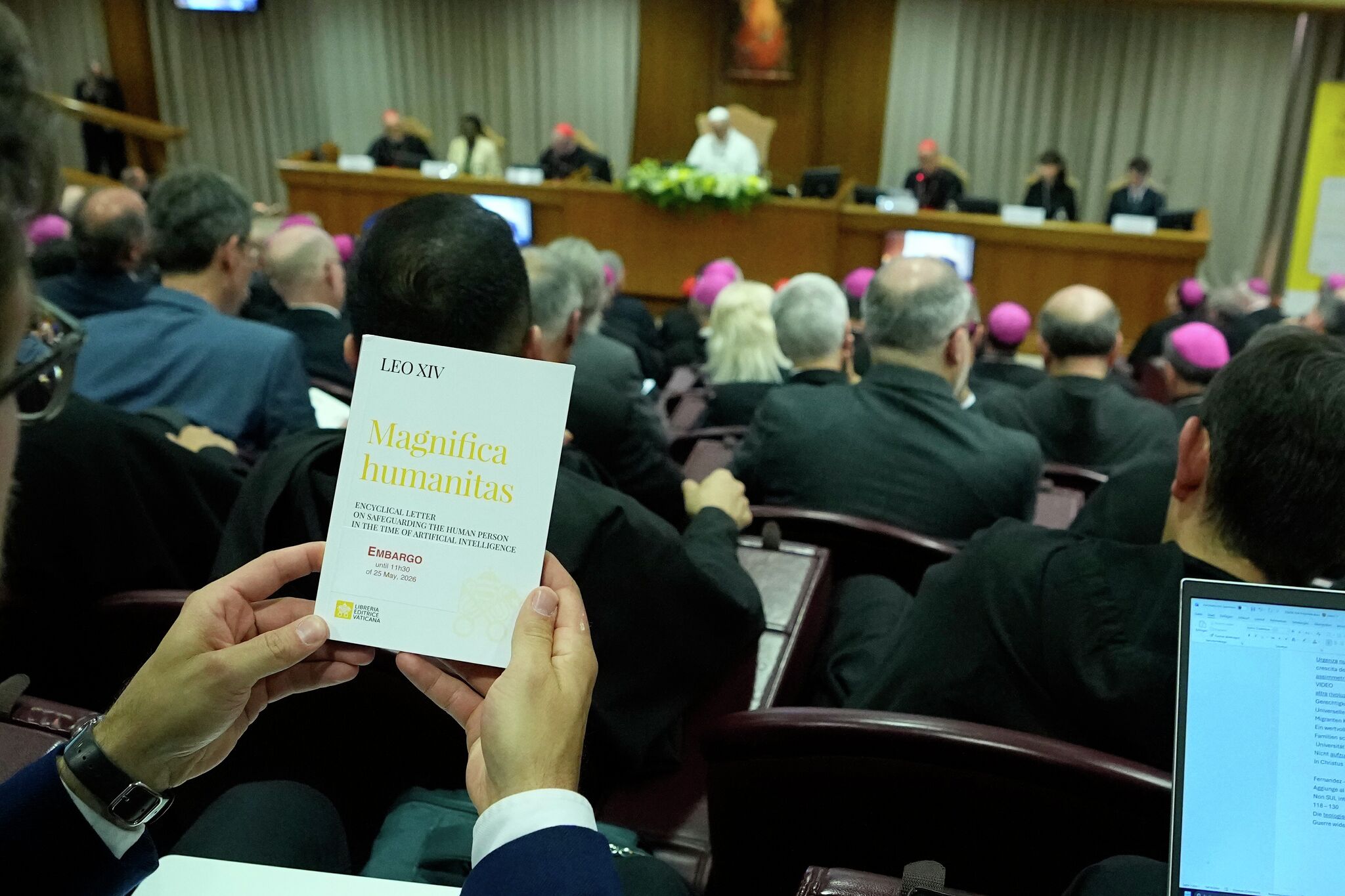
Pope Leo XIV, left, attended the presentation of his first encyclical, "Magnifica humanitas: On Safeguarding the Human Person in the Time of Artificial Intelligence," at the Vatican on Monday.
Michelangelo suffered great physical pain during the four years he painted the ceiling of the Sistine Chapel. He suffered throughout his life with mental and emotional anguish, and yet he created the extraordinary sculpture of David with his hands. I like knowing a human hand created such beauty, not blips and compressed numbers.
In his book, A Man Without a Country, the novelist and essayist Kurt Vonnegut wrote “Bill Gates said: wait till you see what your computer can become. But it's You, who should be doing the becoming, not the damn fool computer. What you can become is the miracle you were born to be through the work that you do.”
In his first landmark teaching, Pope Leo XIV explores a theme he has emphasized since the beginning of his papacy a year ago: social disruption in the digital age, in particular the dangers that AI poses for human flourishing. The encyclical is titled “Magnifica Humanitas,” or “Magnificent Humanity.”
The work of living with a wild rose on my windowsill is the true world in which I want to live. AI cannot compete with magnificent humanity.
Have thoughts about this? Send a letter to the editor using our letters form or email letters@dallasnews.com. Letters should be no more than 200 words and include the first and last name of the writer and city of residence.
Related Stories
 AI News
The World Cup returns to Toronto Saturday. Here’s where the crowds will be
51 minutes ago
 AI News
World Cup 2026: Fastest World Cup to 100 goals in 68 years
51 minutes ago
 AI News
Curaçao earns first-ever World Cup point after 0
51 minutes ago
 AI News
World Cup knockouts: Who has made it to the round of 32 stage?
52 minutes ago
 AI News
Alberta separation debate spills into everyday life as Sundre cancels rodeo parade over Alberta flag float
52 minutes ago
 AI News
Jeremy Clarkson in remission from prostate cancer
52 minutes ago
 AI News
Roughriders survive scare to beat Stampeders in double OT
52 minutes ago
 AI News
Winner crowned at Hampton Beach Master Sand Sculpting Classic
52 minutes ago