
Dauphin greenhouse suffers 'catastrophic situation' after floodwaters sweep through facility
Dauphin greenhouse suffers 'catastrophic situation' after floodwaters sweep through facility
Vermillion Growers lost about 500,000 kilograms of tomatoes to flooding, vice-president says
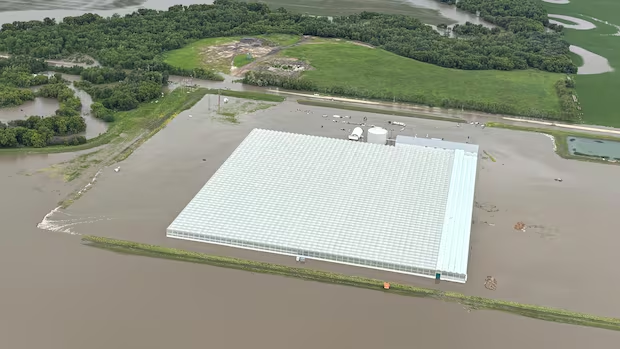
A Dauphin greenhouse that supplies tomatoes to consumers across Manitoba and parts of western Canada says its entire crop has been destroyed after floodwaters tore through the facility about a week ago.
Cormac Foster, vice-president of engineering and development at Vermillion Growers, said about 500,000 kilograms of tomatoes will have to be thrown away, along with about 5,400 cases of tomatoes already packaged and ready to be shipped to grocery stores.
"It's a pretty devastating, catastrophic situation in our facility," Foster told CBC News on Wednesday.
Vermillion Growers operates a massive, 4.85-hectare (12-acre) hydroponic greenhouse facility producing Roma tomatoes and tomatoes on the vine just east of the Vermillion River.
Foster said the greenhouse is a "high-tech operation" that has automated much of its production. It has sensors monitoring the facility's climate control and irrigation systems, and robots that transport tomatoes to the packing line.
But flooding that ripped through the greenhouse on June 30 — a day before Dauphin declared a state of local emergency — damaged much of that technology.
"The water was fast. The surge came quickly," Foster said, adding the fast-moving floodwaters swept tomatoes onto nearby highways and into ditches.
"People described it like it was almost like a hurricane coming across the property."
How geography, climate change conspired to create summer floods in the Parklands
Gas and electricity were turned off to prevent further damage to the facility, but it meant the climate control and irrigation systems weren't running. The crop suffered as a result, Foster said.
Flooding also submerged some sections of tomato vines in water, which makes the crop not harvestable due to contamination risks, he said.
"The entire crop has been concluded that it's a loss at this point," he said.
Vermillion Growers has been in contact with its insurance company, suppliers and consultants about recouping losses and rebuilding.
Foster said the flooding has been "devastating" and "emotional" for staff at Vermillion Growers, and yet they've "banded together" to clear water, silt and debris out of the greenhouse.
Most of the floodwaters have receded from the facility as of Wednesday.
"We're going to come back stronger, we're going to rebuild. We'll come back stronger and better than we were before, and we'll get right back into producing," Foster said.
But there's no timeline yet for when Vermillion Growers will be able to start growing again.
Manitoba farmers face 'huge devastation in crops' from incessant rain, floods
Other farmers told CBC News earlier this week that recent severe weather and storms — bringing everything from hailstones to flooding — have hurt their crops, damaged their fields and affected their ability to plant in parts of Manitoba.
But one University of Manitoba supply chain expert says shoppers may not see a difference at the grocery store.
"Consumers won't really notice anything…. we're only a small part of a much bigger market," said Barry Prentice, adding he doesn't think prices will take much of a hit either.
Western Manitoba tomato grower halts production after facility floods
Water is one of the main constraints for agricultural production in the Prairies. It's possible that some parts of Manitoba that weren't affected by flooding got enough rain to yield more than usual, he said.
However, Prentice said infrastructure like roads and drainage systems should be built to withstand severe weather, so that food can get from farmers' fields to families' tables — now and in the future.
"We don't know whether this is a one-year unusual circumstance or this is something we should be starting to expect more frequently," he said.
"I think more violent weather is quite possible for our future and we have to start thinking about how resilient our transportation and drainage systems are."
Lauren Scott is a Winnipeg-based reporter with CBC Manitoba. They hold a master’s degree in computational and data journalism, and have previously worked for the Hamilton Spectator and The Canadian Press.
With files from Santiago Arias Orozco
Related Stories
 Technology
‘It’s now or never’: why investors are still betting big on Israeli tech
1 hour ago
 Technology
Zelenskyy details rift with dismissed defense minister, saying some of his actions were misguided
2 hours ago
 Technology
Texas Tech football news: Top Red Raiders recruit transfers high schools
4 hours ago
 Technology
A day in the life: Breathwork expert Rob Rea
5 hours ago
 Technology
Calgary’s tech sector sees North America’s highest growth 3 years and counting
6 hours ago
 Technology
Ministry of SMEs and Startups Recruiting Award Candidates for Outstanding Companies in Supply Price Escalation Clauses
7 hours ago
 Technology
Politics, tech take centre stage at Bengaluru book fest
8 hours ago
 Technology
Startups, sustainability, style: Gifts World Expo Bengaluru kicks off 6th edition
8 hours ago