
Data centres are unpopular in Alberta, poll suggests. Are they a political liability?
Data centres are unpopular in Alberta, poll suggests. Are they a political liability?
Only 7% of respondents show strong support for data-centre development
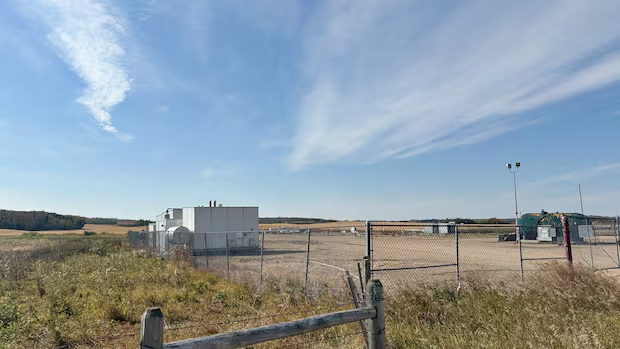
Rita Reich has hosted more than 100 of her neighbours at her farm in Ponoka County, Alta., over the last month to protest a data centre proposed just down the road.
"I just don't want it in our agricultural community. I just don't think that this is the place to put it,” Reich, who farms grain and raises cattle, told CBC’s West of Centre.
She says she’s worried about the potential noise, environmental impact and loss of farm land.
Janet Brown Opinion Research found in polling commissioned by CBC News that many Albertans share her skepticism. Both the pollster and a second political expert say the province welcoming a data centre goldrush risks alienating Premier Danielle Smith's base.
"I think this could be a real sleeper issue for Danielle Smith," Brown said in an interview.
"We've been so focused on other things, but AI is really heating up as a big issue, and most Albertans are concerned."
The polling found only seven per cent of respondents strongly support the development of AI data centres, and 31 per cent strongly oppose them.
Some 26 per cent mostly oppose them, but believe some should be built. The resistance to data centres crosses geographical and partisan lines, the polling suggests.
Top concerns include possible impact on the environment and electricity costs, noise, loss of farmland, and the effect of AI on society.
Opposition has emerged as the province becomes ground zero for new data-centre development in Canada, with cheap natural gas and a government actively trying to grow the sector, including taking trips to Silicon Valley to court big tech firms.
If all projects in the works go ahead, Alberta would be home to 90 per cent of the country’s data centres.
At one of the local town halls held by the province on data centres, Reich said tensions ran high.
“People … came there very unhappy and they didn't get their questions answered adequately. So they left even more unhappy,” she said.
“So I think that the government needs to address this more straight on.”
Eleni Iskierski, press secretary for Alberta’s Technology Minister Nate Glubish, said the government takes concerns seriously. Feedback from the town halls will be used to create province-wide standards on data centres, Iskierski says.
Reich says she is a staunch conservative who still has hope the government will change course.
But Trevor Harrison, a retired political sociologist at the University Lethbridge, says not all voters will be so forgiving.
“It will take a lot to shake people loose from Danielle Smith, who seems to [be] kind of a Teflon political figure … but her support is in the rural areas,” Harrison said.
“There's been no deliberation, they're just going for it. That poses real risks. If it goes south, the government can't blame anybody else.”
Over in Sturgeon County north of Edmonton, the scale of the projects — and backlash — are on another level. Meta, the tech giant behind Facebook and Instagram, is building a massive one-gigawatt data centre.
For some, it’s enough to flip their vote.
“I did vote conservative, and I regret that decision now with this whole AI centre going in,” said Tammy Ranta, who’s lived in the county for 30 years and has an acreage about eight kilometres from the Meta site.
The $13 billion project is Meta’s first data centre in Canada and will be powered by a new natural gas plant that could eventually produce more electricity than what the City of Edmonton uses.
Ranta said she’s worried about what the project’s impact will mean for her dogs, horses and llama. And it doesn’t sit well with her that a big American tech company is setting up shop.
“We moved out to the country so that we could have the fresh air and we can have peace and quiet,” she said. “I'm hoping that it'll stay that way, but I'm not sure.”
The Meta project has attracted attention far beyond county lines.
Sturgeon County’s Mayor Alanna Hnatiw said in the nine years she’s been in office, she hasn’t seen anything like it.
“The pushback, the concern, the rhetoric, the threats far outweigh anything that we saw during COVID — so that is saying something,” Hanatiw said.
Hnatiw stood alongside Smith and Glubish celebrating the Meta project when it was first announced.
Now despite the anger, Hnatiw is still supportive, pointing out the site is inside an established heavy industrial zone. She said at a time when municipalities are cash-strapped, projects like this can help pay for the roads, water and emergency services residents rely on.
Meta didn’t respond to a request for comment but has previously said the project will use less water than a typical Alberta golf course and will create 3,000 jobs during construction.
Hnatiw acknowledges that data centre development represents a lot of change for this community at once. It’s hard to ask for trust in technology in rural areas that have not had much access to it.
“You've had poor cell phone coverage, maybe not able to get reliable internet at home, and then seven or eight kilometers away you can have an artificial intelligence enabling hyperscaler come to town.”
But the resistance isn’t just aimed at Silicon Valley giants; smaller data centres are popping up all over.
For Rita Reich back in Ponoka County, the data centre of concern is called the Sunfavor Agripower Camrose Hub, in the neighbouring county.
Sunfavor director Relax Yi Ding said in an email to CBC that, if approved, the data centre would be powered by natural gas and is designed to host third-party bitcoin mines. The heat generated by the computers and power generators would be used for agricultural processing such as drying out hay and grain.
Catellier and her neighbours have signed up to participate in the Alberta Utility Commission hearing as intervenors. The group was partially inspired by organizers in Olds, Alta., who put a stop to a 1.4 gigawatt project proposed within town limits.
Ding also wrote that the company respects residents’ right to participate in the process and it is committed to providing information and responding to concerns.
The CBC News random survey of 1,200 Albertans was conducted using a hybrid method between September 8 to September 21, 2026, by Edmonton-based Trend Research under the direction of Janet Brown Opinion Research. The sample is representative of regional, age and gender factors. The margin of error is +/- 2.8 percentage points, 19 times out of 20. For subsets, the margin of error is larger.
Emily is a reporter and producer with CBC's West of Centre podcast. Previously, she covered Edmonton city hall. She can be reached at emily.williams@cbc.ca.
Related Stories
 Canada
Doerkson, Clark attend B.C. Lions game
3 minutes ago
 Canada
Lawyer wins case against multinational firm behind day school settlement
3 minutes ago
 Canada
Facing a 2
3 minutes ago
 Canada
Jennifer Lopez brings star wattage to Dolce and Gabbana
1 hour ago
 Canada
Canada's Leylah Fernandez rallies to reach final in Singapore
1 hour ago
 Canada
Parts of Nova Scotia national park closed temporarily after coyote bite: Parks Canada
1 hour ago
 Canada
Alberta separatists remain motivated in face of poll suggesting dip in support
1 hour ago
 Canada
2 teens charged with murder in connection to pedestrian collision that killed 16-year
2 hours ago